






Imagine you have finally made up your mind.
You are leaving the job.
Perhaps you have found a better opportunity. Perhaps the salary no longer makes sense. Perhaps you have endured months of frustration, a difficult manager, broken promises or the exhausting feeling that your career has stopped moving.
You open your laptop and begin to write.
“Dear Sir…”
You stop.
How do you say everything you feel without actually saying everything you feel? How do you remain professional when you are disappointed? How do you resign without sounding ungrateful, bitter, desperate or unnecessarily dramatic?
Then you remember AI.
Within seconds, you have a polished resignation letter. It is courteous, concise and diplomatic. It thanks the organisation for the opportunity, confirms your decision to resign and offers to support a smooth handover.
Beautiful.
There is only one problem: the letter sounds nothing like the conversation you have been having with yourself for the past six months.
Would you send it anyway?
When the machine knows how to say it better
Resignation letters are among those professional documents that appear simple until you have to write one yourself.
The basic information is straightforward: you are resigning, your notice period begins on a particular date, and your last working day will be whatever your contract or applicable arrangement requires.
The emotional work is more complicated.
You may want to leave on good terms without pretending that everything was wonderful. You may need a reference from a manager whose behaviour contributed to your decision. You may be leaving for more money but feel uncomfortable admitting it. Or you may simply want to get out without giving the organisation another opportunity to turn your departure into an argument.
AI is well suited to helping with this kind of writing. It can offer alternative tones, remove unnecessary emotion, improve clarity and help a person organise their thoughts when the right words are difficult to find.
It can turn “I cannot continue like this” into a calm, professional statement of intent.
And that can be genuinely useful.
The danger is not that AI can write a good resignation letter. The danger is that a letter can be professionally worded without being professionally wise.
A perfect letter can still be the wrong letter
Imagine three professionals asking AI to write their resignation letters.
The first has secured a better job and wants to leave gracefully.
The second is leaving because the employer has repeatedly failed to pay salaries on time.
The third has experienced conduct at work that may need to be documented or formally addressed.
All three might receive a beautifully written letter beginning with gratitude and ending with an offer to assist during the transition.
But should they all send the same kind of letter?
Probably not.
The first may benefit from a short, gracious message. The second may need to consider what records to retain, what contractual obligations apply and whether the resignation letter is the appropriate place to raise unpaid salary. The third may need to distinguish a straightforward resignation from a formal complaint, while considering the relevant workplace procedures and seeking appropriate advice where necessary.
AI does not automatically know which of these circumstances applies. It only knows what the person tells it and even then, it may not appreciate the legal, contractual or organisational implications of the details.
This is why asking AI to “write my resignation letter” may be less useful than explaining the circumstances, the desired outcome, the relationship one hopes to preserve and the issues that must be handled carefully.
The better the brief, the more relevant the draft. But even an excellent draft is not a substitute for the employee’s judgement.
What does the research say about AI-written communication?
This question is part of a wider debate about the use of AI in professional writing: can a message be more polished and efficient while making its author appear less sincere?
Research suggests that the answer depends on the circumstances.
A 2024 study by Anthony Coman and Peter Cardon, published in Business and Professional Communication Quarterly, examined how 887 working adults perceived AI-generated workplace messages. Participants generally rated the messages positively for professionalism, effectiveness, efficiency, confidence and directness. Some conditions, however, received lower ratings for sincerity and caring. The findings suggest that polished writing and perceived authenticity are not always the same thing. Read the study.
A later study by Cardon and Coman, published online in 2025 in the International Journal of Business Communication, surveyed 1,100 working professionals about AI-assisted workplace writing. It found that higher levels of AI assistance could put perceptions of the sender’s trustworthiness at risk, as readers began questioning the author’s sincerity, confidence, care and authorship. Read the study.
Neither study examined resignation letters specifically, so their findings should not be treated as proof that an employer will react negatively to an AI-assisted resignation. They do, however, illuminate a relevant tension: a message can sound more professional without necessarily communicating more of the person behind it.
That distinction matters when the message marks the end of an employment relationship.
Your employer does not need your entire emotional history
Here is an important point: authenticity does not require you to tell your employer everything you feel.
A resignation letter is not a diary entry. It does not have to contain every disappointment, every argument or every moment you felt undervalued.
You can be honest without being exhaustive. You can be civil without pretending to be happy. You can express appreciation for specific opportunities without declaring the organisation the best place you have ever worked.
In fact, a short, neutral letter may be the most sensible choice in a difficult situation.
The purpose is not to make your employer understand every reason you are leaving. It is to communicate your decision clearly and handle the transition appropriately.
AI can help you achieve that.
But it should not persuade you to express gratitude you do not mean, apologise for a decision you have carefully considered or promise a level of support during handover that you cannot reasonably provide.
Nor should it invent reasons for your departure simply because those reasons sound more acceptable.
Professionalism is not the same as pretending.
The part AI cannot decide for you
Before sending an AI-written resignation, there are questions worth answering yourself.
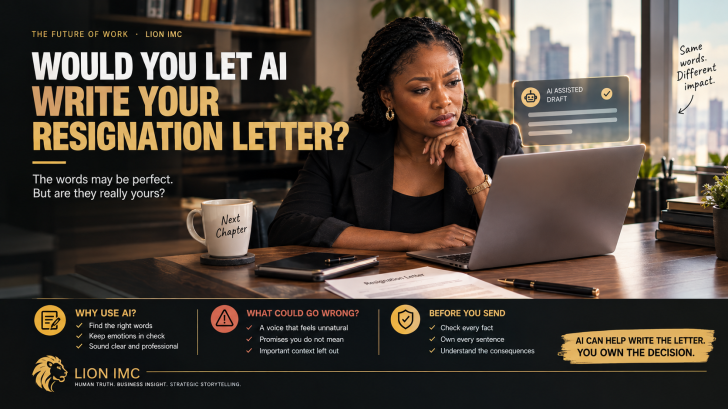
What am I actually trying to achieve? Do you simply want to notify your employer, preserve a professional relationship, document a concern or begin a formal process? Those objectives may require different approaches.
What must be accurate? Check your notice period, proposed last working day, employment terms and any relevant procedures. Do not rely on AI to determine your contractual position without verification.
What should not be included? Avoid unnecessary accusations, confidential information, unsupported claims and emotional details that do not serve your purpose. Equally, do not remove important information merely to make the letter sound pleasant.
Does this sound like something I can stand behind? Read the letter aloud. If it sounds unnatural, revise it. If it promises something you do not intend to do, remove it. If it says something you would struggle to explain in a subsequent conversation, reconsider it.
Have I checked the practical consequences? Make sure the timing and wording are consistent with your circumstances. If there is a dispute, potential legal issue or serious allegation involved, seek appropriate advice rather than relying on a generic template.
These checks do not make AI less useful. They make its usefulness safer.
Perhaps AI should write the first draft, not the final decision
There is a sensible middle ground between writing every word alone and letting a machine handle the entire exercise.
You can use AI to explore different versions: warm and appreciative, brief and neutral, or firm and factual. You can ask it to remove unnecessary emotion, identify ambiguous wording or make the message easier to understand.
You can even tell it what you do not want: no exaggerated gratitude, no unnecessary explanations, no promises beyond your actual obligations.
Then you take ownership.
You check the facts. You decide what to disclose. You make sure the tone reflects your intentions. And you send only the version you are prepared to stand behind.
That is a useful way to think about AI in professional communication more broadly. It can help us express ourselves, but it should not quietly replace the thinking that determines what we want to express.
The goal is not to prove that we can write without AI. Nor is it to demonstrate that we can use AI for everything.
The goal is to use the tool without surrendering our judgement.
So, would you let AI write your resignation letter?
Perhaps the better question is whether you would let it decide what your resignation should communicate.
Let it help you find the words. Let it suggest a calmer opening, a more precise sentence or a more professional closing. Let it help you separate what you feel from what needs to be said.
But remember that the letter carries your name, your decision and your professional reputation.
The machine will not attend the exit interview for you. It will not explain your intentions to your manager. It will not manage the consequences of an inaccurate statement or a promise you never meant to make.
You will.
THE LION TAKE
Let AI help you write the letter. Do not let it make the decision for you or put words in your mouth that you cannot stand behind.
A good resignation letter does not have to reveal everything you feel. It has to communicate what you intend, accurately and appropriately.
And sometimes the most professional thing you can write is not the most eloquent sentence AI can produce. It is the simplest sentence you genuinely mean.
THE BIG QUESTION: Would you trust AI to write your resignation letter and would you tell your employer you used it?