




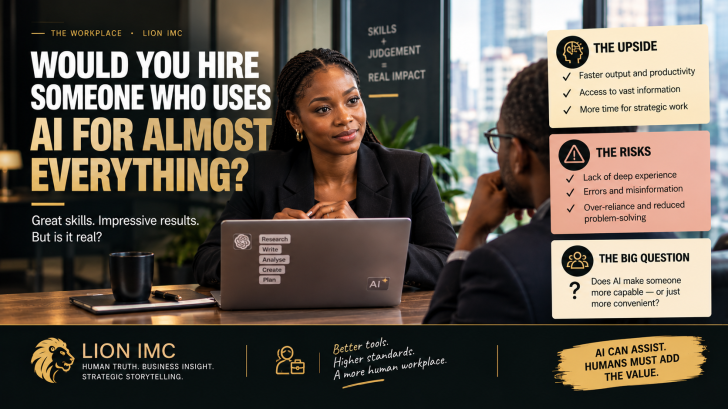
Let’s say you interviewed two candidates for the same role.
The first has impressive credentials, answers your questions confidently and presents a portfolio of polished work. Their writing is sharp, their presentation is excellent, and their proposed strategy is better than you expected.
The second candidate has similar experience but a less dazzling portfolio. Their work is solid, their explanations are clear, and they can tell you exactly how they reached their conclusions.
Then you discover something interesting about the first candidate: They use artificial intelligence for almost everything.
They use it to research, write, analyse, prepare presentations, develop strategies, answer emails and solve problems. Even some of the work you admired during the interview was heavily AI-assisted.
Would that change your decision?
Would you see a resourceful professional who knows how to get things done or someone whose impressive output might conceal a worrying lack of independent ability?
It is a question employers can no longer afford to dismiss as hypothetical.
When impressive work no longer tells the whole story
For years, employers have relied on portfolios, written tests, presentations, interviews and professional experience to assess candidates.
These methods were never perfect. A polished CV could exaggerate someone’s contribution. A confident interviewee could perform poorly on the job. A quiet candidate could turn out to be exceptionally capable.
AI introduces another complication: A candidate can now produce work that looks considerably more sophisticated than their unaided skills might suggest.
A junior marketer can generate a campaign proposal. An inexperienced analyst can produce a convincing report. A job applicant can use AI to prepare interview answers, refine their CV and practise responses to difficult questions.
None of this automatically means the candidate is unqualified. It does mean employers need to think more carefully about what their assessments actually measure.
Are they measuring the quality of the final output? The candidate’s judgement? Their ability to solve a problem independently? Or their ability to use available tools effectively?
Those are related, but they are not identical.
The distinction matters because the ability to produce an impressive answer is not always the same as the ability to recognise whether that answer is correct.
AI can make a good employee even better
Before treating extensive AI use as a red flag, employers should consider what it can make possible.
A professional who knows how to use AI well may research faster, explore more options, automate repetitive work and spend more time on decisions that require human judgement. For a small Nigerian business with limited staff and resources, that can be particularly valuable.
Research published in The Quarterly Journal of Economics in 2025 examined AI assistance among 5,172 customer-support agents. Access to the tool increased the number of issues resolved per hour by an average of 15%, although results varied by experience and skill level. Less experienced workers generally gained more, while some highly experienced workers saw smaller gains in speed and slight declines in quality.
The OECD’s 2025 review of experimental research similarly found that AI can support productivity, learning and innovation, but emphasised the importance of human expertise and oversight. It also warned that accepting AI outputs without evaluating them can weaken critical thinking over time.
The implication for hiring is significant.
A candidate who uses AI extensively may be more productive than one who avoids it. The real question is whether that productivity comes with the ability to judge the work, recognise mistakes and take responsibility for the result.
Using AI frequently is not the same as depending on AI blindly.
The danger is not using AI. It is not knowing when AI is wrong.
Imagine hiring a marketing executive who can generate a 30-page marketing plan in an afternoon.
The presentation looks excellent. The market analysis is neatly organised. The customer personas are detailed. The campaign ideas are compelling, and the budget is presented in a professional format.
Then you ask a simple question:
“Which of these assumptions is based on actual customer data, and which did you generate as a working hypothesis?”
The candidate cannot tell you.
You ask why they selected a particular audience segment. They say the AI recommended it.
You ask how the proposed budget connects to the company’s sales target. They have no answer.
You ask which sources support the market figures. They have not checked.
Now the problem is clearer. The candidate has demonstrated an ability to generate a document, but not necessarily an ability to develop a strategy.
That distinction matters in marketing, finance, communications, human resources, technology and virtually every role where a convincing answer can still be a wrong answer.
AI systems can produce fabricated references, outdated information, flawed calculations and confident recommendations based on assumptions that do not fit a particular business. A professional who cannot identify these problems may simply deliver them faster.
This is why the OECD review stresses that domain knowledge helps people interpret and apply AI-generated insights effectively.
The question employers should ask is not, “Did you use AI?”
It is, “How did you determine that the result was good enough to use?”
What does “using AI for almost everything” actually mean?
The phrase sounds alarming, but it can describe very different professionals.
What does “using AI for almost everything” actually mean?
The phrase sounds alarming, but it can describe very different professionals.
The AI-empowered professional
Uses AI to brainstorm, organise information, challenge assumptions, draft material and explore alternatives. Checks important facts, brings their own experience to the task and can explain why the final result makes sense.
The AI-dependent professional
Relies on AI to make decisions they cannot explain, accepts recommendations without testing them and struggles when the tool is unavailable or the problem falls outside its familiar patterns.
The AI-disguised professional
Presents AI-generated work as proof of personal expertise, exaggerates their contribution or cannot reproduce the reasoning behind work they claim to have done.
These are not formal categories from a research study; they illustrate three different patterns employers should distinguish.
The first candidate may be an excellent hire. The second may need training or a more suitable role. The third raises questions about honesty and professional integrity.
A person can also move between these patterns depending on the task. Someone may use AI responsibly for routine emails but rely on it too heavily for financial analysis or legal interpretation.
That is why the amount of AI use alone is a poor measure of professional competence.
The interview question employers should start asking
Employers do not need to ban AI from recruitment exercises to discover what a candidate can actually do.
They need to design assessments that reveal how the candidate thinks.
For example, instead of asking a communications candidate to submit a polished press release, an employer could provide a short, fictional company scenario and ask the candidate to:
– Develop an initial response, with or without AI.
– Identify the facts that still need verification.
– Explain the assumptions behind their approach.
– Respond to a new piece of information that changes the situation.
– Describe what they would do if the AI-generated recommendation proved incorrect.
The final question can be particularly revealing. A person who understands the task should be able to reconsider their approach when the evidence changes.
For technical or analytical roles, employers can ask candidates to explain their calculations, test a sample output or diagnose a deliberately introduced error. For creative roles, they can examine how candidates make decisions, refine ideas and adapt work to a specific audience or brief.
This does not require employers to demand that every candidate work without assistance. It requires them to assess the skills that matter for the actual job.
A 2025 Microsoft Research field experiment involving 6,000 knowledge workers found that access to an AI tool changed some work patterns, including time spent on email, but did not significantly change time spent in meetings. The wider lesson is that access to AI changes particular tasks; it does not automatically establish that someone can perform every aspect of a role well.
Should candidates disclose how much AI they use?
This is where the issue becomes more complicated.
If a candidate uses AI to improve their CV, prepare for interviews, organise research or polish a presentation, must they disclose every instance?
Not necessarily. The appropriate expectation depends on the employer’s instructions, the nature of the assessment, the role and any relevant confidentiality or professional requirements.
If an employer explicitly asks candidates to complete an unaided assessment, using AI in violation of that instruction is a different matter. If the role involves handling confidential customer information, the candidate’s approach to data security is also relevant.
What employers should care about is whether candidates are honest about their contributions, comply with reasonable assessment rules and understand the risks associated with the tools they use.
There is a difference between saying, “I used AI to help me develop this proposal, then checked the assumptions and rebuilt the recommendations around the company’s needs,” and claiming sole expertise in work the candidate cannot explain.
The first answer demonstrates a process. The second may expose a credibility problem.
Employers should also be careful not to assume that polished writing is proof of AI use or that a candidate who writes less elegantly is less competent. A fair hiring process tests actual capabilities rather than relying on guesses about who used which tool.
What about junior employees who are still learning?
This is perhaps the most important part of the conversation.
Junior professionals often use AI because they are still building knowledge, confidence and experience. It can help them understand unfamiliar concepts, practise tasks and get feedback they might not otherwise receive.
But if AI performs every difficult step, the junior employee may miss opportunities to develop the judgement that comes from doing the work, making mistakes and correcting them.
The OECD’s review notes both sides: AI can help less experienced workers improve on well-defined tasks, but overreliance may undermine critical thinking if users stop evaluating the outputs. It also cautions that long-term effects remain uncertain.
oecd.org
For employers, the answer is not necessarily to insist that junior staff struggle through every task unaided. It is to create a balance between assistance and learning.
A manager might ask a new analyst to prepare an initial interpretation before consulting AI, then compare the two. A communications lead might ask a junior writer to explain why a draft’s tone fits the audience. A finance manager might require employees to reconcile AI-assisted calculations against source records.
The aim is not to preserve unnecessary drudgery. It is to make sure that, as employees become faster, they also become more capable.
And employers have a responsibility here too. They cannot demand sophisticated AI skills while providing no training, no approved tools and no clarity about acceptable use.
The question for Nigerian employers
For Nigerian businesses competing in a demanding environment, AI can be a practical advantage. It may help small teams undertake research, improve customer communication, automate repetitive tasks and produce work that previously required more time or resources.
But employers must decide what they are actually hiring for.
If the role is primarily about producing routine outputs, strong AI fluency may be a major advantage. If the role requires judgement, accountability, original thinking or decisions with significant financial or human consequences, those capabilities must be assessed directly.
And if an employee can use AI to do in two hours what once took two days, the employer should ask what that extra capacity can achieve—not assume that the employee has somehow become less valuable because the process has changed.
The strongest professionals will not necessarily be those who do everything manually. Nor will they automatically be those who delegate everything to a machine.
They will be those who understand the work well enough to know what to delegate, what to verify, what to challenge and what must remain their responsibility.
The Lion Take
Would I hire someone who uses AI for almost everything?
I would consider hiring someone who uses AI for almost everything. I would not hire someone who has outsourced almost all their judgement to it.
AI fluency can make a professional faster, more versatile and more productive. But speed without discernment can multiply mistakes just as efficiently as it produces good work.
Employers should assess the person behind the output: their reasoning, curiosity, integrity, ability to learn, and willingness to take responsibility for the result.
Because the real competitive advantage is not simply knowing how to make AI work.
It is knowing when the work AI produces deserves to be trusted.
The big question
If two candidates produced equally impressive work, but one relied heavily on AI while the other did most of the work independently, whom would you hire and what would you need to know before deciding?