







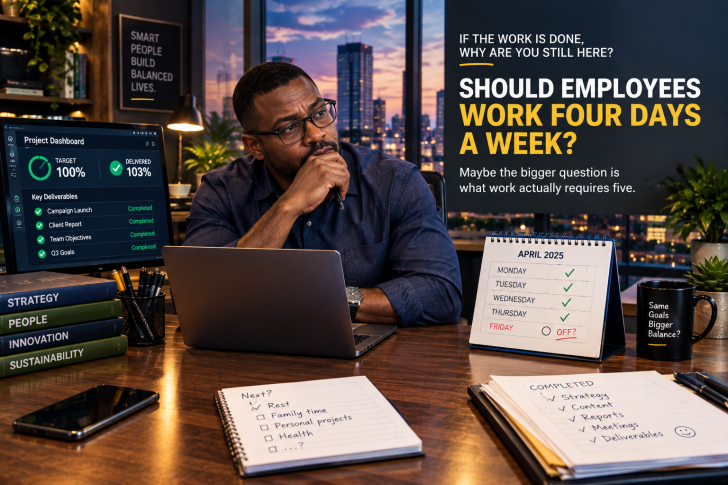
A large 2025 study of 2,896 workers across 141 organisations published in Nature Human Behaviour found improved burnout, job satisfaction, mental and physical health under income-preserving four-day arrangements. But the evidence on productivity and long-term sustainability is more mixed, and some sectors simply cannot operate on a one-size-fits-all model.
Say your employer makes an announcement:
From next month, Friday is no longer a working day.
Your salary remains the same.
Your responsibilities remain.
Your targets remain.
Your customers still expect service.
But you have one additional day that belongs to you.
You could sleep.
Take your children to school.
Run errands without taking annual leave.
Study.
Exercise.
Start something.
Travel.
Rest.
Or simply do absolutely nothing.
Sounds wonderful.
Until the CEO asks the question that usually follows:
“But will we still get the work done?”
That is where the four-day workweek stops being a lifestyle fantasy and becomes a serious business question.
Because the debate isn’t really about Friday.
It is about something much bigger:
Does working longer necessarily mean creating more value?
FOUR DAYS DOES NOT NECESSARILY MEAN FOUR DAYS OF LESS WORK
This is the first distinction that needs to be made.
There are different versions of the four-day workweek.
One company might move from 40 hours to 32 hours across four days, with no reduction in pay.
Another might simply squeeze the existing 40 hours into four 10-hour days.
Another might give different employees different days off so the business remains open five or seven days a week.
These are not the same experiment.
Much of the recent research has focused on reducing working time without reducing pay, rather than simply squeezing five days of work into four.
A 2025 study published in Nature Human Behaviour examined 2,896 employees across 141 organisations in Australia, Canada, Ireland, New Zealand, the UK and the United States. The organisations reorganised work before a six-month trial, and researchers found improvements in burnout, job satisfaction, mental health and physical health compared with control companies.
That is interesting.
But it does not mean every company should simply erase Friday from the calendar tomorrow.
The details matter.
THE FIVE-DAY WEEK MAY HAVE A PRODUCTIVITY PROBLEM
We have inherited the five-day working week as though it were a law of nature.
Monday.
Tuesday.
Wednesday.
Thursday.
Friday.
Then weekend.
But the number five is not necessarily evidence that five is the optimal number of days for every kind of work.
A professional who spends Monday morning in meetings, Tuesday responding to emails, Wednesday recovering from meetings, Thursday racing to finish actual work and Friday pretending to have enough energy to do anything meaningful may technically have worked five days.
That doesn’t automatically mean five highly productive days.
This is one reason four-day-week experiments often force organisations to examine what they were previously treating as unavoidable.
How many meetings are actually necessary?
How many approvals?
How much duplicated reporting?
How much time is lost searching for information?
How much work exists because another inefficient process created it?
How much of the working day is genuinely productive?
Research reviewing four-day-week trials has found organisations making changes such as reducing distractions, improving processes and restructuring meetings as they adapt to shorter working time.
And that may be the hidden value of the experiment.
It forces companies to audit the work itself.
WHAT IF THE PROBLEM ISN’T THE NUMBER OF DAYS?
This is where employers have a legitimate question.
What if employees simply work more intensely for four days and become exhausted?
What if Thursday becomes a twelve-hour marathon?
What if meetings multiply because everyone wants to squeeze everything into Monday to Thursday?
What if employees spend Friday secretly checking email anyway?
What if customers still expect five-day service?
What if managers interpret fewer days as needing greater surveillance?
Then the organisation hasn’t really redesigned work.
It has simply compressed the stress.
A four-day week can therefore fail if management thinks:
“We have four days now. Everybody must work harder.”
The better question is:
“What work can we eliminate, simplify, automate, delegate or redesign so that valuable work fits into less time?”
That is a completely different management philosophy.
THE BUSINESS DOES NOT HAVE TO CLOSE ON FRIDAY
This is another misconception.
A four-day employee week does not necessarily mean a four-day business.
A hospital cannot simply tell patients:
“Sorry, it’s Friday.”
An airline cannot close because employees need a long weekend.
A hotel cannot tell guests to return Monday.
A bank may need customer support beyond four days.
A manufacturing plant may require continuous operations.
A media organisation may need to publish every day.
But those realities don’t necessarily eliminate the possibility of reduced working time.
Employees can be staggered.
Teams can rotate days off.
Some roles can operate Monday–Thursday.
Others Tuesday–Friday.
Some organisations can use a nine-day fortnight or other reduced-time models.
A 2025 Scottish public-sector pilot, for example, moved staff to 32 hours over four days while staggering days off to maintain a full five-day public service. The participating organisations reported no deterioration in their identified KPIs during the pilot.
The lesson isn’t:
“Everybody must take Friday off.”
It is:
“The working week does not have to look identical for every role.”
THEN THERE IS THE NIGERIAN QUESTION
This conversation becomes particularly interesting in Nigeria.
Because the theoretical four-day workweek meets some very practical realities.
Consider Lagos.
A professional may spend hours commuting.
Traffic.
Transport costs.
Fuel.
Power interruptions.
Internet problems.
School runs.
Childcare.
Food.
Security concerns.
Family responsibilities.
Then arrive at work already tired.
If that employee could remove one commute from the week, the benefit would not simply be:
one extra day off.
It could mean:
one less journey through traffic.
one less transport expense.
one less day of getting dressed for work.
one more day for family responsibilities.
one more day for recovery.
one more day for personal productivity.
And that matters.
Because the actual cost of employment is not always contained within the office.
BUT WHAT ABOUT THE EMPLOYER?
The employer is not running a charity.
This needs to be said.
A company has customers.
Revenue targets.
Payroll.
Shareholders.
Deadlines.
Regulators.
Competitors.
Production requirements.
If reducing working time causes output to fall materially, the company has a legitimate problem.
That is why the strongest argument for a four-day week isn’t:
“Employees deserve more free time.”
It is:
“Can the organisation produce equal or greater value with less employee time?”
That is a business proposition.
And the evidence so far is encouraging in some settings, but it is not universal.
A 2026 review by the Australian Parliamentary Library notes that trials have reported benefits for work-life balance, while evidence on productivity, costs and long-term sustainability remains mixed. It also notes that unsuccessful trials have cited implementation costs and the difficulty of applying a one-size-fits-all model.
That uncertainty is important.
Lion should not turn a promising workplace experiment into a miracle cure.
THE FOUR-DAY WEEK ALSO CHANGES THE MEANING OF “PRODUCTIVITY”
This may be the most interesting part of the debate.
For decades, many organisations have measured work through visible activity.
Who arrived first?
Who stayed late?
Who responded to the email at 11:48pm?
Who was online at midnight?
Who spent the most time in the office?
But presence is not the same as output.
And output is not always the same as value.
A professional can spend nine hours in the office and accomplish less than another person accomplishes in six focused hours.
The four-day experiment therefore challenges a deeply embedded managerial assumption:
If I cannot see you working, how do I know you are working?
The answer has to become:
Look at the work.
Did the project move?
Did the customer get served?
Did revenue improve?
Did errors fall?
Did deadlines get met?
Did quality remain acceptable?
Did the team collaborate?
Did the organisation achieve its objectives?
Those are harder questions than checking attendance.
But perhaps that is precisely why they matter.
THE MANAGER MAY BE THE REAL PROBLEM
There is a possibility that a four-day workweek would expose something uncomfortable:
Some jobs are not actually five-day jobs.
Some jobs are badly managed five-day jobs.
Too many meetings.
Too many approvals.
Too much bureaucracy.
Too much reporting.
Too much duplication.
Too much presenteeism.
Too much work that exists simply because nobody has questioned it.
A shorter week would force managers to ask:
What are these people actually doing all day?
And that can be uncomfortable.
Because once you start measuring outcomes instead of attendance, some traditional management practices become much harder to justify.
BUT DON’T TURN THE EMPLOYEE INTO A PRODUCTIVITY MACHINE
There is another danger.
Companies could embrace the four-day week for the wrong reason.
Instead of:
“How can we create a healthier, more sustainable way of working?”
the message becomes:
“How much more can we squeeze out of employees in four days?”
That is not liberation.
It is compression.
One recent qualitative study of a four-day-week trial in a financial-services organisation in New Zealand raised concerns that management practices around performance measurement and productivity pressure could intensify even under reduced working time.
That is a useful warning.
A shorter week is not automatically a better workplace.
The management philosophy has to change with it.
WHAT HAPPENS TO CAREER DEVELOPMENT?
There is another question professionals should ask.
If everyone works fewer days, what happens to:
training?
mentoring?
informal learning?
networking?
junior staff development?
collaboration?
These things can disappear if companies treat Friday simply as a day that has been removed.
A good four-day model therefore requires intentional redesign.
If the organisation wants fewer hours, it has to protect the things that make people better.
Otherwise, employees may have more free time but less opportunity to grow.
And that would be a strange trade.
WHO GETS THE FOUR-DAY WEEK?
This is perhaps the biggest fairness question.
If a software developer can work four days but a security guard cannot, what happens?
If a consultant gets Friday off but a nurse works five or six days, is that fair?
If headquarters gets a four-day week but factory workers do not, how is the benefit distributed?
If senior management gets flexibility while junior employees remain tied to desks, does the policy actually improve workplace equality?
There may be legitimate reasons why different roles require different arrangements.
But organisations should be transparent about them.
Otherwise, “flexibility” can quietly become another privilege attached to seniority.
MAYBE THE FUTURE IS NOT A FOUR-DAY WEEK
This is where I think the conversation gets even more interesting.
Perhaps the future is not:
Everyone works Monday to Thursday.
Perhaps it is:
Work is organised around outcomes rather than a universal number of days.
One team works four days.
Another rotates.
Another works a nine-day fortnight.
Another works shorter days.
Another requires continuous coverage.
Another needs to be physically present.
Another doesn’t.
The question becomes:
What is the minimum amount of coordinated time this particular work requires?
That is much more useful than declaring four days universally superior to five.
AND THEN THERE IS AI
This debate is becoming even more interesting as AI takes over some routine tasks.
If technology allows a professional to produce in six focused hours what previously required eight, should the organisation simply fill the remaining two hours with more work?
Or can productivity gains eventually become time gains?
That is one of the bigger questions of the future of work.
For decades, technology has promised to make work more efficient.
But efficiency has often meant:
Do more.
Perhaps the next question should be:
Can we use some of that efficiency to work less without producing less?
That is a very different idea of progress.
THE FOUR-DAY WEEK SHOULD NOT BE A FREE FRIDAY
If companies adopt it, there should be a bargain.
The employee gets reduced working time.
The employer gets a workforce expected to focus intensely on outcomes.
That means:
fewer unnecessary meetings.
clearer priorities.
better processes.
less duplication.
better technology.
stronger accountability.
clearer performance measures.
serious customer coverage.
And perhaps most importantly:
No pretending that everything can remain exactly the same.
You cannot remove a day and refuse to change the system.
SO, SHOULD EMPLOYEES BE ALLOWED TO WORK FOUR DAYS A WEEK?
For some jobs, absolutely, the model deserves serious testing.
For others, the operational requirements may make a standard four-day schedule difficult.
And for many organisations, the answer may depend less on whether four days sounds attractive and more on whether the work can be redesigned around measurable outcomes.
The strongest approach may therefore not be a universal rule.
It may be:
Test it.
Measure it.
Redesign the work.
Protect service.
Measure employee wellbeing.
Measure output.
Measure customer experience.
Then decide.
Because the real experiment isn’t:
“Can employees survive without Friday?”
It is:
“Can organisations create the same value without requiring five full working days?”
That is a question worth testing.
THE LION TAKE
The four-day workweek is often presented as an employee demand.
Maybe it should also be treated as a management experiment.
If an organisation can maintain quality, customers, revenue, collaboration and accountability while giving employees more time outside work, the old assumption that five days are automatically necessary becomes harder to defend.
But if the four-day week simply means:
four days of compressed exhaustion,
then the calendar has changed while the workplace has not.
The point isn’t to make Friday disappear.
The point is to make unnecessary work disappear.
Because perhaps the future of work is not about asking:
“How many days can we keep people at work?”
It is about asking:
“How little time can we require from people while still doing excellent work?”
And if a company can answer that question honestly, perhaps it has finally learned what productivity was supposed to mean in the first place.