







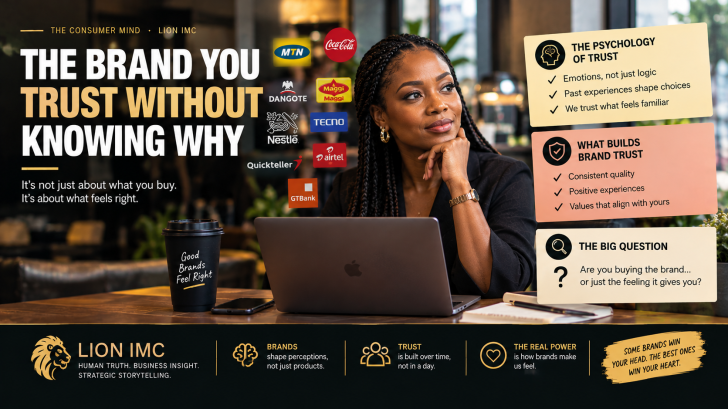
You probably have a brand you reach for without thinking too hard.
When you need to transfer money, you open the banking app you already know. When you want a particular snack, you pick the familiar packet from the shelf. When your phone needs replacing, one or two names come to mind before you have even compared the specifications.
Perhaps you have used these brands for years. Perhaps somebody you trust recommended them. Perhaps they have simply never given you a serious reason to look elsewhere.
But here is the interesting question: if someone asked you exactly why you trust that brand, could you explain it?
You might mention quality, reliability, convenience or good customer service. Those are reasonable answers. Yet sometimes our preference runs deeper than a list of product features.
We may trust a brand because it feels familiar. Because it has been part of our lives for years. Because our previous experiences have taught us what to expect. Or because, without consciously examining the evidence, we have come to associate it with a certain feeling: reassurance, competence, belonging or peace of mind.
We think we are making a straightforward purchasing decision.
In reality, we may be drawing on years of accumulated impressions.
Trust is often built before we stop to examine it
Think about the first time you used a new financial service, ordered from an unfamiliar online store or bought a product from a company you had never encountered before.
You probably looked for reassurance.
Was the business legitimate? Did the website look credible? Had somebody recommended it? Were the reviews convincing? Would your money be safe? If something went wrong, would anyone take responsibility?
Now compare that experience with dealing with a brand you already know.
You may not ask yourself the same questions. You already have a mental picture of what the brand represents and what is likely to happen when you use it.
That expectation can make the decision feel easier.
Psychologists and consumer researchers have long examined how people form trust, and the evidence suggests that it is not reducible to one factor such as product quality or familiarity.
A major 2024 meta-analysis published in the Journal of Consumer Research examined 2,147 effect sizes drawn from 549 studies, representing 324,834 respondents across 71 countries over five decades. It found that perceptions of integrity—whether a company can be regarded as honest and principled—were particularly important drivers of consumer trust, alongside reliability. The research also found that trust was more strongly associated with attitudinal outcomes, such as how consumers feel about a brand, than with behavioural outcomes alone. Read the research.
In other words, a brand earns trust not merely by delivering a product that works, but also by giving people reasons to believe the company behind it can be relied upon.
And much of that judgement may happen without a customer consciously listing the evidence.
The small experiences that quietly build a brand
A brand does not need to make a grand emotional statement every time it interacts with a customer.
Sometimes trust grows through ordinary, repeated experiences.
A bank sends a transaction alert when expected. A delivery company keeps you informed when an order is delayed. A telecoms provider makes it reasonably easy to resolve a problem. A food product tastes the way you expect it to. A retailer handles a complaint without treating you as though you are the problem.
Individually, these moments may not seem remarkable.
Together, they create a pattern.
You begin to expect a certain standard. You become less anxious about the next transaction. You spend less time wondering whether the business will deliver on its promise.
That expectation is valuable because purchasing decisions involve uncertainty. Even when a product is inexpensive, a customer may worry about wasting money, losing time or dealing with an avoidable problem.
A familiar brand can reduce some of that uncertainty not because it is guaranteed to be the best, but because the customer has a history with it.
This is one reason consistency matters so much in branding. A company may spend heavily on advertising to promise excellence, but the everyday experience is where customers learn whether the promise deserves to be believed.
Advertising introduces the promise. Experience teaches people whether to trust it.
Familiarity can feel like trust but they are not the same thing
Here is where the story gets more complicated.
A brand can feel trustworthy simply because we recognise it. Its colours are familiar. We know its packaging. We have seen its advertisements for years. Our family uses it. People around us buy it.
Recognition can make a brand feel less unfamiliar, and familiarity can influence our comfort with a choice.
But familiarity is not proof of integrity.
You can recognise a company without knowing how it handles customer data. You can have used a service for years without understanding its fees. You can admire a brand’s public image without knowing whether its internal practices match its promises.
Sometimes we say, “I trust them,” when what we really mean is, “I know them.”
That distinction matters.
A familiar company can still disappoint customers. A widely admired brand can make a serious mistake. A business with a long history can lose the confidence it took decades to build.
Trust must survive contact with reality.
Research published in the Journal of Consumer Research in 2024 reinforces the importance of distinguishing trust from simple favourable impressions: the large meta-analysis found that integrity and reliability both contribute to trust, and that the strength of these relationships varies across circumstances. Familiarity alone should not be treated as proof that a company is trustworthy.
The lesson for consumers is to ask not only whether a brand feels familiar, but also what its behaviour has taught them to expect.
The lesson for businesses is even more demanding: being well known is not the same as being worthy of confidence.
Why we sometimes defend brands as if they were people
Have you ever recommended a brand to someone, only for that person to complain about it later?
Perhaps you immediately explained why their experience was unusual. Maybe you told them which product to buy instead, or insisted that the company normally performed better.
There may be a perfectly reasonable explanation. You have had good experiences and genuinely believe the complaint does not reflect the brand as a whole.
But something else can happen, too.
When a brand becomes part of our routines, identity or personal history, criticism of it can feel surprisingly personal. We may have spent years choosing it, recommending it and telling others that it is reliable. Admitting that the company has failed us can mean reconsidering our own judgement.
This does not happen with every brand or every customer. But it helps explain why some people defend a preferred brand even when new evidence gives them reason to reconsider it.
A brand relationship can become more than a calculation of price and quality. It can be tied to personal memories, social belonging and the kind of person we believe ourselves to be.
A 2019 meta-analysis in the Journal of Consumer Research, examining 588 estimates from 290 studies involving 348,541 respondents across 46 countries, found that consumer–brand relationships were positively associated with brand loyalty, with stronger relationships for some forms of emotional attachment than others. The findings also varied by brand and context. Read the study.
This does not mean that loyal customers are irrational. Emotional attachment can grow from genuinely good experiences.
It means that when a brand has earned a place in someone’s life, the relationship may be harder to evaluate as though it were a completely new purchase.
The Nigerian dimension: when trust saves you the stress
In Nigeria, trust in a brand can carry practical weight.
Customers may be weighing not just price and quality, but also the time it takes to resolve a problem, the reliability of a service, the difficulty of getting a refund or the uncertainty of dealing with an unfamiliar seller.
Consider buying an appliance from a seller you have never used. A cheaper offer may be attractive, but you might wonder whether the item is genuine, whether the warranty will be honoured and whether the seller will answer your calls if it develops a fault.
A slightly more expensive option from a business with a dependable track record may feel safer.
Or consider a financial service. You may not be able to inspect every aspect of its technology or operations. You have to rely partly on the company’s reputation, its communication, its safeguards and what happens when customers encounter difficulties.
In such situations, trust is not merely an emotional luxury. It can reduce the perceived risk of making a decision.
That does not mean Nigerian consumers all behave alike, or that a familiar local brand is necessarily more trustworthy than an unfamiliar international one. People have different budgets, experiences and priorities. Nor does a positive reputation guarantee a good outcome.
But the principle travels well: when customers cannot know everything about a product or service before buying it, they look for signals that help them decide whom to believe.
Those signals may come from personal experience, recommendations, reputation, visible conduct or the way a company responds when something goes wrong.
And that is why a single poor experience can sometimes matter far more than a dozen attractive advertisements.
What brands often misunderstand about trust
Some companies treat trust as a communications problem.
If customers are losing confidence, the instinct is to launch a new campaign, refresh the logo, publish a statement about corporate values or enlist a familiar face to endorse the brand.
These actions may help people understand a brand’s offer or reconsider their perceptions. But they cannot, by themselves, repair a pattern of broken promises.
The 2025 Edelman Trust Barometer Special Report on Brand Trust surveyed 15,000 people across 15 markets. Globally, 88% of respondents said trust in a brand was important or a deal-breaker in purchase decisions—a level equal to the importance they attached to quality and value for money in the report. Read the report.
The finding does not mean that 88% of Nigerian consumers share that exact view; the reported figure is an average across the 15 markets studied. But it illustrates the commercial significance of trust.
If customers care deeply about trust, businesses must treat it as something they earn through operations, not merely something they communicate through advertising.
That means asking uncomfortable questions:
- Does the product consistently deliver what we promise?
- Are our prices, terms and conditions clear?
- Do we take responsibility when something goes wrong?
- Do we treat customers fairly even when they are unlikely to complain publicly?
- Are our public claims consistent with our actual behaviour?
A company may have an excellent brand identity and a weak trust foundation. It may also have a modest public profile but earn extraordinary confidence through dependable service.
The strongest brands work to align the two.
How to tell whether your trust is deserved
You do not have to become suspicious of every company you like. Nor do you need to conduct a corporate investigation before buying your favourite product.
But it helps to pause occasionally and distinguish the feeling of trust from the evidence supporting it.
Try asking yourself three questions.
1. What has this brand actually done to earn my trust?
Think about your experiences with its products, customer service, pricing, reliability and response to problems. Can you identify concrete reasons for your confidence, or is the feeling based mainly on familiarity?
2. How does the brand behave when things go wrong?
Almost any company can appear competent when everything is working. How it handles complaints, delays, mistakes and disputes may tell you more about its character.
3. Would I still choose this brand if I encountered it for the first time today?
Imagine that you had no history with it. Would its current product, price, service and reputation still persuade you to choose it? The answer might confirm your confidence or reveal that habit is doing more of the work than you realised.
These questions are not about finding a perfectly trustworthy brand. No company is flawless, and one bad experience does not automatically invalidate a long history of good ones.
They are about making sure that your confidence can respond to new evidence.
The Lion Take
The brand you trust without knowing why may have earned that confidence through years of consistent experiences. Or it may have benefited from familiarity, habit and a reputation you have never seriously examined.
The important thing is to know the difference.
For businesses, the implication is clear: you cannot build enduring trust through visibility alone. You must give customers reasons to believe you, opportunities to experience your promises and evidence that your values survive difficult moments.
For consumers, it is equally simple: Familiarity may make a brand feel safe, but its behaviour is what deserves your attention.
The best brands do not merely become familiar. They become dependable and keep giving people reasons to believe in them.
The big question
Think about the brand you trust most. Is your confidence based on what the company has consistently done for you, or have you trusted it for so long that you have stopped asking why?