






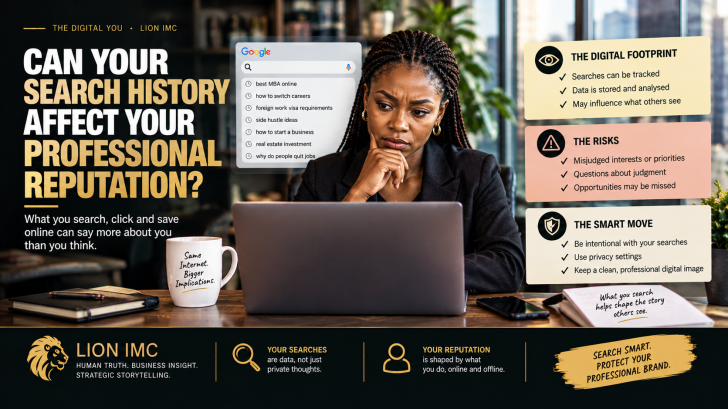
Have you ever searched for a new job while sitting at your office desk? Looked up how to negotiate a higher salary? Researched a competitor, wondered whether your boss could be fired, or searched for the qualifications required for a role you secretly hope to get?
Perhaps you have looked up how to start a business because you are tired of your job. Or searched for ways to explain a career gap, recover from a professional mistake, or leave a workplace without burning bridges.
These are ordinary searches. Some are private questions people may not feel comfortable asking another person.
But imagine that someone could see a record of those searches and draw conclusions about your ambition, loyalty, judgement or intentions.
Would the searches tell the whole story?
Probably not. Yet they might tell a story about you that you never intended to tell.
That is where the question becomes interesting: can your search history affect your professional reputation, even when you have done nothing wrong?
Your digital life may be more visible than you think
Search history is often treated as a personal record of curiosity. But depending on your settings, browser, device and the services you use, digital activity may be stored in different places.
For example, Google says that when Web & App Activity is enabled, searches can be saved to your Google Account to support personalised results and recommendations. Your browser may also keep a separate record, and deleting activity from your Google Account does not necessarily delete every record held elsewhere.
That does not mean your employer automatically has access to your personal Google search history. Nor does it mean that every search is being watched by a recruiter or manager.
The important distinction is between what a platform stores, what another person can access, and what someone might infer if they see it.
Those are three different things.
Your search for “how to resign professionally” could mean you have already accepted another job. It could also mean you are exploring your options after a difficult week. A search for “how to start a business” could indicate an entrepreneurial ambition, a university assignment, or simple curiosity.
A search alone rarely establishes the full context.
But people do not always wait for the full context before forming an opinion.
The professional reputation risk is not just about search engines
There is a difference between your private search history and the information you deliberately or inadvertently make visible online.
Recruiters and employers may review publicly available social media profiles as part of recruitment. Research has examined how personal online content can influence their impressions of candidates, sometimes beyond the qualifications presented in a CV.
A 2025 experimental study involving 480 hiring managers and HR specialists in Türkiye found that manipulated social media content influenced perceptions of applicants’ competence, organisational fit and hiring suitability. The study examined social media profiles—not private search histories—so it cannot establish that employers judge candidates by their searches. It does, however, illustrate how online information can shape professional impressions.
This is the broader lesson: online information can become part of the story others construct about you, even when that information offers only a partial view.
Imagine three professionals:
- The ambitious employee researches salary benchmarks, executive courses and vacancies at competing companies. A colleague who sees this activity might assume the employee is preparing to leave.
- The business-minded manager researches competitors, market opportunities and ways to reduce costs. Someone without the context might mistake legitimate commercial research for disloyalty.
- The curious professional searches controversial subjects, personal challenges or unfamiliar ideas simply to understand them. A person reviewing isolated searches might misinterpret curiosity as endorsement.
In each case, the search itself may be perfectly legitimate. The risk lies in the gap between what the person meant and what someone else believes it means.
Could your search history affect a promotion or job offer?
Potentially, but the circumstances matter.
There is no basis for assuming that every employer routinely examines private search histories, or that a particular search will cost someone a job. Whether digital activity becomes visible depends on factors such as the device being used, the account involved, workplace monitoring arrangements, applicable policies and the specific technology in place.
Still, three situations deserve attention.
1. You use a work device for personal searches
A company-managed laptop or workplace network may operate under monitoring, security and acceptable-use policies. The precise visibility depends on the systems and settings involved.
Using an office device to research a career move, a personal financial problem or a private health question may therefore create a different privacy situation from using your own device and personal connection.
That does not automatically make every personal search inappropriate. It simply means you should understand the environment in which you are searching.
2. Your online activity becomes visible to other people
A search is not the same as a public post. Nevertheless, screenshots, shared devices, browser access, account access or other forms of disclosure can expose information you expected to remain private.
Once exposed, that information may be interpreted without context.
And if it is discussed in a workplace, the resulting reputation issue may become larger than the original activity.
3. Someone mistakes curiosity for character
This may be the most subtle risk.
Searching for a controversial idea does not necessarily mean you support it. Looking up a competitor does not automatically mean you intend to disclose confidential information. Researching a resignation letter does not prove that you have decided to resign.
Curiosity is not confession. Research is not intention. A search is not proof of character.
Responsible employers should recognise these distinctions rather than treating isolated digital traces as conclusive evidence about a person’s professional suitability.
Should professionals start policing their own curiosity?
No. A professional life in which every question must be safe enough to withstand an imagined audience would be an impoverished one.
People need room to learn, explore unfamiliar subjects, consider career changes and ask questions they are not yet ready to discuss publicly.
The answer is not to become afraid of searching. It is to understand digital privacy and separate personal activity from professional systems where appropriate.
Here are practical steps worth taking.
Use the right device and account. Keep personal research on personal devices and accounts where practical, especially when the subject is sensitive. Remember that personal devices can also share data with apps and cloud services.
Review your privacy settings. Check what your search engine and browser save, whether activity is linked to your account, and whether automatic deletion is available. Google provides controls for reviewing, deleting and managing saved Search activity.
Understand workplace policies. If you use company equipment, learn what your employer says about monitoring, acceptable use and data retention. Do not assume that a work device offers the same privacy as your personal device.
Protect sensitive information. Avoid entering confidential business information, customer details or proprietary material into public search tools or AI services unless the use is authorised and appropriate.
Do not confuse privacy with concealment of wrongdoing. Wanting privacy for legitimate personal research is not evidence of misconduct. Equally, privacy controls should not be treated as permission to misuse company information or evade legitimate security requirements.
Be careful before drawing conclusions about others. If you are a manager or recruiter, do not treat an isolated search, post or digital trace as proof of someone’s intentions. Consider relevance, context, accuracy and fairness before making decisions.
The bigger question: who gets to tell your digital story?
The internet has made professional identity more complicated.
Your CV tells people what you choose to present. Your public posts show what you choose to share. Your search history, where recorded, may reflect the questions you are still trying to answer.
Those are not interchangeable records.
A person can be privately uncertain and professionally capable. Someone can research a career change and remain committed to their current responsibilities. A curious mind can explore an idea without adopting it.
This is why digital reputation should not be reduced to the simplistic idea that every trace online reveals the “real you.”
People are more complicated than their browsing history.
At the same time, digital privacy is not automatic. Professionals need to understand where their information goes, which accounts and devices they use, and what others may reasonably be able to access.
Organisations have a responsibility, too. If they collect or review digital information, they should have legitimate purposes, clear policies and fair processes rather than allowing speculation to substitute for evidence.
The Lion Take
Your search history may reveal what you are curious about, what you fear, what you want to change and what you hope to become. It does not, by itself, establish who you are as a professional.
Protect your privacy. Be deliberate about the systems you use. But do not let the fear of being misunderstood stop you from asking questions, exploring possibilities or planning your future.
And if you are responsible for hiring or managing people, remember this: the ability to find information about someone does not automatically make that information a fair measure of their character.
Your professional reputation should be built on evidence of your conduct, competence and judgement not speculation about a question you once typed into a search box.
The Big Question: If an employer could see every search you made over the past year, would you feel comfortable explaining the context or do you believe some parts of your digital life should remain entirely separate from your professional identity?