





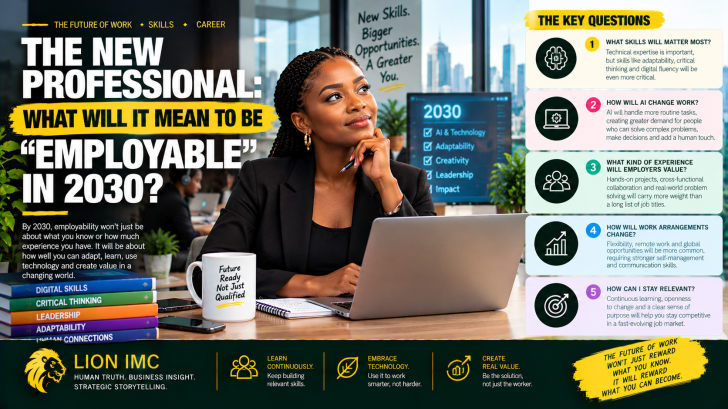
By 2030, a degree and years of experience may still open doors. But staying employable will increasingly depend on how well you adapt, use technology, solve problems and demonstrate value in a changing workplace.
Your qualifications may get you the interview. What you can do next may determine whether you get the job.
Imagine two professionals applying for the same role in 2030.
Both have university degrees. Both have ten years of experience. Both have worked for respected organisations.
The first candidate presents a familiar record: job titles, years served, responsibilities handled and certificates collected.
The second presents something different: problems solved, results achieved, technology used intelligently, teams influenced and evidence of learning new skills as the work changed.
Who gets hired?
It will depend on the role, the employer and the circumstances. But the second candidate has something increasingly valuable: evidence of being able to deliver results in conditions that may not remain the same.
That is the question behind the future of employability.
It is no longer enough to ask, “What qualifications do I have?” Professionals must also ask, “What can I do with what I know, how quickly can I learn what I don’t know, and what value can I create as the world changes?”
The distinction matters for Nigerian graduates entering a competitive job market, mid-career professionals trying to remain relevant, managers preparing for technological change and executives responsible for building teams that can deliver.
A useful clue comes from the World Economic Forum’s Future of Jobs Report 2025. Based on a survey of more than 1,000 employers globally, it projects that 22% of jobs will be disrupted by 2030, with 170 million new roles created and 92 million displaced. The report also estimates that nearly 40% of the skills required on the job will change. These are global projections, not a forecast of exactly what will happen in Nigeria.
The message is not that everybody must become a technology expert or that existing qualifications will become worthless.
It is that the professional who stops developing may find that the value of yesterday’s strengths is no longer enough for tomorrow’s opportunities.
1. Being qualified and being employable are not the same thing
A qualification tells an employer something about what you have studied or been trained to do. Experience offers clues about what you have encountered and handled.
Neither automatically proves that you can solve the problem an employer faces today.
Consider a marketing professional who has spent eight years preparing campaign reports. That experience may be useful. But can the person interpret customer data, explain why a campaign is underperforming, use AI tools responsibly, recommend a change and connect the recommendation to revenue?
Or consider a finance professional who understands reporting procedures. Can that person also identify patterns, explain risks to non-financial colleagues and use digital tools to improve the quality or speed of analysis?
The underlying professional knowledge still matters. What changes is the expectation that it should be applied to real problems.
This is not an argument against degrees, professional certifications or experience. It is an argument against treating them as the complete package.
Employers still need people who know their disciplines. But in changing workplaces, they also need people who can apply that knowledge beyond routine tasks.
Your qualification establishes a foundation. Your ability to turn knowledge into useful outcomes makes the foundation valuable.
2. Digital competence will extend beyond technology jobs
A Nigerian professional does not necessarily need to become a software developer to remain relevant in 2030.
But being able to work intelligently with digital tools is likely to matter in an increasing range of occupations.
The World Bank’s digital-skills analysis estimated that Nigeria’s labour force would need approximately 28 million workers trained in digital skills across sectors by 2030. This is a forecast, not a count of current vacancies, and digital skills range from foundational competence to advanced technical expertise.
The practical implication is important: digital capability is not only an issue for people working in technology companies.
A human resources professional may use digital tools to screen information and analyse workforce trends. A journalist may use AI to assist research while independently verifying facts. An accountant may automate repetitive tasks. A sales manager may use customer data to improve forecasting. A small-business owner may use digital platforms to reach customers beyond their immediate location.
The tools will differ by occupation. The underlying expectation is similar: understand which tools can improve your work, know their limitations and remain accountable for the result.
This includes understanding basic data, protecting confidential information, checking AI-generated output and recognising when a human decision is necessary.
Owning a laptop, having a social media account or occasionally using an AI chatbot is not the same as digital competence.
The relevant question is whether technology helps you produce better work—not whether you can name the latest tool.
3. AI may change the work before it eliminates the job
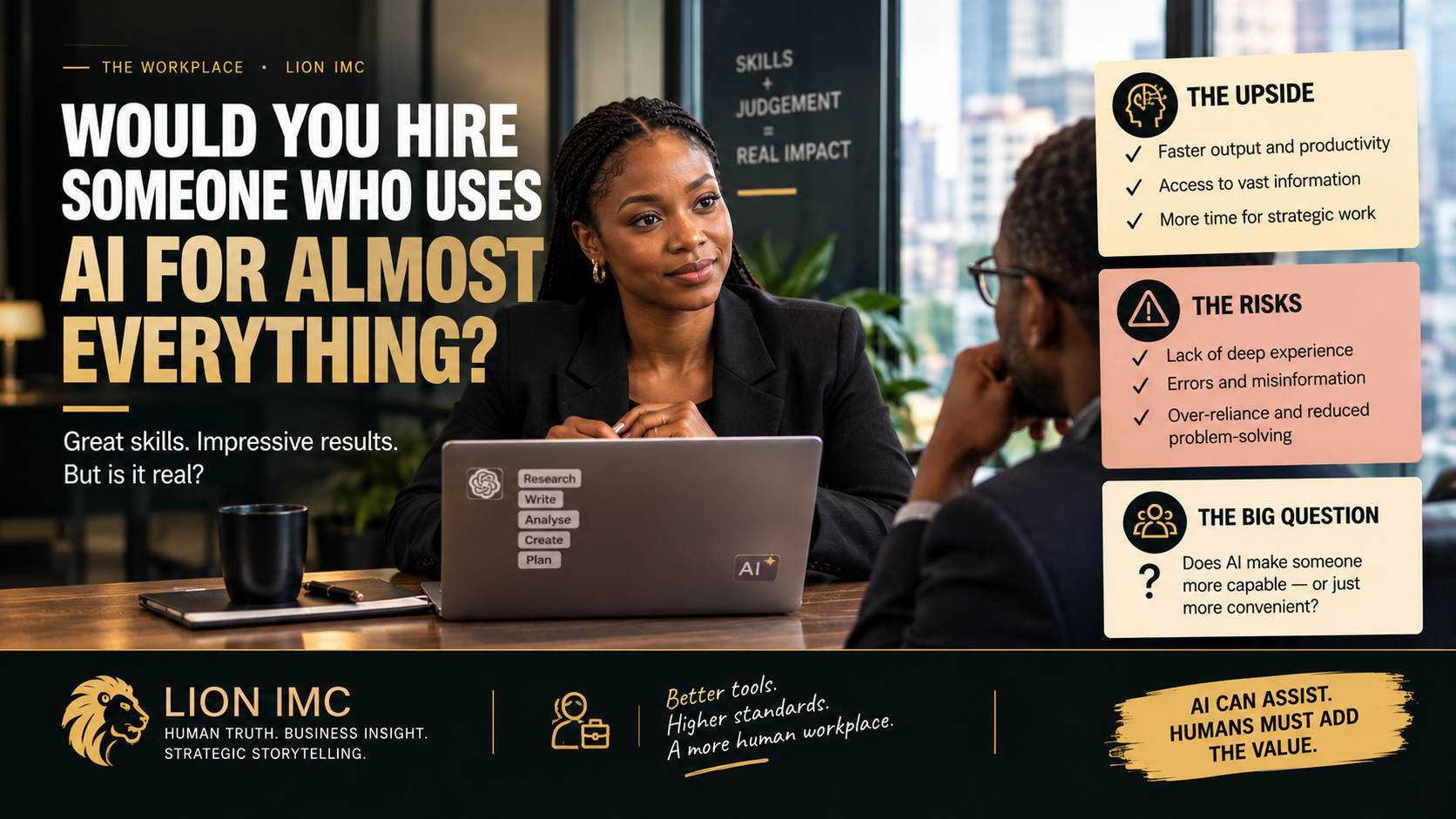
For professionals worried about AI, the most useful question may not be, “Will AI take my job?”
It may be, “Which parts of my job are becoming easier to automate, and what will my employer need me to do instead?”
The International Labour Organization’s 2025 assessment of generative AI found that one in four workers globally are in occupations with some degree of exposure to the technology. Its central finding was that most jobs are more likely to be transformed than made entirely redundant, although the degree of exposure varies across occupations and tasks.
That distinction is crucial.
A job title may survive while the work inside it changes substantially. Drafting, summarising, basic research, routine reporting and other repeatable activities may become faster or increasingly automated. The extent depends on the occupation, the technology available and how an organisation chooses to use it.
That can create opportunities. A professional who once spent hours compiling information may have more time to interpret it, advise a client or solve a business problem.
But it can also create pressure. If several people can produce the same routine output more quickly, the employer may question how much of that work is needed and what additional value each employee contributes.
This is where judgement, context, accountability and communication become especially important.
AI can produce a plausible answer. A professional must decide whether it is accurate, appropriate, ethical and useful in the actual situation.
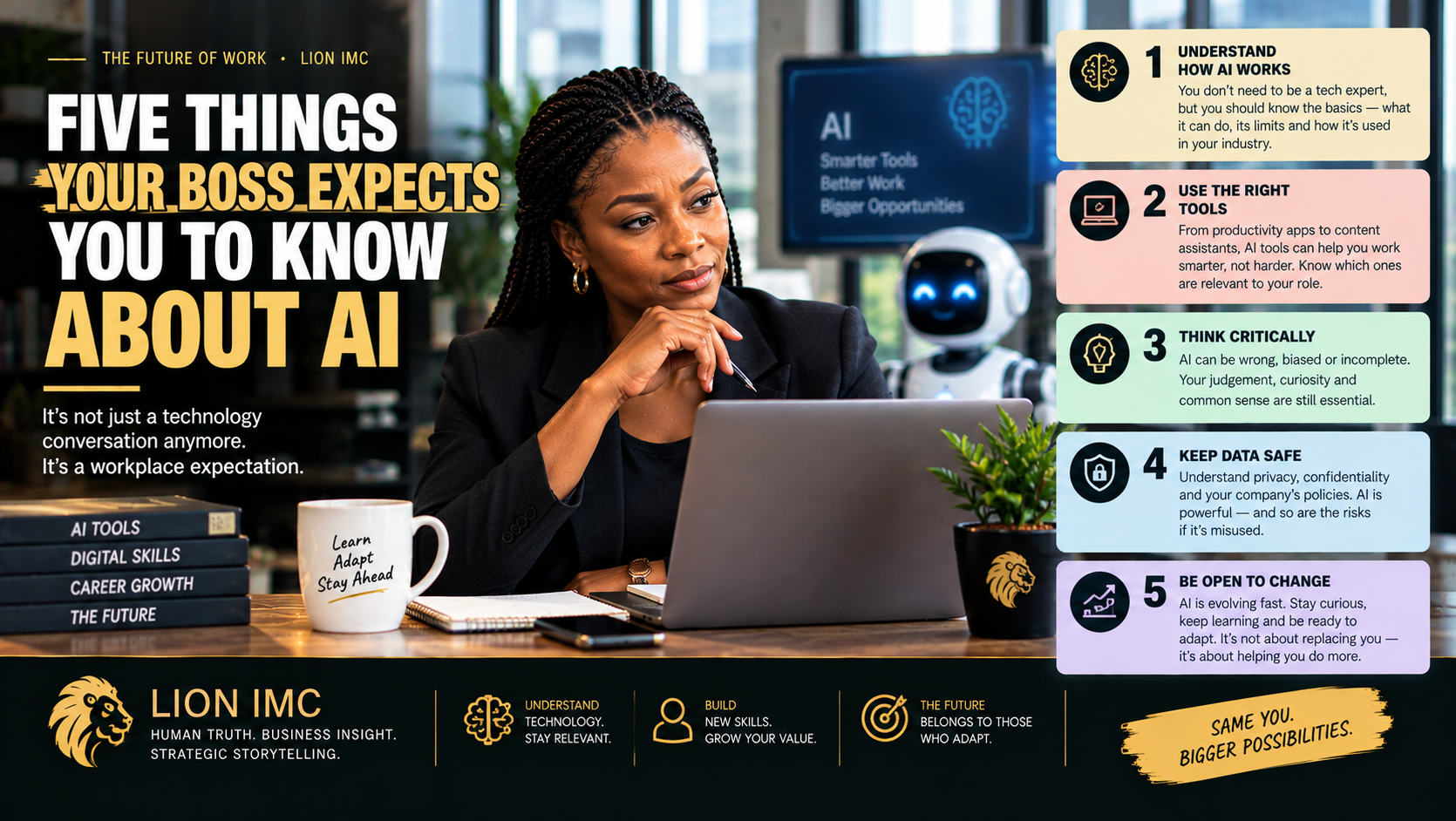
The strongest candidate in 2030 may not be the person who avoids AI or the person who lets AI do everything. It may be the person who knows what to delegate to technology, what to verify and what still requires human judgement.
4. Human skills will matter because work is about people, not just tasks
There is a curious contradiction in the future-of-work debate.
As technology becomes more capable, people sometimes assume that technical skills alone will determine who succeeds.
Yet the World Economic Forum’s research identifies analytical thinking, resilience, flexibility, creative thinking, leadership, social influence and curiosity among the skills employers consider important or increasingly relevant through 2030.
Think about what this means in practice.
A manager may have access to sophisticated data but still need to persuade a team to act on it.
A consultant may generate an excellent recommendation but fail to win a client’s trust.
A technically skilled employee may identify a problem but struggle to explain it to a decision-maker who controls the budget.
A business owner may understand the numbers but misread the customer.
In each case, knowledge matters. But the ability to interpret, communicate, collaborate and influence determines whether that knowledge produces results.
For Nigerian professionals, these skills are particularly relevant in workplaces where success may depend on managing different stakeholders, working across departments, negotiating competing priorities or building trust with customers and partners.
Being good at your job is one thing. Helping other people understand your value, trust your judgement and act on your recommendations is another.
The future professional will need to combine technical competence with the ability to work effectively with human beings.
5. Employers may care more about what you can demonstrate
For years, professionals have been encouraged to accumulate qualifications. Another certificate, another course, another title.
Learning remains valuable. But the connection between learning and performance needs to be clear.
Imagine that you have completed a course in data analytics. Can you show how you used the knowledge to identify a business problem?
You have learned digital marketing. Can you explain a campaign decision, the audience it targeted and what the results revealed?
You have taken a leadership course. Can you describe a situation in which you resolved a conflict, improved a process or helped a team deliver?
This is the difference between listing a skill and demonstrating it.
A portfolio does not have to be a designer’s collection of creative work. Depending on your profession, it could include a case study, a process improvement, a research project, a presentation, a documented result or a carefully anonymised example of your work.
For professionals handling confidential information, the goal is not to publish company secrets. It is to explain the problem, the contribution made, the approach taken and the outcome without exposing sensitive data.
The same principle applies to people in less visible roles. An operations professional can document reduced delays. A customer-service professional can explain how recurring complaints were addressed. A human resources professional can show how a recruitment process improved.
Not every result can be measured neatly, and not every employer will recruit using a skills-first approach. Qualifications, formal experience, networks and institutional requirements will continue to matter in many professions.
Still, professionals who can show what they know and how they use it have a stronger story to tell than those who rely entirely on job titles.
6. Adaptability will become a career asset
There is a difference between being experienced and being adaptable.
Experience tells an employer what you have done. Adaptability offers evidence that you can respond when circumstances change.
Consider a professional whose industry adopts new software, a business changes its operating model or a long-established process becomes automated.
One response is to insist that the old way worked perfectly well.
Another is to understand what is changing, identify which skills remain useful, learn what is missing and adjust without abandoning professional standards.
Adaptability does not mean chasing every new trend. It does not mean changing careers whenever a technology company announces a new product.
It means recognising when a change is relevant to your work and responding deliberately.
The OECD’s Skills Outlook 2025 emphasises the importance of lifelong learning, adaptable skills strategies and better recognition of skills acquired through different routes. It also highlights the unequal access people have to opportunities for learning and development.
It is easy to tell professionals to keep learning. It is harder for someone working long hours, supporting a family, paying rent and managing transport costs to find the time and money for training.
Employability is therefore not solely an individual responsibility. Employers, educational institutions and governments also shape whether people can access relevant training, gain practical experience and move into new opportunities.
Nevertheless, professionals can take a more deliberate approach to learning by identifying the capabilities their current or desired roles actually require, rather than collecting certificates without a clear purpose.
The goal is not to learn everything. It is to keep learning what helps you remain useful.
7. Your job title may become less important than your combination of skills
Job titles make careers easier to organise. They tell employers where someone has worked and offer a rough idea of their responsibilities.
But titles do not always reveal what a person can do.
Two brand managers may have very different strengths. One may excel at consumer research and brand strategy; another may be stronger in commercial planning, sales alignment and campaign execution.
A communications professional may also understand stakeholder management, digital analytics and business performance. A finance professional may combine technical expertise with data visualisation and strategic communication.
These combinations can become valuable because real business problems rarely respect departmental boundaries.
A customer-retention problem, for example, may involve product quality, pricing, service, marketing and technology. Solving it requires more than one narrow skill.
This does not mean everyone must become a generalist. Deep expertise will remain important, particularly in specialised and regulated professions.
The opportunity lies in combining strong professional depth with enough adjacent knowledge to solve problems across boundaries.
Ask yourself: what do I understand that helps me work better with people outside my immediate function? What can I do that complements my main expertise? What business problem could I solve more effectively because of that combination?
Those questions may reveal a more useful career-development path than simply asking which title comes next.
8. Employability in Nigeria will also depend on access and opportunity
There is a danger in discussing the future of work as though everyone starts from the same position.
A professional with reliable internet, a good laptop, supportive management and access to training has advantages over someone who must pay for data, contend with power interruptions and learn new tools entirely outside working hours.
A graduate who can afford an unpaid internship may gain experience that another graduate cannot afford to pursue.
A talented worker may be ready for a remote role but lack access to the networks or opportunities through which employers discover suitable candidates.
These differences matter. Skills do not develop in a vacuum, and possessing a skill does not guarantee a job.
Nigeria’s digital-skills demand forecast points to a substantial need for digital capability across sectors. But turning that need into real employment opportunities will depend on the availability of training, productive businesses, investment, infrastructure and employers who can connect skills to meaningful work.
Professionals should prepare for change, but organisations should not use the language of employability to transfer every responsibility to the individual.
An employee cannot independently solve a company’s lack of investment in technology. A graduate cannot create relevant work experience where employers refuse to provide entry-level opportunities. A worker cannot reskill effectively without adequate time, resources or access to training.
The future of work must therefore be discussed from both sides: what professionals can do to improve their prospects and what employers must do to make those prospects possible.
What should Nigerian professionals start doing now?
2030 is close enough to plan for, but far enough away to make deliberate changes.
Rather than trying to predict every new job title, start with a practical review of your career.
1. Identify the problems your profession is being asked to solve
Study job descriptions, industry developments and the challenges facing your sector. Look for recurring requirements, not just fashionable skills.
2. Learn the digital tools relevant to your work
Choose tools that help you analyse information, improve quality, save time or serve customers better. Learn their limitations and use them responsibly.
3. Strengthen your thinking, not just your technical ability
Practise interpreting evidence, challenging assumptions, solving unfamiliar problems and explaining your reasoning clearly.
4. Keep evidence of your contribution
Record projects, decisions, improvements and outcomes. Where possible, explain how your work affected revenue, costs, efficiency, customer experience, risk or organisational goals.
5. Learn to communicate value
Practise explaining complex ideas simply, presenting recommendations, listening to different perspectives and working with people whose expertise differs from yours.
6. Build a learning habit you can sustain
Set aside realistic time to develop one relevant capability at a time. Apply what you learn to a real task rather than measuring progress only by certificates completed.
The bigger question: who will still be employable in 2030?
Nobody can describe the exact requirements of every job in 2030. Industries will evolve at different speeds. Some predictions will be wrong. Some jobs will change less than expected, while others may emerge in forms that are difficult to imagine today.
But the direction of travel is clear enough to justify preparation: digital capability is becoming more important, employers expect skills to change, and human abilities such as analysis, creativity, adaptability and collaboration remain central to the future-work discussion.
The professional of 2030 will not necessarily be the youngest, the most qualified or the person who has completed the most online courses.
Nor will it automatically be the person who uses the most technology.
It may be the professional who understands their field deeply, learns what the changing environment demands, uses available tools intelligently and can demonstrate how their work makes a difference.
That is a more demanding definition of employability because it requires more than getting hired once. It requires remaining capable of contributing as the job, the organisation and the market evolve.
And there is an important distinction here: being employable does not mean accepting every new demand from employers or making yourself permanently available for work. It means building capabilities that give you more choices, more confidence and a stronger basis for negotiating your next move.
THE LION TAKE
Your career is not protected by what you already know. It is strengthened by what you can do with it and what you are prepared to learn next.
Do not wait until your job changes to discover which of your skills have become outdated.
Start now. Identify the work that matters, develop the capabilities that help you do it better, and keep evidence of the value you create.
THE BIG QUESTION
If your current job changed significantly tomorrow because of AI, new technology or a different business model, which skills would help you remain valuable and which would you need to develop?