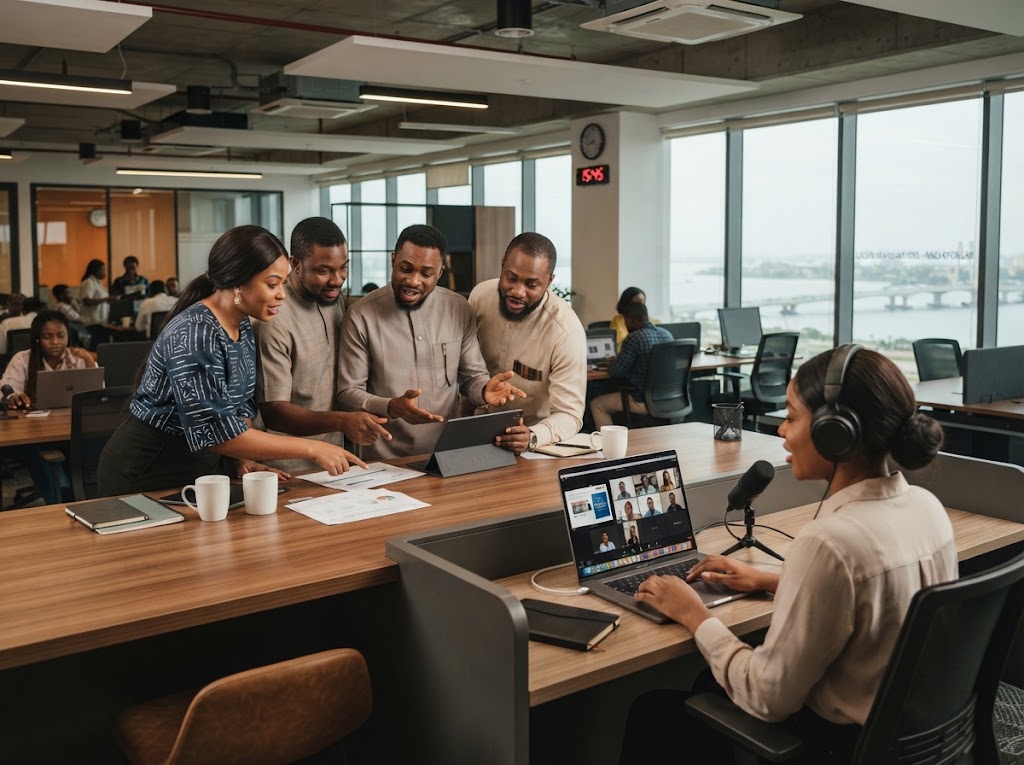







At 4:45 p.m., one employee is already thinking about the journey home. Another is still waiting for a meeting that was supposed to end an hour ago. A third has left the office but continues answering messages on the bus. Meanwhile, somewhere else, a professional is working from home, taking a break in the afternoon and finishing a report later that evening.
They may have the same job title, similar responsibilities and identical salaries. Yet their working lives look nothing alike.
So, what exactly does it mean to have a nine-to-five job today?
Is it the hours you spend at a desk? The results you deliver? The place you work from? Or simply the understanding that your employer owns eight or nine hours of your day?
For generations, the traditional workday has offered a familiar arrangement: arrive at a particular time, work through the day, and leave at a designated hour. It has shaped office culture, transport patterns, family routines and the way people measure commitment.
But technology has changed what can be done outside the office. Remote work has challenged the assumption that productivity requires physical presence. Artificial intelligence is changing how certain tasks are performed. And professionals increasingly have to negotiate the boundaries between being available and actually working.
The nine-to-five may not be disappearing. But the assumptions that made it the default model of professional life are being tested.
The clock is no longer the whole story
For a long time, being seen at work was a convenient way for managers to judge whether work was happening.
If an employee arrived early, stayed late and appeared busy, that visibility could be interpreted as commitment. The system was not perfect, but it offered a relatively simple measure of attendance.
Knowledge work complicates that equation.
A professional may spend three hours solving a problem that saves a company millions. Another may spend ten hours in meetings without resolving it. One employee may produce excellent work remotely; another may struggle without direct supervision.
Hours matter, of course. Many jobs require people to be available at particular times, and some tasks cannot be completed without sustained effort. But time spent working and value created are not always the same thing.
This is one reason flexible schedules have attracted attention.
In its 2023 report Working Time and Work-Life Balance Around the World, the International Labour Organization found that more than one-third of workers globally regularly worked over 48 hours a week. It also reported that working longer than preferred was associated with poorer work-life balance. The report argued for wider consideration of reduced hours and flexible arrangements, while recognising the need for safeguards.
The point is not that everyone should work fewer hours regardless of their responsibilities. It is that the number of hours worked, how those hours are organised and what they produce are three separate questions.
Organisations that treat them as interchangeable may be measuring attendance when they should be measuring performance.
Nigeria has its own working-hours conversation
In Nigeria, the debate cannot simply be imported from countries where remote work, public transport, childcare and employment protections operate under different conditions.
Consider the realities many professionals face: long commutes, unpredictable traffic, rising living costs, family responsibilities, unreliable infrastructure in some locations and the pressure to remain visible to management.
For an employee who spends hours travelling to and from the office, a flexible arrangement can mean more than convenience. It may change how much time, energy and money remain for the rest of life.
But flexibility is not automatically freedom.
A professional working from home may still be expected to attend meetings throughout the day, respond to messages late at night and remain available long after official working hours. In that situation, the office has disappeared, but the workday has expanded into the home.
And there is another complication: not every worker can work remotely. A nurse, factory operator, security officer, retail assistant, driver or hospitality worker may need to be physically present to perform essential duties.
That makes the real question more nuanced than whether everybody should work from home.
Can employers organise work more intelligently without making the burden of flexibility fall unfairly on employees?
Nigeria’s National Bureau of Statistics published working-hours data in its Labour Force Survey reporting. In the report covering the period reflected in the available results, 46.8% of employed Nigerians were recorded as working more than 48 hours a week. That figure describes the survey’s reported working-hours measure; it should not be interpreted as the proportion of formal office employees working overtime.
The wider point is worth considering: for many people, the challenge is not how to escape the nine-to-five. It is how to earn a living without allowing work to consume nearly every available hour.
AI could change the workday but not in the way you expect
Artificial intelligence adds another dimension to this conversation.
Imagine a professional who once spent two hours preparing a first draft, another hour organising research and additional time producing a routine report. With suitable AI tools, some of those tasks might take considerably less time.
What happens next?
There are at least two possibilities.
The employer could use the efficiency gains to reduce unnecessary work, improve the quality of output or give employees more room for strategic thinking.
Or the employer could simply assign more tasks.
The first possibility creates a case for rethinking the workday. The second may create a faster, more demanding version of the same working arrangement.
Technology does not determine which outcome an organisation chooses. Management decisions, business pressures, staffing levels and workplace culture all matter.
This is why predictions that AI will automatically give everyone a shorter workweek deserve caution. Completing a task faster does not necessarily mean an employee’s total workload will fall.
The crucial question is who benefits from the time saved.
If an employee uses AI to complete a report in half the time but is immediately given two additional reports, productivity may have increased without creating any additional personal time.
The future of work will depend not only on what technology makes possible, but also on what employers decide to do with those possibilities.
The four-day workweek: evidence, not magic
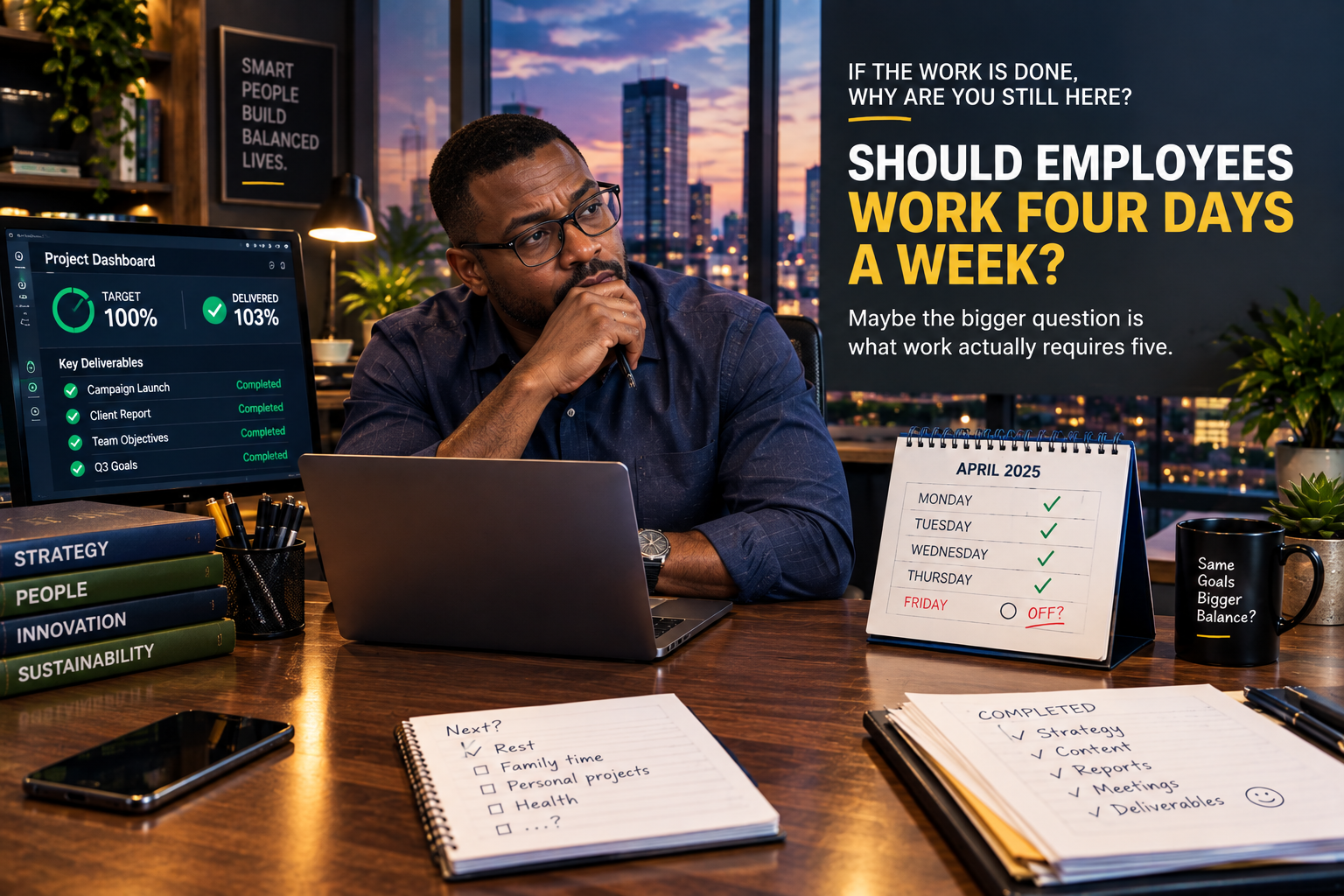
One alternative to the traditional workweek is the four-day model. But even that phrase can mean different things.
Some arrangements compress the usual working hours into four longer days. Others reduce the total number of hours while maintaining pay. These are not identical experiments, and their outcomes should not be treated as interchangeable.
A 2025 study published in Nature Human Behaviour examined a six-month, reduced-hours, four-day workweek intervention across 141 organisations in six countries, involving 2,896 employees. The participating organisations reorganised work before the trial. Researchers reported improvements in burnout, job satisfaction, mental health and physical health compared with patterns observed in 12 control companies.
That is encouraging evidence, but it is not proof that every company can introduce a four-day week without consequences. The participating organisations volunteered for the intervention, prepared for the change and operated in particular national and organisational contexts.
A separate 2024 study of 247 employees in a construction company that moved to a compressed four-day schedule found improvements in work-life balance, reduced fatigue and time pressure, while perceived productivity remained stable after three months. Because the hours were compressed into longer days, the results also illustrate why the details of a schedule matter.
For Nigerian businesses, these findings suggest an opportunity to experiment carefully—not to copy a foreign model without considering local realities.
A bank, a digital agency, a factory and a hospital cannot necessarily organise their working hours in the same way.
The useful starting point is to identify which activities genuinely require continuous coverage, which require collaboration at specific times and which can be completed with greater autonomy.
Then measure the results.
What could replace the nine-to-five?
The future may not produce one universal alternative. It may produce several ways of organising work, depending on the role, industry and needs of the business.
1. Flexible hours
Employees have agreed core hours for collaboration but greater control over when they begin and finish individual work. This can help people manage commuting and personal responsibilities, provided expectations are clear.
2. Hybrid work
Some tasks happen in the office; others happen remotely. The model works best when in-person time has a clear purpose rather than being required simply to prove that employees are working.
3. Output-based work
Employees are assessed against agreed deliverables, quality standards and deadlines, rather than physical presence alone. This requires clear objectives, fair evaluation and realistic workloads.
4. Shorter working weeks
Some organisations may test reduced working hours or four-day schedules. These require careful redesign of work, appropriate staffing and measures of quality and service not merely squeezing five days of tasks into four.
None of these models is automatically superior. A flexible schedule that works beautifully for a consultant may be unsuitable for a customer-service operation that must remain open throughout the day.
The objective should be to match the arrangement to the work, while protecting employees from excessive hours and unclear expectations.
The danger: flexibility can become permanent availability
There is a version of the future of work that looks progressive but feels exhausting.
You can work from anywhere—but you are expected to answer messages everywhere.
You can choose your hours but the deadlines assume that you are always available.
You can leave the office at five but the work follows you home through email, messaging apps and video calls.
In that arrangement, flexibility becomes a transfer of responsibility. The employer gains access to an employee’s time without necessarily taking responsibility for how that time is used.
This is particularly important for professionals who work remotely or across different time zones. Without clear boundaries, the distinction between working hours and personal time can become increasingly difficult to maintain.
The ILO has highlighted the need for appropriate regulation and safeguards around flexible working arrangements, including measures often described as a right to disconnect.
For employers, that means defining expectations around response times, after-hours communication, workload and genuine emergencies.
For employees, it means understanding the terms of their work arrangement and seeking clarity when flexibility starts to mean unlimited availability.
A different schedule should not quietly become a longer workweek.
What should Nigerian employers do now?
Businesses do not have to abolish the traditional workday to prepare for its evolution. They can start by asking better questions about how work is organised.
- Identify what requires presence. Separate tasks that genuinely need employees on-site from those that can be completed elsewhere.
- Measure outcomes. Use quality, timeliness, customer satisfaction and agreed performance indicators alongside attendance.
- Test before making sweeping changes. Pilot flexible start times, hybrid arrangements or compressed schedules where operationally appropriate.
- Protect boundaries. Establish clear expectations for meetings, response times and after-hours communication.
- Make flexibility fair. Ensure that employees whose roles require physical presence are not automatically excluded from every possible benefit, such as predictable schedules or greater control over shifts.
- Review the evidence. Assess productivity, service delivery, costs, employee wellbeing and unintended consequences before deciding whether a model should continue.
For professionals, the adjustment is equally important.
Technical competence remains valuable, but so do independent judgement, communication, collaboration, adaptability and the ability to deliver without constant supervision. As work arrangements change, professionals will need to demonstrate not simply that they are busy, but that their work creates value.
For managers, the challenge is to distinguish an employee who is genuinely productive from one who is merely visible.
And for business leaders, there is a larger strategic question: are working arrangements designed around the needs of the organisation and its people—or preserved simply because that is how work has always been done?
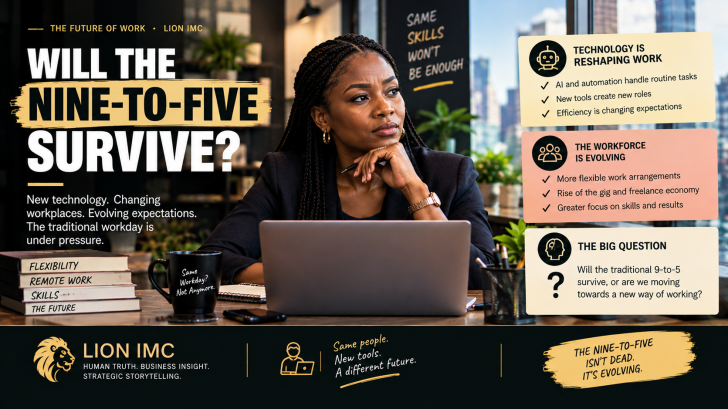
So, will the nine-to-five survive?
Yes, in many workplaces. Fixed hours remain useful where teams need coordinated coverage, customers expect service at specific times, or work depends on physical presence.
But the nine-to-five is unlikely to remain the only model professionals consider legitimate.
Some employees will continue to work traditional office hours. Others will work hybrid schedules, flexible hours, shifts or arrangements organised around deliverables. Some organisations will experiment with shorter weeks; others will find that their operations require a different structure altogether.
The more significant change may be cultural.
For a long time, being at work was often treated as evidence of working. The emerging challenge is to build organisations that can assess contribution more accurately while respecting the human beings doing the work.
That requires more than new technology. It requires thoughtful leadership, sensible policies and the willingness to question assumptions that no longer serve the organisation.
The nine-to-five may survive as a schedule. What deserves closer scrutiny is the belief that time spent at work is always the best measure of work done.
The Lion Take
The future of work is not simply about working fewer hours, working from home or letting AI do more. It is about designing work so that time, talent and technology produce meaningful results—without making constant availability the price of professional success.
The question for employers is not merely whether their employees can finish work faster. It is what they intend to do with the time and capacity that better systems create.
And the question for professionals is not whether they can escape the office clock. It is whether they can build careers in which performance, wellbeing and personal life are not permanently at war with one another.
The Big Question: If you could choose, would you keep the traditional nine-to-five, move to flexible hours, work a four-day week or be assessed primarily on results? And what would your employer need to change to make your preferred model work?