







It was the OECD’s 2023 policy guide explains that credible social-impact measurement requires more than counting activities: organisations need to examine the changes associated with their work, involve affected stakeholders and use evidence to improve decisions.
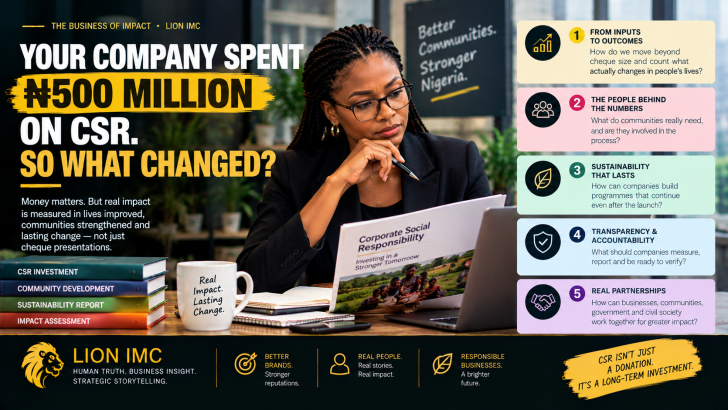
A company spends ₦500 million on corporate social responsibility.
It builds classrooms. Donates medical equipment. Trains young people. Supports small businesses. Provides water to a community. Its annual report carries impressive photographs, carefully worded testimonials and a list of beneficiaries.
At the end of the year, the CSR department presents its report to management.
The money has been spent. The projects have been delivered. The photographs have been taken. The report is ready.
Then somebody asks a question that should have been asked before the first cheque was written.
“So what actually changed?”
Not how much money was spent. Not how many projects were launched. Not how many people attended an event.
What changed in people’s lives because the company made that investment?
Could more children now read confidently? Are patients receiving better care? Have small businesses become more profitable? Is access to clean water more reliable? Are young people earning sustainable incomes months after their training ended?
And, perhaps most importantly, can the company demonstrate any of this?
That is where corporate social responsibility moves beyond expenditure and begins to confront the question of impact.
The problem with celebrating what we spent
Corporate responsibility reports often contain figures that are easy to communicate.
Money invested. Schools renovated. Boreholes installed. Scholarships awarded. People trained. Trees planted. Food packages distributed.
These figures matter. They tell us what an organisation committed and what activities it delivered.
But they do not automatically tell us whether those activities produced the intended change.
Consider a hypothetical company that spends ₦100 million on a vocational training programme for 500 young Nigerians.
Its report might proudly announce that 500 young people were trained.
That is an output: the immediate result of an activity.
But imagine that six months later, only 40 participants have secured paid work or established viable businesses. What happened to the other 460? Did they need more training, access to capital, equipment, mentoring or links to employers? Did the course teach skills that local businesses actually require?
The original figure remains true: 500 people were trained. But it is not enough to establish that the programme achieved its employment objective.
The 40-person example is illustrative, not a real programme result. Its purpose is to show why counting participation and measuring change are different exercises.
The OECD’s guidance on social-impact measurement distinguishes between monitoring direct outputs and assessing the effects of an intervention. It also stresses the importance of using evidence to learn and improve rather than treating measurement merely as an external reporting requirement.
A programme can deliver exactly what it promised to deliver and still fail to achieve the change it was meant to create.
That is an uncomfortable possibility. It is also one of the most important reasons to measure impact.
Three questions every CSR report should answer
A useful way to examine a corporate social investment is to separate three levels of results.
1. What did we put in and deliver?
Inputs and outputs
The budget, staff time, materials, facilities, scholarships, training sessions and people reached. These establish the scale of activity.
Example: 300 farmers received training and agricultural inputs.
2. What changed afterwards?
Outcomes
Whether participants acquired useful skills, adopted better practices, improved access to services, increased earnings or experienced another intended change.
Example: Farmers adopted the recommended practices and experienced measurable changes in yields or income.
3. Did the change last and how much did we contribute?
Longer-term impact and contribution
Whether improvements persisted, whether unintended harms emerged and how much of the observed change can reasonably be linked to the programme rather than other factors.
Example: Farmers sustain improved practices and livelihoods over subsequent seasons, with evidence helping assess the programme’s contribution.
These distinctions matter because social change is rarely simple. A farmer’s income may improve because of a corporate programme, favourable weather, market prices or a combination of factors. A credible evaluation does not automatically claim the entire improvement as the company’s achievement.
The stronger the claim, the stronger the evidence needed to support it.
The community may be measuring something entirely different
There is another complication: the company and the community may not agree on what success looks like.
A business might regard a newly constructed health centre as a major achievement. Residents may be grateful for the building but frustrated that there is no regular medical staff, essential medicine or reliable electricity.
The company can legitimately report that it constructed the facility. But it cannot use the building alone to establish that access to quality healthcare has improved.
The same problem can arise with water projects, school renovations, entrepreneurship training and agricultural support.
A company may select a project because it is visible, straightforward to deliver within a financial year or easy to document in an annual report. The community, however, may prioritise something else entirely.
This is why consultation should not be reduced to inviting community leaders to a launch ceremony.
The people affected need meaningful opportunities to help define the problem, shape the intervention and assess whether it is working.
The OECD’s impact-measurement guidance highlights stakeholder participation and the need to understand the perspectives of people and places affected by an intervention. It also recognises that outcomes such as well-being, social inclusion and community trust can be difficult to capture with a single numerical indicator.
A community is not simply the destination of a CSR budget. Its members are stakeholders whose experiences should help determine whether the investment has delivered value.
What happens after the cameras leave?
Imagine a company that sponsors a digital-skills programme for young people.
The launch is successful. Participants receive certificates, dignitaries deliver speeches and the communications team publishes a series of photographs.
Three months later, the company has moved on to its next initiative.
But have participants found work? Can they access the computers and internet needed to practise their skills? Are employers willing to recruit them? Do they need further support to turn their training into income?
Without follow-up, the company may never know.
This is not an argument that every CSR programme must guarantee a particular outcome. Economic conditions, infrastructure, individual circumstances and other external factors can affect results. Nor should every intervention be expected to transform an entire community immediately.
It is an argument for designing programmes with realistic objectives and a plan to learn what happens afterwards.
For a vocational programme, that could mean checking completion rates, skills gained, employment or self-employment after three and six months, and whether participants are still earning from those skills later.
For a water project, it might mean testing water quality, monitoring functionality, assessing reliability and establishing who will fund repairs.
For a school intervention, it might mean looking beyond the number of classrooms renovated to examine usability, attendance, learning conditions and maintenance.
The launch tells us that something has begun. Follow-up tells us whether it is working.
How should a company measure ₦500 million in CSR investment?
There is no universal formula that can convert every naira of CSR expenditure into a single, comparable impact figure.
A health intervention, a scholarship scheme, a community water project and a small-business support programme produce different kinds of outcomes. A credible measurement system must reflect those differences.
However, every programme can begin with a disciplined set of questions.
| What to establish | The question management should ask |
| The need | What problem did the community identify, and how serious was it before the intervention? |
| The baseline | What was the situation before the programme began? |
| The target | What measurable change did the programme intend to achieve, and by when? |
| The results | What evidence shows that the situation changed? |
| The contribution | What role did the programme play, and what other factors influenced the result? |
| The durability | Did the improvement continue after the initial funding or activity ended? |
| The learning | What should be continued, redesigned, expanded or discontinued? |
The process need not begin with an expensive impact study. Smaller programmes can start with clearly defined objectives, baseline information, participant feedback and simple follow-up measures. More complex or higher-risk interventions may warrant specialist evaluation and independent verification.
The point is proportionality: measurement should be rigorous enough to support the claims being made, while remaining appropriate to the programme’s scale, purpose and resources.
The OECD’s practical guidance recommends an iterative approach: design the change strategy, collect and analyse data, then use the findings to improve decisions and communicate results.
The business case for asking harder questions
Impact measurement is not simply an exercise in satisfying the public or producing a better sustainability report.
It can help a company make better decisions about its own investment.
Suppose a business runs three community programmes. One has strong participation but limited evidence of lasting benefit. Another reaches fewer people but produces sustained improvements. A third struggles because the community was not sufficiently involved in its design.
Without follow-up, management may continue funding all three because their launch reports look impressive.
With better evidence, it can determine which programme to expand, which to redesign and where resources would be more useful.
This can improve the quality of expenditure, strengthen relationships with communities and help the company communicate its work more credibly.
It can also reveal uncomfortable findings: A programme may have underperformed, a target may have been unrealistic or a community may have experienced an unintended consequence.
Those findings are not automatically proof that the investment was wasted. They can be essential to learning what needs to change.
The UNDP’s SDG Impact Standards approach encourages enterprises to integrate impact considerations into strategy and decision-making, including understanding stakeholder needs and considering both positive and negative effects. The standards were also the focus of impact-management training delivered to Nigerian enterprises in 2023.
For a business, the goal should not be to make every CSR report look successful. It should be to make every investment decision better informed.
The communications trap: when reporting becomes the objective
There is a particular risk for corporate affairs, public relations and sustainability teams.
When leadership expects a steady stream of positive stories, communications professionals may find themselves under pressure to showcase activities that photograph well and produce impressive numbers.
A cheque presentation is easy to document. A newly commissioned building is easy to photograph. A crowd at a training event is easy to count.
Changes in household income, improved learning outcomes, reduced disease burden or stronger community trust can take much longer to establish.
If communications priorities dominate programme design, organisations may end up optimising for visibility rather than results.
The answer is not to stop telling stories. Human stories can make complex outcomes understandable and show what change means in people’s lives.
The answer is to connect those stories to evidence.
If a company says its programme helped a business owner expand, it should explain what the programme provided and what evidence supports the reported progress. If it says a community intervention improved access to water, it should show how access was assessed. If the results are mixed, the report should say so.
A photograph can illustrate an outcome. It cannot establish the outcome on its own.
And communications teams should not be left to manufacture confidence around programmes that were never designed to measure their results.
Impact should shape the story the company tells not be invented to make the story sound better.
Five questions every board should ask about CSR
Before approving another major community investment, directors and senior management should ask:
- What specific problem are we trying to solve? Is the investment aligned with a demonstrated need and our organisation’s responsibilities?
- How will we know whether it worked? Have we defined outcomes and a baseline before spending the money?
- Have the affected people helped shape the programme? What did they identify as priorities, and how will they provide feedback?
- What happens after our funding ends? Who owns the project, maintains the assets or sustains the benefits?
- What will we do if the evidence shows that the programme is not working? Are we prepared to change course rather than defend an underperforming initiative?
These questions turn CSR from a periodic philanthropic exercise into a more disciplined approach to social investment.
They also help management distinguish between an initiative that is simply visible and one that is delivering meaningful value.
The real meaning of ₦500 million
Return to our hypothetical company.
It has spent ₦500 million on CSR. That amount may have funded important work. It may have helped families, strengthened livelihoods, improved access to essential services or supported communities in ways that deserve recognition.
But the amount spent does not answer the question of what changed.
To answer that, the company needs to know what the situation was before the intervention, what happened during and after it, how affected people experienced the programme, and what evidence supports its conclusions.
Sometimes the results will be impressive. Sometimes they will be mixed. Sometimes the organisation will discover that a programme needs to be redesigned.
All three findings can be valuable provided the company is willing to learn from them.
The standard should not be whether the annual report contains enough photographs or whether management can point to a large expenditure figure.
The standard should be whether the organisation can explain, credibly and transparently, what its investment achieved, what remains unresolved and what it intends to do next.
Because corporate responsibility is not measured by the size of the cheque alone.
It is measured by the change that cheque helped make possible and the evidence that the change is real.
The Lion Take
CSR expenditure tells us what a company committed. Project counts tell us what it delivered. Impact evidence helps us understand what changed.
Responsible organisations need all three, but they should never confuse one for another.
The cheque is the beginning of the accountability not the end of the story.
The Big Question
If your company had to justify every naira in its CSR budget to the communities it serves, what evidence could it show beyond the amount spent and the number of people reached?