






The finance director walks into the executive meeting with numbers nobody wants to see.
Revenue is down. Operating costs have climbed. Customers are spending more cautiously, suppliers are demanding better terms, and management is under pressure to protect cash flow.
Then comes the familiar recommendation: cut costs.
Travel is reviewed. Recruitment is slowed. Marketing budgets are questioned. Projects without immediate financial returns are placed under scrutiny.
And then somebody raises the corporate social responsibility budget.
The company has been funding a community health programme, supporting vocational training for young people and maintaining a water project in a neighbouring community. There is also an annual donation to a local school and a sustainability initiative that management proudly featured in its last corporate report.
The question is straightforward: can the business continue to afford these commitments?
But there is another question management should ask before reaching for the scissors.
When a business is struggling, should the first response be to cut CSR or to reconsider what the company is funding, why it is funding it and what those investments actually achieve?
It is a difficult question because both sides have legitimate concerns. A company cannot responsibly spend money it does not have. But abandoning meaningful commitments simply because they do not produce immediate revenue may create costs that do not appear on the next financial statement.
The challenge is not to protect every CSR expense at all costs. It is to distinguish the investments that still matter from the activities that can be redesigned, reduced or paused.
When CSR becomes the easiest budget to cut
CSR budgets can become vulnerable during financial pressure for a simple reason: their returns are often less immediate and less straightforward to quantify than sales, production or distribution expenditure.
A sales manager can point to revenue. A procurement manager can demonstrate a reduction in supplier costs. A production manager can identify savings from improved efficiency.
But what is the immediate financial return on a community scholarship, a health intervention or a long-term environmental programme?
Sometimes the value is measurable in direct terms. Sometimes it emerges over several years through improved relationships, reduced risks, stronger local capabilities or better environmental outcomes. Sometimes the programme may not be producing the intended results at all.
When organisations cannot explain that value clearly, CSR can be treated as discretionary expenditure rather than a strategic investment.
This is where the problem begins. If management cannot distinguish between a programme that creates meaningful value and one that merely consumes money, both can end up on the same chopping block.
That is not sound cost management. It is a sign that the company may not have evaluated its CSR portfolio adequately.
What happens when companies face a downturn?
Research into previous economic crises offers useful insights, although it does not provide a universal rule for every company or every recession.
A 2015 study published in Long Range Planning, examining the 2008–2009 global recession, explored how organisations responded to economic pressure. The researchers distinguished between tactical CSR activities, which are relatively short-term and transactional, and strategic CSR activities, which involve longer commitments and deeper organisational changes. Their analysis suggested that strategic and tactical activities could be affected differently by economic conditions.
Another study, published in Finance Research Letters in 2018, examined CSR investments during the Great Recession. It found that companies reduced investment in five categories, community, employee, environment, human rights and product-related activities while increasing investment in corporate governance and diversity. The findings suggest that businesses may protect some priorities while reducing others when resources become constrained.
These studies examined historical periods and particular sets of companies. They do not establish that every organisation should preserve its CSR budget or that every CSR programme improves business performance.
They do, however, raise an important management question: when resources become scarce, are companies making deliberate choices about impact—or simply cutting whatever is easiest to remove?
That distinction matters.
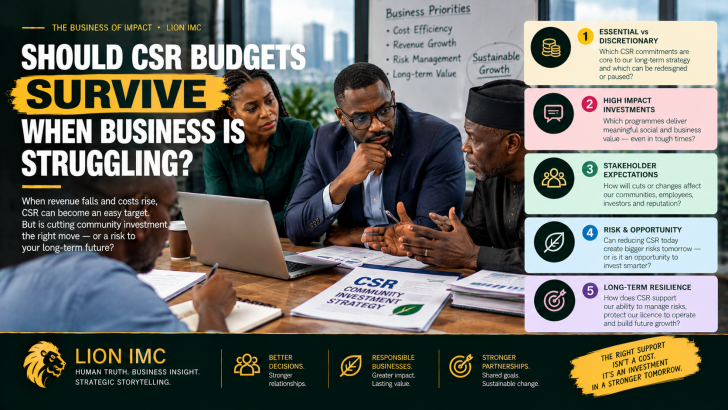
Five questions to ask before cutting the CSR budget
1. Is the programme essential, strategic or discretionary?
Not every CSR activity has the same importance. A recurring donation with limited evidence of impact may be suitable for review. A programme addressing a significant impact associated with the company’s operations may require a very different response.
Management should identify which activities are tied to material risks, stakeholder commitments, regulatory obligations or long-term business priorities. Those considerations should not be casually grouped with optional events and one-off sponsorships.
2. Who will bear the consequences of the cut?
A budget reduction may look harmless on a spreadsheet but have serious implications for the people who depend on the programme.
Will a clinic lose essential supplies? Will trainees be left midway through a course? Will a water facility become unusable because maintenance funding has disappeared?
Before changing a commitment, the company should understand who will be affected, how severely and whether alternatives exist.
3. Can the programme deliver more value with less money?
Financial pressure can expose inefficiencies that went unnoticed during better times.
Could the company collaborate with another organisation, redesign procurement, reduce administrative overheads, phase an expansion or focus on the activities producing the strongest outcomes?
A programme that needs redesign does not necessarily need to be abandoned. Equally, a programme that consistently fails to deliver its intended results should not be protected simply because it has existed for years.
4. What risks could the decision create?
Companies should consider more than the immediate cash saved.
Could the decision undermine a relationship with a host community? Interrupt a programme on which vulnerable people rely? Damage employee confidence? Increase the likelihood of conflict or create concerns about an unfulfilled commitment?
These outcomes are not inevitable. They are risks to assess alongside the financial benefits of reducing expenditure.
5. Have the people affected been consulted?
Management may understand the company’s financial position, but it may not fully understand the consequences of a proposed change for a community or programme partner.
Speaking to affected stakeholders before making major changes can reveal options the company has overlooked. It also gives the organisation an opportunity to explain its constraints honestly and discuss realistic alternatives.
The business case for preserving trust
There is evidence that responsible corporate behaviour can matter during a financial crisis.
In a 2017 study published in The Journal of Finance, researchers examined 1,673 non-financial firms during the August 2008–March 2009 financial crisis. Firms with higher CSR intensity experienced stock returns that were four to seven percentage points higher than those of firms with lower CSR intensity during the period studied. The researchers also reported stronger profitability, growth and sales per employee among the higher-CSR firms.
These are associations observed in a particular sample and historical crisis, not proof that maintaining any individual CSR programme will improve a company’s performance. The results should not be turned into a promise of financial returns.
Still, the research supports an important consideration: relationships and trust built before a crisis may matter when businesses encounter uncertainty.
Employees, customers, suppliers and communities do not stop being stakeholders because revenue has fallen. In some cases, financial pressure may make their concerns more urgent.
A business that has maintained meaningful relationships may find it easier to have difficult conversations, understand stakeholder expectations and work collaboratively through a challenging period.
But trust is not a blank cheque. Communities should not be expected to accept every corporate decision simply because a company previously supported them. The relationship must be sustained through honest communication and responsible conduct.
Not all CSR spending deserves protection
There is a danger in making the opposite argument too strongly.
CSR should not be treated as sacred expenditure that management is forbidden to review. A programme may be poorly designed, disconnected from genuine needs, difficult to sustain or ineffective despite repeated investment.
A company facing serious financial distress may need to reduce, defer or suspend some activities. Protecting jobs, maintaining essential operations and meeting obligations to creditors and suppliers can also have profound social consequences.
The goal is not to spend money for the sake of appearing generous.
It is to make informed decisions about which activities deliver meaningful value, which commitments cannot responsibly be abandoned and which expenses should change.
Consider three hypothetical situations:
Preserve or protect
An essential community water facility
The company has helped establish a water facility used by nearby residents. Routine maintenance is needed to keep it functioning. Cutting all maintenance funding could leave the facility unusable.
A better response: protect essential maintenance where feasible, explore shared management or alternative funding, and agree on a realistic plan with the community.
Redesign
A vocational programme with weak outcomes
The company funds annual training, but follow-up data show limited evidence that participants are securing employment or starting viable businesses.
A better response: review course relevance, employer partnerships, participant selection and post-training support before deciding whether to continue, modify or discontinue the programme.
Consider pausing
A costly one-off sponsorship
The company funds a high-profile event that produces publicity but has little demonstrated connection to its CSR objectives or intended beneficiaries.
A better response: consider pausing or reducing the sponsorship, then redirect resources towards better-evidenced priorities if the business case and budget permit.
These examples are illustrative, not assessments of specific Nigerian companies. The right decision depends on the facts, the severity of the financial pressure, the commitments already made and the consequences of changing them.
What if the company itself is struggling to survive?
This is where the discussion becomes especially difficult.
Imagine a business that is struggling to pay suppliers, meet payroll or keep its operations running. Its CSR team has planned several community projects for the coming year.
Should the company continue spending money on those projects while its financial position deteriorates?
There is no responsible universal answer.
If continuing the programme would threaten the company’s ability to meet essential obligations, management may have to scale back or suspend it. A company cannot create a sustainable social contribution by ignoring the financial conditions necessary for its own survival.
But the way the decision is made still matters.
The company should distinguish between projects not yet started and commitments already made. It should assess whether essential services would be disrupted, whether another partner can take over, whether funding can be phased and whether affected stakeholders can be given adequate notice.
Where a programme must be paused, clear communication is preferable to silence. The company should explain what has changed, what it can still deliver and whether there is a realistic path to resuming the work.
And where its own operations are creating adverse impacts on people or the environment, management should not assume that cancelling a charitable programme resolves those underlying responsibilities. Responsible business conduct requires attention to the impacts of the business itself, not only its voluntary community investments.
A financial crisis may justify difficult decisions. It does not make every decision equally responsible.
The communications mistake: announcing the cut before understanding the impact
For corporate affairs and PR professionals, a CSR budget review can quickly become a reputation-management exercise.
Management makes the decision. Communications receives the instruction. A statement is prepared explaining that the company is “repositioning its community investment priorities in response to prevailing economic realities.”
The language sounds polished. But it does not answer the questions stakeholders are likely to ask.
Which programmes are changing? Why were they selected? Who will be affected? What happens to existing commitments? What alternatives were considered? Is this a temporary adjustment or a permanent withdrawal?
Communications cannot resolve those questions through wording alone. The answers must come from the underlying decision-making process.
This is why PR should be involved before the announcement not merely when management is ready to explain the cut.
The communications team can help identify stakeholder concerns, assess the likely consequences of different options, coordinate engagement with affected groups and ensure that the company does not promise more than it can deliver.
It should also challenge language that disguises a reduction as progress. If the company is suspending a programme, it should say so clearly. If it is redesigning the programme, it should explain what will change.
Credibility depends not on making every decision sound positive, but on helping people understand the decision and its implications.
A practical framework for the boardroom
Before approving CSR budget cuts, management can assess each programme against five questions:
| Decision test | What management should establish |
|---|---|
| Impact | What measurable social or environmental outcome does the programme deliver? |
| Responsibility | Is it connected to significant business impacts, formal commitments or essential services? |
| Financial resilience | Can it continue within a revised budget without undermining the company’s viability? |
| Stakeholder consequences | Who will be affected by a reduction, and what alternatives are available? |
| Evidence and accountability | What information supports the decision, and how will it be explained and reviewed? |
The result should not automatically be a protected budget or a list of cuts. It should be a defensible set of decisions: preserve where necessary, redesign where possible, scale back where justified and pause where continuation is not viable.
The company should also establish when those decisions will be reviewed. A temporary cash-flow problem may require a different response from a structural decline in the business.
Most importantly, the review should be based on actual financial and impact information not on the assumption that every CSR activity is expendable or that every existing programme deserves to continue.
The question is not whether CSR is affordable. It is what responsible spending looks like.
When business is thriving, it can be tempting to treat CSR as an annual budget, a collection of community projects or an opportunity to tell a positive corporate story.
Financial pressure forces a more searching question: which activities matter enough to justify scarce resources, and what evidence supports that judgement?
Some programmes will survive the review because their benefits, commitments or risks justify continued investment. Others will need to change. A few may have to stop.
That is not necessarily a failure of CSR. It can be an opportunity to move away from activity for activity’s sake and towards more deliberate, measurable and responsible investment.
But the review must be honest about its purpose. If a company cuts an ineffective programme and redirects resources towards a better intervention, that may be sound management. If it abandons a meaningful commitment simply because the benefits are less visible than immediate cost savings, it may be overlooking important consequences.
The strongest companies will not necessarily be those that spend the most on CSR during difficult times. They will be those that understand what their investments achieve, recognise the people affected by their decisions and make changes without pretending that the consequences do not exist.
A struggling business may need to spend less. It should still have a clear understanding of what—and whom—it is choosing to stop supporting.
THE LION TAKE
When business is struggling, CSR should face scrutiny not an automatic death sentence.
Protect what is essential. Redesign what is ineffective. Reconsider what delivers little value. Communicate honestly when a commitment must change.
The goal is not to preserve a budget line. It is to make responsible decisions about the business, its stakeholders and the long-term consequences of its choices.
THE BIG QUESTION
If your company’s revenue fell sharply tomorrow, which CSR commitments would you protect, which would you redesign and which would you pause and what evidence would justify each decision?