







Communities rarely judge a company by its mission statement alone. They judge it by whether it listens, honours its commitments and responds when its operations affect their lives.
A company can have an impressive corporate social responsibility report, a generous community development budget and a communications team capable of securing national media coverage. Yet, if the people living beside its operations feel ignored, exploited or excluded from decisions that affect them, its reputation may be far more fragile than management realises.
The reverse is also possible. A company that listens early, communicates honestly and follows through on its commitments can build relationships that help it navigate difficult periods.
This is why community engagement is not simply a CSR activity or a public relations assignment. It is part of how a company earns the trust of the people who live with the consequences of its presence.
A company can be popular in the boardroom and unpopular next door
Imagine a manufacturing company expanding its operations in a Nigerian community.
The investment promises jobs, supplier contracts and economic activity. Management announces the expansion as evidence of growth. The company prepares a media campaign and plans a community donation.
But residents have questions.
Will the expansion increase traffic? Could it affect water sources? Will local people have access to the new jobs? Who will respond if operations cause disruption? Were community representatives consulted before the major decisions were made?
If the company announces its plans without creating a credible way to hear and address these concerns, it may discover that the story it wants to tell is not the story the community is telling.
The company sees investment and opportunity.
Residents may see uncertainty and risk.
Neither perspective should simply be dismissed. The company’s commercial objectives matter, but so do the interests and rights of people affected by its activities.
Community engagement helps an organisation understand that gap before it becomes a larger problem.
The Nigerian lesson: community relations cannot be reduced to donations
Nigeria’s oil-producing communities provide a particularly important context for understanding this issue.
Research published in Corporate Social Responsibility and Environmental Management by Uwafiokun Idemudia and Uwem E. Ite examined corporate–community relations in the Niger Delta. Their 2006 study argued that CSR policies and community programmes had failed to resolve conflict partly because companies did not adequately understand or incorporate community perceptions into their decisions.
A later study by Idemudia, published in Resources Policy in 2009, compared corporate–community involvement strategies in Nigeria’s oil industry. It found that different programme structures had advantages, but both approaches faced limitations affecting their contribution to community development.
These studies focus on the oil industry and should not be treated as proof that every Nigerian company faces identical problems. But they illustrate a broader lesson: spending money on a community is not the same as building a functioning relationship with it.
A scholarship may support a student. A health outreach may provide a useful service. A road project may improve access. Those contributions can matter.
But they do not automatically answer questions about how decisions are made, how complaints are handled, whether commitments are honoured or whether affected people have meaningful influence over the issues that concern them.
The relationship is built through what happens before, during and after the project.
Five ways community engagement shapes corporate reputation
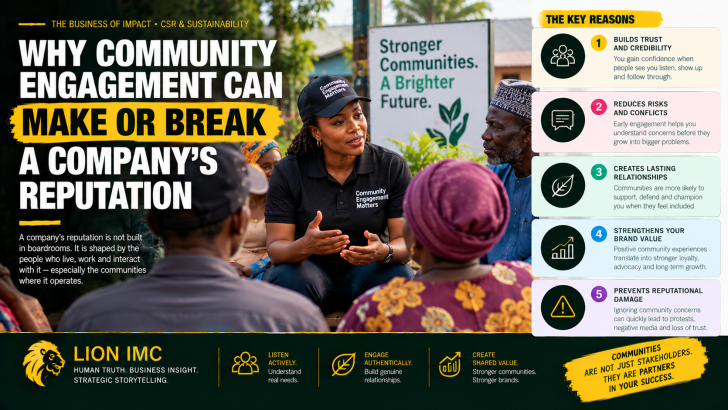
1. It builds trust before the company needs it
Trust is easier to build through consistent conduct than through an emergency publicity campaign.
When a company communicates regularly, explains its plans, listens to concerns and follows through on commitments, community members have reasons to take its assurances seriously.
A Nigerian study published in the Nigerian Academy of Management Journal in 2020 examined transparent stakeholder involvement and corporate credibility among oil firms in the Niger Delta. Based on responses from 301 participants across 10 host communities, it reported a positive relationship between transparent stakeholder involvement and corporate credibility, including trustworthiness and advocacy.
Nigerian Academy of Management Journal
The findings are specific to the study’s context and design; they do not prove that engagement guarantees trust everywhere. They nevertheless support the practical importance of transparency in company–community relationships.
The implication for businesses is straightforward: do not wait until a dispute arises before introducing the people who live around your operations to the people responsible for making decisions.
2. It reveals problems that internal reports may miss
A company can have excellent internal reporting and still misunderstand what is happening outside its offices.
A community may be concerned about a change in access roads, the conduct of contractors, recruitment practices, noise, environmental effects or the distribution of local economic opportunities.
Some concerns may be based on incomplete information. Others may reveal real operational risks. Without a credible channel for listening, management may not know which is which.
Meaningful engagement provides another source of information. It helps the organisation test its assumptions, identify emerging issues and investigate complaints before they become more difficult to resolve.
The OECD’s guidance on meaningful stakeholder engagement in the extractive sector emphasises that engagement should help companies understand stakeholders’ concerns and integrate relevant information into decisions.
Listening does not mean agreeing with every demand. It means taking concerns seriously enough to assess them and explain the outcome.
3. It can reduce the risk of conflict and disruption
Community concerns can become operational issues when they remain unresolved.
A disagreement about employment, access, environmental effects or an unfulfilled commitment may escalate into protests, damaged relationships, project delays or legal disputes. Not every disagreement will escalate, and engagement cannot eliminate all conflict. But early, credible dialogue can create opportunities to address issues before they become harder to manage.
This is particularly important for businesses whose operations depend on land access, local infrastructure, supply chains or sustained relationships with host communities.
The OECD’s responsible-business guidance highlights the importance of identifying adverse impacts, engaging affected stakeholders and providing effective grievance mechanisms.
For management, the question is not merely how much a community engagement programme costs.
It is also what the organisation risks by failing to understand and address legitimate concerns.
4. It gives CSR programmes a better chance of being relevant
Companies sometimes design community projects around what they can readily provide, what fits an existing budget or what will produce a strong photograph.
But the most visible project is not necessarily the most useful one.
A community may need vocational training linked to actual employment opportunities, while a company offers a programme that trains participants for jobs that do not exist locally. A business may fund a facility without establishing who will maintain it. A scholarship programme may attract attention but overlook other barriers preventing children from attending school.
Engagement can help the company identify priorities, understand constraints and involve affected people in defining success.
That does not mean the community must control every business decision. It means the company should not assume it understands local needs simply because it has allocated money to address them.
The strongest community programmes begin with a problem worth solving, not a photograph worth publishing.
5. It helps protect reputation when something goes wrong
No organisation can guarantee that its operations will never cause disruption or that every stakeholder will always agree with its decisions.
What matters is how the company responds.
If a company has established credible communication channels, knows who represents different stakeholder interests and has a process for handling complaints, it has a stronger foundation for investigating concerns and explaining what it will do.
If it has ignored the community until a crisis erupts, even a technically accurate statement may be received with suspicion.
A history of reliable engagement does not buy immunity from criticism. Nor should it. But it can give a company a more credible starting point when it needs to explain a difficult decision, acknowledge harm or negotiate a remedy.
Reputation is shaped not only by whether problems occur, but by whether people believe the organisation is acting honestly and responsibly when they do.
Community engagement is not a meeting with a few influential people
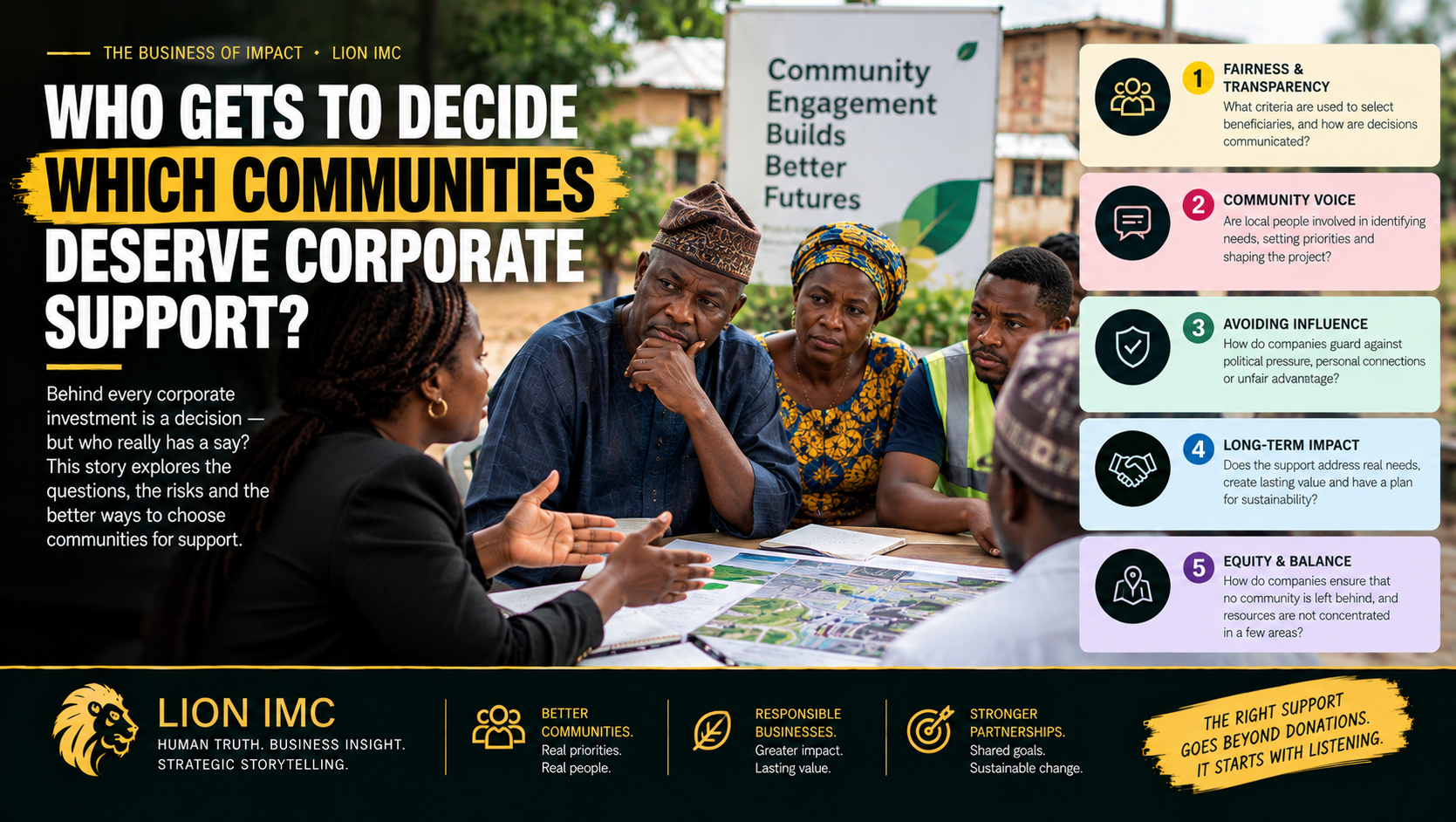
One of the easiest ways for a community engagement process to fail is to mistake access to prominent individuals for an understanding of the whole community.
Traditional rulers, community leaders, elected representatives, youth groups, women, business owners, employees, people with disabilities and other residents may have different interests and experiences.
No single person necessarily speaks for everyone.
A company that consults only the people easiest to reach may miss the concerns of groups with less influence or fewer opportunities to participate. It may also become vulnerable to disputes over who was consulted, who benefited and whose views were excluded.
Meaningful engagement should therefore consider:
- Representation: Who is affected, and whose perspective is missing?
- Accessibility: Can people participate safely and practically?
- Transparency: Do stakeholders understand what is being proposed and what remains undecided?
- Two-way communication: Can people raise concerns and receive meaningful responses?
- Follow-through: Are commitments tracked, and are changes communicated?
OECD guidance on stakeholder engagement stresses that effective processes should be timely, accessible, responsive and genuinely interactive, rather than simply providing information after decisions have already been made.
The goal is not to hold more meetings for the sake of holding them. It is to make engagement useful to the people involved and relevant to the decisions being made.
What companies should measure beyond the number of meetings
Community engagement reports often count activities: meetings held, participants reached, complaints received, projects funded or newsletters distributed.
These figures can be useful, but they do not establish whether the relationship is improving.
A more meaningful assessment might ask:
| Measure | What management should find out |
| Participation | Were the affected groups able to take part, including people whose voices are often overlooked? |
| Responsiveness | How many concerns received a substantive response within the stated timeframe? |
| Resolution | Were complaints resolved, referred appropriately or left outstanding? |
| Commitment delivery | Were agreed actions completed, and if not, why? |
| Relationship quality | Do stakeholders believe the company listens, communicates honestly and treats them fairly? |
| Community outcomes | Did the relevant intervention produce the intended change? |
| Learning | What did the company change because of what it heard? |
These measures should be tailored to the company’s operations and the community’s circumstances. A company should not claim that trust has improved simply because it held more meetings or received fewer complaints. Fewer complaints might reflect improvement, but they might also reflect a lack of confidence in the reporting process.
The important thing is to combine activity data with evidence of responsiveness, outcomes and stakeholder experience.
Who inside the company owns the relationship?
Community engagement can fall between departments.
The CSR team may manage development projects. Corporate affairs may handle communication. Operations may control the activities generating local concerns. Human resources may oversee recruitment. Legal may manage disputes. Senior management may make the decisions that affect all of them.
If these functions do not coordinate, the company may make promises that operations cannot fulfil, announce programmes before funding is secured or communicate one position while another department takes a conflicting action.
Community engagement therefore needs clear accountability.
A workable approach is for the company to identify who owns the relationship, who is responsible for specific commitments, how issues are escalated and how affected departments share information. Senior management should receive reports not only on completed projects but also on unresolved concerns and risks that require decisions.
Communications professionals have an important role here, but their role is not simply to make the company look good. They can help establish dialogue, identify stakeholder expectations, explain decisions and ensure that concerns reach the people with authority to act.
The communications team cannot build lasting trust on behalf of an organisation that refuses to change its behaviour.
The real test begins after the meeting ends
A community meeting may end with handshakes, photographs and assurances that the company values its neighbours.
The relationship is tested afterwards.
Does the company do what it promised? Does it explain delays? Can residents raise new concerns without fear of being dismissed? Are decisions revisited when the evidence changes? Does the organisation acknowledge when its own actions have caused harm?
These questions matter more than the appearance of agreement at the end of a meeting.
Community engagement is not a one-off event designed to secure approval for a project. It is an ongoing process of listening, explaining, responding and adapting.
And sometimes the process will reveal disagreement that cannot be resolved immediately. That is not necessarily a failure. A respectful relationship can accommodate disagreement when people understand the issues, the process is fair and commitments are handled transparently.
The aim is not to make every community member a supporter of the company.
It is to make sure that the organisation understands the people affected by its presence and responds to them responsibly.
THE LION TAKE
A company’s reputation is shaped in places its board may rarely visit: the neighbourhood around its factory, the community beside its project site, the market where its products are sold and the homes affected by its operations.
Community engagement cannot guarantee approval or prevent every conflict. But ignoring affected people can leave a company blind to the concerns that matter most to them.
For Nigerian businesses, the lesson is bigger than CSR budgets or public relations campaigns. Community relationships should be treated as part of responsible management, with clear accountability, honest communication and evidence that commitments are being honoured.
Do not ask only what the company wants the community to understand. Ask what the company needs to understand about the community.
That is where meaningful engagement begins.
THE BIG QUESTION
If a company spends millions on community projects but makes major decisions without listening to the people affected, can it honestly claim to have a strong community relationship?