






A company has ₦50 million to spend on community development.
One community wants a healthcare centre. Another needs reliable water. A third is asking for vocational training and jobs for its young people. Somewhere else, a local organisation has submitted a proposal for a school renovation.
The company cannot fund everything.
So who gets to decide?
The board may favour a project that aligns with its sustainability strategy. The CSR team may recommend the community with the strongest proposal. Government officials may have their own priorities. Traditional leaders may advocate for their people. A well-connected individual may know exactly whom to call.
And the communities themselves? They may discover what has been decided only when the project is announced.
This is one of the less discussed questions in corporate social responsibility: when a company decides who deserves support, whose definition of need actually counts?
Because allocating a CSR budget is not simply a matter of generosity. It is an exercise of power. It determines which needs receive attention, which voices influence decisions and which communities must continue waiting.
The problem with deciding for people
Imagine a company operating across several communities in the same state.
Its CSR team identifies a school renovation project as an attractive opportunity. The photographs will be compelling, the results will be visible and the project can be completed within the financial year.
But the people living in the proposed beneficiary community have a different concern. Their children already have access to a school, albeit one that needs improvements. What they urgently need is safe drinking water.
The company proceeds with the renovation.
It has delivered a project. It may have spent its budget appropriately. It may even have improved learning conditions.
Yet an important question remains: did it address the community’s most pressing need?
The point is not that school renovation is a bad investment. It is that a project can be well executed and still be poorly prioritised.
This is where CSR decision-making becomes more complicated than selecting a worthy cause. A company must decide not only what it can afford to do, but also how it determines what should be done in the first place.
And those are two different questions.
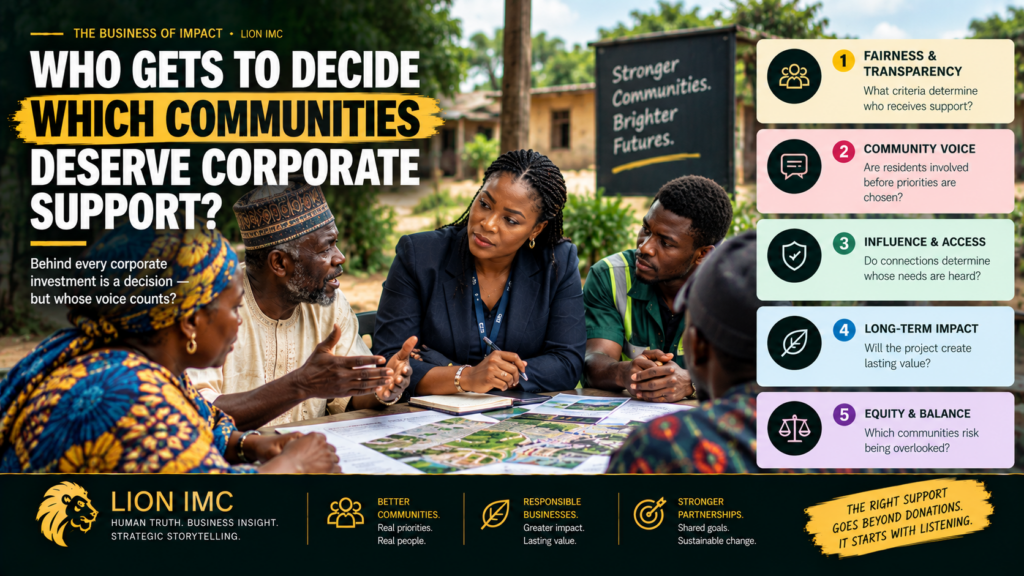
Five forces that can shape who receives corporate support
1. The company’s business priorities
Businesses have legitimate reasons to consider where they operate, where their activities create significant impacts, which communities face particular risks and which interventions align with their capabilities.
A company may reasonably prioritise a community affected by its operations or invest in skills that support local economic development.
The difficulty arises when business convenience becomes the only measure of need. A project that is easy to execute or photograph is not automatically the most valuable one.
2. The people who already have access to decision-makers
Traditional leaders, local officials, influential residents and established organisations can play important roles in identifying needs. They can also help companies understand local context.
But access and representation are not the same thing.
The person who submits the most polished proposal may not represent the people with the greatest need. A community leader’s priorities may not reflect the concerns of women, young people, people with disabilities or households that are less visible in public meetings.
3. Whose voice counts as evidence?
A formal needs assessment can reveal important gaps, but so can the lived experience of residents.
When companies rely exclusively on documents, official representatives or a small group of familiar contacts, they risk overlooking people whose needs are less organised or less easily expressed in corporate language.
Meaningful engagement means asking people what matters to them, creating opportunities for different groups to contribute and showing how their input influenced the final decision.
4. The absence of clear selection criteria
If a company cannot explain why one community was selected over another, even a well-intentioned decision can create suspicion.
Were the most urgent needs considered? Was the company’s operational impact relevant? Were vulnerable groups included? Could the project be sustained? Were similar proposals assessed using the same standards?
Clear criteria do not eliminate every disagreement. They make decisions easier to explain, challenge and improve.
5. The preference for visible projects
Some projects produce immediate, photogenic results. Others involve less visible but essential work: maintaining existing facilities, strengthening local organisations, training people over time or improving access to services.
When publicity potential influences project selection too heavily, companies may favour what is easiest to showcase over what is most useful.
A ribbon-cutting ceremony can mark a beginning. It cannot, by itself, establish lasting impact.
What the evidence tells us about community participation
This is not just a theoretical concern.
The OECD’s Practical Guidelines for Supporting Locally Led Development, published on 28 May 2026, warns that local actors are often brought into development planning too late, after priorities and budgets have largely been determined. It also notes that consultations can become symbolic when local people have little real influence over decisions.
The distinction is crucial. Inviting residents to a meeting is not the same as allowing their perspectives to shape a decision.
A company can hold a town hall, record attendance, take photographs and publish a report stating that stakeholders were consulted. Yet if the company has already decided which project it will fund, the consultation may have little practical influence.
The OECD’s 2026 progress report on development cooperation similarly highlights the need for more inclusive and substantive stakeholder engagement, including attention to groups that risk being left behind. Its findings draw on reporting from governments, development partners, civil society organisations, trade unions and private-sector representatives across participating countries. These are international development-cooperation findings, not a direct measurement of CSR practices in Nigeria.
For businesses, the lesson is useful: participation should influence priorities, not merely document that a conversation happened.
Does the community always get the final say?
Not necessarily.
A company is not a public treasury with an unlimited obligation to fund every request. It has a defined budget, commercial responsibilities, operational realities and legitimate governance requirements.
A community may request a project that exceeds the available budget. Several communities may identify equally urgent needs. Some proposals may fall outside the company’s expertise. Others may require government involvement or long-term funding that the company cannot responsibly guarantee.
The answer is not to transfer every decision entirely to community representatives.
It is to make the decision-making process more balanced, transparent and evidence-led.
The company should explain its constraints. Communities should have a meaningful opportunity to identify priorities and question assumptions. Relevant public institutions and technical experts can contribute where their responsibilities or expertise matter. Final decisions should be made through a process that clearly defines who has input, who has authority and how the outcome will be communicated.
In other words, community participation does not remove corporate accountability. It improves the information on which corporate decisions are made.
A fairer way to decide who receives support
What would a more credible CSR allocation process look like?
Step 1: Listen before designing the project
Engage a broad range of residents and local organisations before choosing the intervention. Do not limit consultation to the most prominent voices. Ask what people need, what is already available and what has failed in the past.
Step 2: Publish the selection criteria
Explain how proposals will be assessed. Relevant criteria could include urgency of need, number and vulnerability of people affected, connection to the company’s impacts, feasibility, cost, long-term sustainability and potential outcomes.
Step 3: Assess proposals consistently
Use the same basic framework for comparable proposals. Document exceptions and explain why they were necessary. This makes it easier to identify whether influence, convenience or personal connections are distorting the allocation.
Step 4: Explain the decision
Tell communities what was selected, why it was selected and what could not be funded. Provide a way for people to ask questions or raise concerns without having to rely on personal access to company officials.
Step 5: Measure what changed
Track whether the project addressed the identified need, who benefited, what obstacles emerged and whether the benefits continued. Give communities a role in assessing the outcome—not merely appearing in the launch photographs.
These steps do not guarantee that everyone will agree with every allocation. They make the process more defensible and give companies a stronger basis for explaining their choices.
The uncomfortable question: who gets left behind?
Suppose a company supports three communities over five years. Each project is completed and each annual report presents a positive story.
But what if the same communities keep receiving support because they have established relationships with the company, while smaller settlements remain largely invisible?
The total amount spent may be impressive. The number of projects delivered may also be impressive. Yet neither figure reveals how fairly support has been distributed.
This does not mean every community must receive identical funding. Needs differ. Some projects cost more than others, and a community facing a severe problem may reasonably require a larger investment.
Fairness is not necessarily equal amounts for everyone. It is a clear, defensible explanation of why resources are distributed as they are—and whether people with significant needs are being overlooked.
That requires companies to look beyond the projects they have funded and examine the communities they have not reached.
It also requires patience. Some of the most meaningful interventions may take years to produce measurable outcomes. A short-term publicity cycle should not be allowed to dictate the entire development agenda.
When CSR becomes a relationship, not a distribution exercise
The strongest community investment programmes are not simply annual exercises in deciding where to donate money.
They are ongoing relationships between businesses and the people whose lives, livelihoods and environments may be affected by their operations.
The UN Guiding Principles on Business and Human Rights emphasise engaging, wherever possible, with people whose human rights may be directly affected by a company’s activities, or with their legitimate representatives.
That principle matters beyond the immediate question of donations. If a company’s operations affect a community, a charitable project should not be treated as a substitute for addressing adverse impacts or meeting applicable responsibilities.
A company cannot simply fund a school, sponsor a community event or donate medical equipment and assume that the relationship is therefore healthy. The quality of its engagement, the consequences of its operations and its willingness to respond to legitimate concerns all matter.
Corporate support should contribute to community wellbeing. It should not become a way of controlling the narrative about the company’s presence.
For communications professionals, this creates a responsibility that goes beyond announcing beneficiaries. The story should explain how priorities were identified, how decisions were made, what communities contributed and what the investment actually achieved.
That is a much richer story than a photograph of an oversized cheque.
The final decision is about more than money
Return to the company with ₦50 million.
It cannot solve every problem. It cannot satisfy every request. It must make choices.
But it can decide whether those choices are made behind closed doors or through a transparent process. It can decide whether a handful of influential voices dominate the discussion or whether less visible groups are deliberately included. It can decide whether success means delivering a project on schedule or demonstrating that the project addressed a genuine need.
Most importantly, it can recognise that having the money to help does not automatically confer the best understanding of what help should look like.
Companies bring resources, technical knowledge and the ability to execute projects. Communities bring lived experience, local knowledge and an understanding of the challenges they face every day.
Neither perspective is sufficient on its own.
The better approach is to bring them together before the money is committed—not after the photographs have been taken.
Because the real test of corporate support is not simply how much a company gives, how many projects it launches or how prominently its name appears.
It is whether the people whose lives the investment was supposed to improve had a meaningful voice in deciding what improvement should mean.
THE LION TAKE
The power to fund a community should not become the power to decide its priorities without listening.
Corporate support becomes more credible when businesses explain their criteria, include the people affected, acknowledge competing needs and measure outcomes beyond the launch event.
The goal is not to fund everyone equally. It is to make sure that the decision about who receives support is fair, transparent and grounded in genuine need.
THE BIG QUESTION
If your company had to explain to every community it did not select for CSR support why another community was chosen instead, could it defend that decision using clear criteria and credible evidence?