






You have prepared your CV.
You have researched the company.
You know the answers.
And yet, outside the interview room, you suddenly become an actor playing “confident professional.”
Let’s fire.
Absolutely Lion. You can be terrified inside and still walk into the room looking like you have absolutely nothing to worry about. Yes, there is a particular moment before an interview when a perfectly normal human being becomes strangely interested in appearing normal.
You have arrived early.
Perhaps too early.
You have checked your phone.
Checked the address.
Checked your CV.
Checked your phone again.
You have rehearsed your introduction in your head approximately 47 times.
Then you look at yourself.
Straighten your shirt.
Adjust your hair.
Take a breath.
Relax your shoulders.
And suddenly you remember:
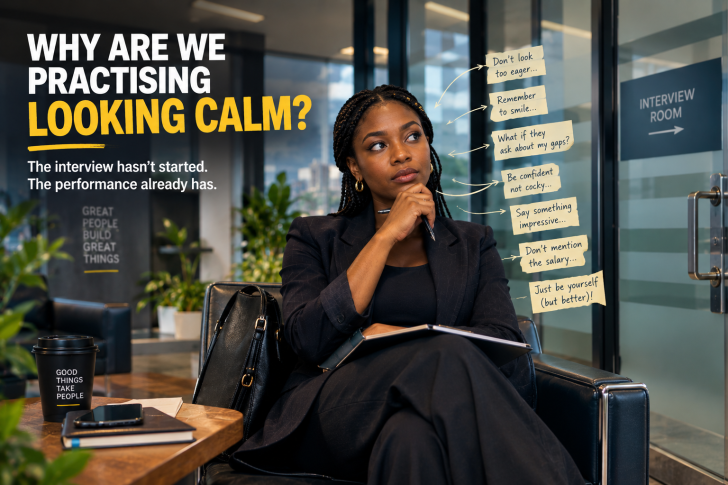
“Don’t look nervous.”
So you practise looking calm.
Not feeling calm.
Looking calm.
You sit there like a person whose heart is not currently conducting a small protest inside their chest.
And if someone walks past and says:
“Good morning.”
You answer:
“Good morning.”
Perfectly composed.
Meanwhile, internally:
“WHAT IF THEY ASK ME ABOUT MY BIGGEST WEAKNESS?”
THE INTERVIEW HAS NOT STARTED. THE PERFORMANCE HAS.
This is one of the funny things about job interviews.
The formal interview may begin when the interviewer says:
“Please, have a seat.”
But psychologically, the interview may have started much earlier.
At reception.
In the waiting room.
In the lift.
At the security desk.
Sometimes even in the car park.
You are suddenly aware of everything.
How you walk.
How you sit.
What you do with your hands.
Whether you are smiling too much.
Whether you are smiling too little.
Whether you should look at your phone.
Whether looking at your phone makes you look busy.
Whether not looking at your phone makes you look nervous.
So you sit.
And wait.
And perform calm.
WHY DO WE DO THIS?
Because interviews are not only about competence.
They are also about evaluation.
Someone is about to form an impression of you.
And humans know, consciously or otherwise, that other people are watching more than our answers.
So we start managing the visible signs of anxiety.
The straightened back.
The controlled breathing.
The composed expression.
The deliberate walk.
The handshake.
The carefully measured:
“Good morning. It’s a pleasure to meet you.”
Meanwhile, your brain is saying:
“Please don’t let me forget my own name.”
THE STRANGEST PART IS THAT WE HAVE ALL SEEN THIS BEFORE
You have probably done it.
But you have also probably watched somebody else do it.
Someone sitting outside an interview room looking extremely serious.
They are not necessarily thinking about strategy.
They may simply be trying to calm themselves down.
Another candidate is quietly reading something on their phone.
Another is staring into space.
Someone is practising answers under their breath.
Someone has suddenly become fascinated by the office décor.
And someone is walking around as if they are already the Managing Director.
Everyone is pretending not to be nervous.
Which means almost everybody knows everybody else is nervous.
And yet we continue the ritual.
THEN COMES THE “CONFIDENT WALK”
There should probably be an entire study devoted to this.
You hear:
“Mr Nwabueze, you can go in now.”
And suddenly your walking style changes.
You don’t want to walk too quickly.
That looks nervous.
You don’t want to walk too slowly.
That looks strange.
You don’t want to look at the floor.
You don’t want to look too intensely at the interviewer.
You don’t want to smile too much.
You don’t want to look too serious.
So you walk at the precise speed of a person who has allegedly been expecting this moment all morning.
Even though 90 seconds earlier you were Googling “how to answer tell me about yourself.”
THE HANDSHAKE DESERVES ITS OWN STORY
Then comes the handshake.
Too weak?
Bad.
Too strong?
Also bad.
Too long?
Now everyone is uncomfortable.
Too short?
Did you even shake hands?
And while all of this is happening, another part of your brain is shouting:
“DON’T SWEAT.”
Which, naturally, makes you more conscious of sweating.
This is the cruel thing about self-consciousness.
The harder you try to control one visible sign of nervousness, the more aware you become of it.
AND THEN THEY SAY:
“TELL US ABOUT YOURSELF.”
After all that preparation.
All those career achievements.
All those rehearsals.
All those carefully prepared answers.
They ask the one question that somehow makes you temporarily forget what a human being is.
“Tell us about yourself.”
You:
“Okay…”
Pause.
“My name is…”
You know your name.
Of course you know your name.
But suddenly introducing yourself feels like an advanced examination.
MAYBE THE CALM PERSON IS NOT ACTUALLY CALM
This is worth remembering.
The person who looks completely composed may be nervous.
The person who speaks confidently may have rehearsed for two hours.
The person who gives a smooth answer may have practised it yesterday.
And the person who looks uncomfortable may actually be extremely competent.
We sometimes mistake visible confidence for actual capability.
They are not the same thing.
Some people are simply better at performing confidence under observation.
Others become more confident once they understand the room.
That distinction matters because interviews can reward presentation skills alongside competence.
Neither is irrelevant.
But they are not identical.
THE INTERVIEWER IS PROBABLY PERFORMING TOO
Here is the funny part.
We talk about candidates as if they are the only people being evaluated.
They aren’t.
The interviewer may also be thinking:
Am I asking good questions?
Did I explain the role properly?
Does this candidate think I’m intimidating?
What if they ask me something I don’t know?
How do I explain the salary?
Should I tell them the team is understaffed?
Did I just interrupt them?
The candidate is performing calm.
The interviewer may be performing authority.
Everybody is doing a little theatre.
AND THEN THERE IS THE “I’M FINE” FACE
Perhaps the most impressive part of the whole exercise is what happens when someone walks past the waiting candidate.
“Are you here for an interview?”
The candidate:
“Yes.”
Smile.
Nod.
Calm.
Professional.
Then the person walks away.
The smile disappears.
Back to survival mode.
😂
WHY THIS LITTLE RITUAL MATTERS
It is easy to laugh at ourselves.
But there is something useful underneath the humour.
An interview is an unusual human situation.
You are being asked to demonstrate your value while knowing that somebody else has the power to decide whether you get an opportunity.
Of course people become self-conscious.
Of course people rehearse.
Of course people try to regulate their nerves.
The problem is not nervousness.
The problem is believing you must eliminate every sign of it.
You don’t.
A little nervousness can simply mean:
This matters to me.
MAYBE WE SHOULD STOP TRYING TO LOOK CALM
Perhaps the better goal is not:
“How do I look completely confident?”
But:
“How do I remain useful while I am nervous?”
Can you listen?
Can you think?
Can you answer honestly?
Can you ask an intelligent question?
Can you admit when you don’t know something?
Can you recover when you stumble?
Can you explain what you have actually accomplished?
Can you remain yourself long enough for another human being to understand who they might be hiring?
That may be a much more useful form of confidence.
Because confidence is not necessarily the absence of nerves.
Sometimes it is the ability to function while the nerves are there.
THE LION TAKE
The next time you see someone sitting outside an interview room looking completely calm, don’t be too impressed.
They may be absolutely terrified.
They may simply be very good at looking calm.
And if you’re the one sitting there practising your “I have got this” face, remember:
You don’t have to look fearless.
You just have to be able to walk through the door.
Take the seat.
Breathe.
Listen.
Think.
Answer.
And let the person on the other side meet the professional underneath the performance.
Because the person who gets the job isn’t the person who looked the calmest in the waiting room.
It is the person who became useful once the interview actually began.