








Let’s say, you are paid ₦1 million a month.
Now imagine that someone hands you a list of everything you do at work.
You answer emails.
You prepare reports.
You attend meetings.
You write proposals.
You analyse data.
You prepare presentations.
You speak to customers.
You solve problems.
You make decisions.
You manage people.
You follow up with colleagues.
You create documents.
You explain things to your boss.
You explain things to your team.
You spend hours doing things that nobody notices until they are not done.
Now remove the job title.
Remove the office.
Remove the laptop.
Remove the prestige.
Look at the individual tasks.
Which of them are actually worth ₦1 million a month?
That may be a more important question than whether artificial intelligence will take your job.
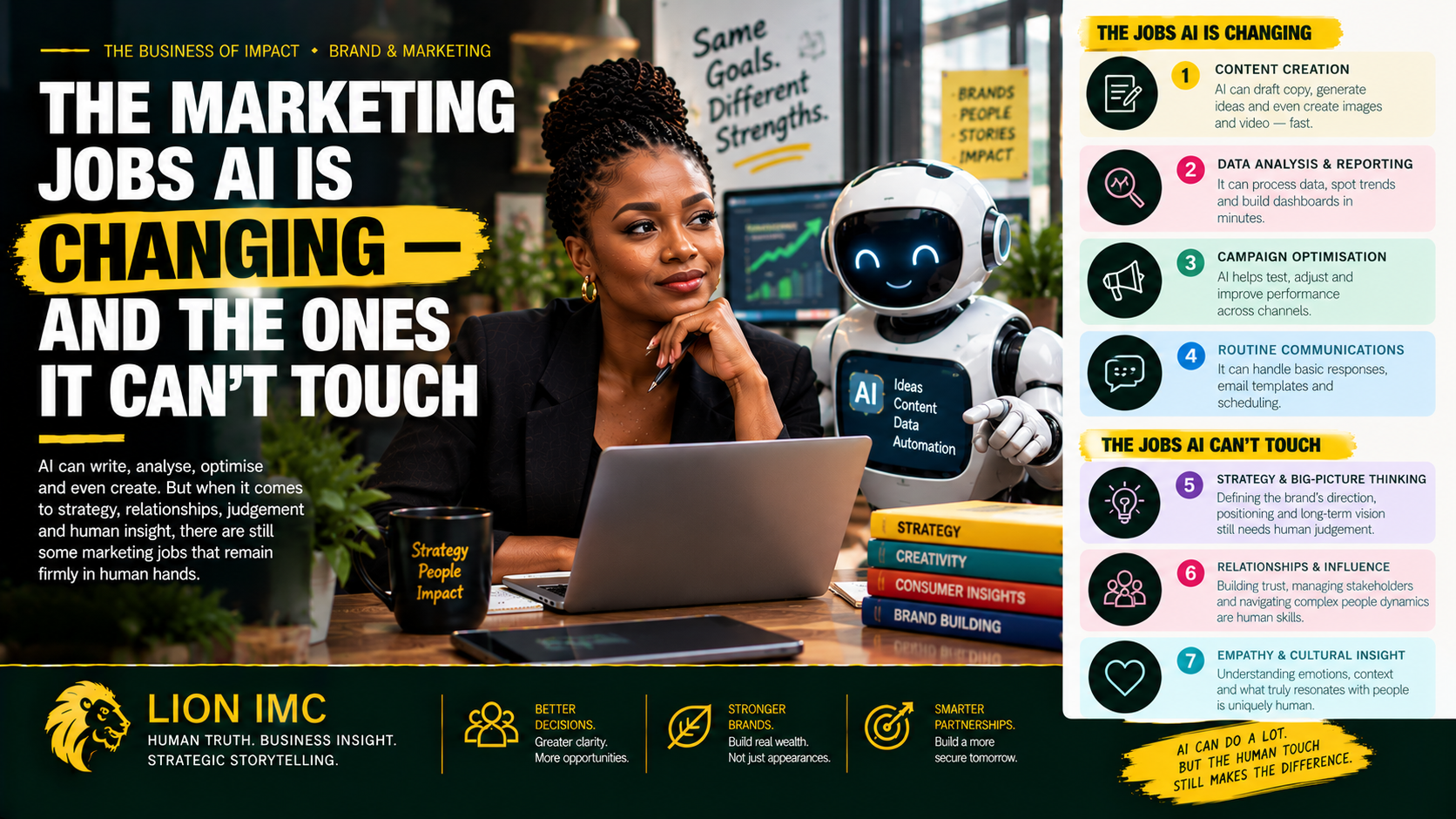
Because AI does not necessarily have to replace your entire job to change the value of your job.
It only has to make some of the work inside it faster, cheaper or easier.
And that is already becoming part of the workplace conversation.
The World Economic Forum’s Future of Jobs Report 2025, based on employers representing more than 14 million workers across 55 economies, expects the human-machine division of work to change substantially between 2025 and 2030. Employers surveyed expect the proportion of tasks performed mainly by humans alone to fall, while technology-only work and human-machine collaboration increase.
That changes the question.
Instead of asking:
“Will AI take my job?”
Perhaps professionals should be asking:
“If AI can do 30 percent of my job, which 70 percent is the reason my employer still needs me?”
That is where things get interesting.
YOUR JOB IS NOT ONE SKILL
We often talk about jobs as if each job is a single skill.
A marketer.
An accountant.
A lawyer.
A journalist.
A banker.
A salesperson.
A graphic designer.
A public relations professional.
A software developer.
But a job is usually a bundle of activities.
A marketing manager may spend Monday analysing campaign performance, Tuesday writing a brief, Wednesday sitting in meetings, Thursday negotiating with an agency and Friday trying to convince senior management to approve a budget.
Some of those activities are highly repetitive.
Some require technical knowledge.
Some require judgement.
Some require relationships.
Some require persuasion.
Some require institutional knowledge.
Some require courage.
And some require the ability to walk into a room where everyone disagrees and somehow get people moving in the same direction.
Those things do not have equal value.
That distinction matters enormously in the age of AI.
The World Economic Forum found that AI and big data are among the fastest-growing skill areas, but also identified analytical thinking, creative thinking, resilience, flexibility and agility, leadership and social influence among important skills for the changing workplace.
The message is not that human skills are magically protected from technology.
It is that professional value is becoming more complicated than simply being able to produce an output.
THE WORK AI CAN DO IS NOT NECESSARILY THE WORK THAT MAKES YOU VALUABLE
Consider a communications professional.
Writing a first draft can take hours.
AI can dramatically reduce that time.
Summarising a long report can take an afternoon.
AI can do it in minutes.
Turning information into a presentation can take hours.
AI can help accelerate it.
Producing multiple versions of a social media post is no longer particularly difficult.
So what happens to the professional?
The answer depends partly on what else that professional can do.
Can you decide what should be written in the first place?
Can you recognise when the information being presented is wrong?
Can you understand the politics inside the organisation?
Can you persuade a difficult executive?
Can you tell when a campaign is going to offend the wrong audience?
Can you build trust with a journalist?
Can you calm an angry client?
Can you interpret a confusing situation and determine what actually matters?
Can you take responsibility when the answer is not obvious?
Those are different forms of value.
And they are much harder to measure than the number of documents sitting in your laptop.
THE DANGEROUS EMPLOYEE MAY NOT BE THE ONE WHO USES AI
There is a strange twist in the AI conversation.
We spend so much time worrying about employees who use AI that we may overlook another group:
employees whose entire professional value is built around work AI is increasingly capable of doing.
That is a different vulnerability.
Suppose two employees produce similar reports.
One spends six hours collecting information, cleaning it, summarising it and preparing the document.
The other uses AI to accelerate much of that process and spends the saved time interpreting the information, speaking to stakeholders and recommending what management should do.
The second employee may eventually become more valuable—not because AI replaced them, but because they learned to move up the value chain.
That distinction is critical.
AI can make production cheaper.
It does not automatically make judgement cheaper.
SO, WHAT PARTS OF YOUR JOB ARE ACTUALLY VALUABLE?
There is no universal list.
But there are certain categories worth examining.
- JUDGEMENT
Information is becoming easier to obtain.
Deciding what to do with it remains harder.
A machine can give you ten possible strategies.
Someone still has to decide which one makes sense for the organisation, the customer, the market, the timing and the available resources.
That decision has consequences.
And someone has to own those consequences.
- PROBLEM DEFINITION
This may become one of the most underrated professional skills.
A surprising amount of corporate work begins with a badly defined question.
“Why are sales down?”
“Why isn’t the campaign working?”
“Why are customers leaving?”
“Why aren’t employees performing?”
“Why isn’t this product selling?”
The quality of the answer often depends on whether someone asked the right question first.
AI can help analyse a problem.
But if you feed the wrong problem into the machine, you can get a beautifully written answer to the wrong question.
- TRUST
There are jobs where people are not merely buying an output.
They are buying confidence.
A client may want your recommendation because they trust your judgement.
A CEO may listen because you have demonstrated that you understand the business.
A customer may stay because they believe you will solve the problem.
A team may follow because they trust the person leading it.
Technology can produce information.
Trust is something else.
- RELATIONSHIPS
Some professional outcomes happen because someone knows how to work with people.
Negotiation.
Sales.
Leadership.
Stakeholder management.
Partnerships.
Conflict resolution.
Client management.
Government relations.
Media relations.
Team management.
Community engagement.
These are not simply information-transfer exercises.
They involve context, incentives, emotion, reputation and human judgement.
The World Economic Forum specifically identifies leadership and social influence among the skills expected to remain important as work changes.
- TASTE
This one is harder to explain.
Two people can have access to the same AI tools and produce completely different results.
Why?
Because tools do not eliminate taste.
Someone still has to know:
This is good.
This is boring.
This sounds wrong.
This will not work for our audience.
This is technically correct but strategically stupid.
Taste is the ability to recognise quality, relevance and appropriateness.
As machines make production easier, the ability to distinguish excellent work from merely abundant work may become more valuable.
- CONTEXT
Imagine an AI gives you an excellent recommendation.
Now imagine you know something the AI does not:
The CEO hates the idea.
The regulator is unlikely to approve it.
The sales team will never implement it.
The customer has complained about something similar three times.
The company’s biggest competitor tried it last year and failed.
The organisation is about to change its strategy.
Suddenly, the “excellent” recommendation is not so excellent.
Context changes value.
And professionals accumulate context through experience.
- ACCOUNTABILITY
This may be one of the biggest differences between producing work and owning work.
If an AI generates a recommendation and it fails, who explains the failure to the board?
If an AI-written campaign damages the brand, who answers the CEO?
If an automated decision costs the company money, who takes responsibility?
Organisations do not merely need outputs.
They need people willing and able to stand behind important decisions.
That is a different kind of professional value.
THE REAL CAREER RISK MAY BE STAYING AT THE “TASK” LEVEL
This is where the conversation becomes uncomfortable.
If your professional identity is:
“I write reports.”
AI is relevant.
If your identity becomes:
“I help management understand what the numbers mean and decide what to do next.”
That is a different proposition.
If your identity is:
“I create social media posts.”
AI is relevant.
If your identity becomes:
“I understand our audience, shape our communication strategy and determine how the brand should behave in public.”
Again, different proposition.
If your identity is:
“I make presentations.”
AI can help.
If your identity is:
“I can take a complicated business problem and make senior decision-makers understand it in ten minutes.”
That is different.
The lesson is not that everyone must become a strategist.
The lesson is that professionals should understand where their work creates value.
THE “BUSY” PROFESSIONAL MAY HAVE A PROBLEM
There is another uncomfortable question.
What if the task that consumes most of your time is not the task that creates most of your value?
You could spend eight hours answering emails.
Six hours in meetings.
Five hours formatting documents.
Four hours updating spreadsheets.
Three hours preparing reports.
At the end of the week, you may feel exhausted.
You may even be praised for being hardworking.
But exhaustion is not the same thing as value.
AI could eventually remove some of those low-value activities.
That should not necessarily frighten professionals.
It could create an opportunity.
The problem begins if the professional has no idea what to do with the time that has been freed.
THIS IS WHERE YOUNG PROFESSIONALS FACE A PARTICULARLY DIFFICULT QUESTION
There is a legitimate concern about what happens when AI takes over some of the junior tasks through which people traditionally learned.
You start in an organisation by researching.
You prepare the first draft.
You clean the spreadsheet.
You observe senior colleagues.
You make mistakes.
You gradually handle more complicated work.
But if technology handles much of the basic work, how does the next generation acquire experience?
This is not merely an employee problem.
It is a management problem.
It is also an education problem.
And eventually, it becomes a professional pipeline problem.
The World Economic Forum’s 2025 report says employers expect substantial skills transformation by 2030 and identifies reskilling and upskilling as central responses to workplace change.
The question for organisations therefore cannot simply be:
“How much work can AI automate?”
It should also be:
“How will people develop the capabilities they need when the old learning-by-doing model changes?”
YOUR SALARY MAY EVENTUALLY FOLLOW YOUR VALUE, NOT YOUR EFFORT
This is perhaps the most uncomfortable part.
For years, professionals have been taught to demonstrate commitment by working hard.
Stay late.
Answer quickly.
Take on more.
Be available.
Do everything.
But a workplace increasingly equipped with AI may make another distinction more important:
How much value can you create?
Not:
How many emails did you answer?
Not:
How many documents did you produce?
Not:
How many hours were you online?
Not even:
How busy were you?
But:
What changed because you were there?
Did revenue improve?
Did a customer stay?
Did a problem get solved?
Did risk decrease?
Did a decision improve?
Did a team perform better?
Did a relationship strengthen?
Did the organisation understand something it previously didn’t?
Those questions take us much closer to professional value.
AI MAY ACTUALLY MAKE SOME PROFESSIONALS MORE VALUABLE
This is the part that gets lost when every AI conversation becomes a job-loss story.
The World Economic Forum projects both job creation and displacement through 2030, with employers expecting technology to reshape tasks and skills rather than simply eliminate all human work.
Microsoft’s 2026 Work Trend Index similarly frames the emerging workplace around humans directing work while AI agents take on more execution, arguing that the opportunity lies in what organisations do with the greater human capacity created by these systems.
That suggests a different professional strategy.
Don’t compete with AI at being a machine.
Learn to become the person who knows:
what should be done,
why it should be done,
what good looks like,
what could go wrong,
who needs to be involved,
and
what happens next.
Then use AI to help you execute.
SO, TAKE A LOOK AT YOUR JOB
Tonight, take your job description.
Or better still, write down everything you actually do in a normal week.
Then divide the list into four columns:
A — AI CAN DO THIS
Tasks that can increasingly be automated or accelerated.
B — AI CAN HELP ME DO THIS
Tasks where human judgement remains important but AI can improve speed or quality.
C — I DO THIS BECAUSE PEOPLE NEED PEOPLE
Relationships, trust, negotiation, leadership, empathy, influence and other human interactions.
D — THIS IS WHERE I CREATE DECISION VALUE
The work where your judgement, experience, context and accountability materially affect outcomes.
Then ask yourself the question most professionals are not asking often enough:
If half of my current tasks became almost free to perform, what would my employer still need me for?
Your answer is not a prediction about AI.
It is a career audit.
And it may be one of the most useful career audits you can conduct.
THE LION TAKE
The future of work may not divide people neatly into humans versus machines.
It may divide work differently:
tasks machines can execute,
tasks humans and machines can perform together,
and
responsibilities where someone still has to understand, decide, persuade and take ownership.
That means the question is no longer simply:
“Can AI do my job?”
The better question is:
“Which part of my job creates value that is difficult to automate—and am I becoming better at that part?”
Because your employer may not need you to spend eight hours producing what a machine can produce in eight minutes.
They may need you to know what is worth producing in the first place.
And that is a very different kind of professional.