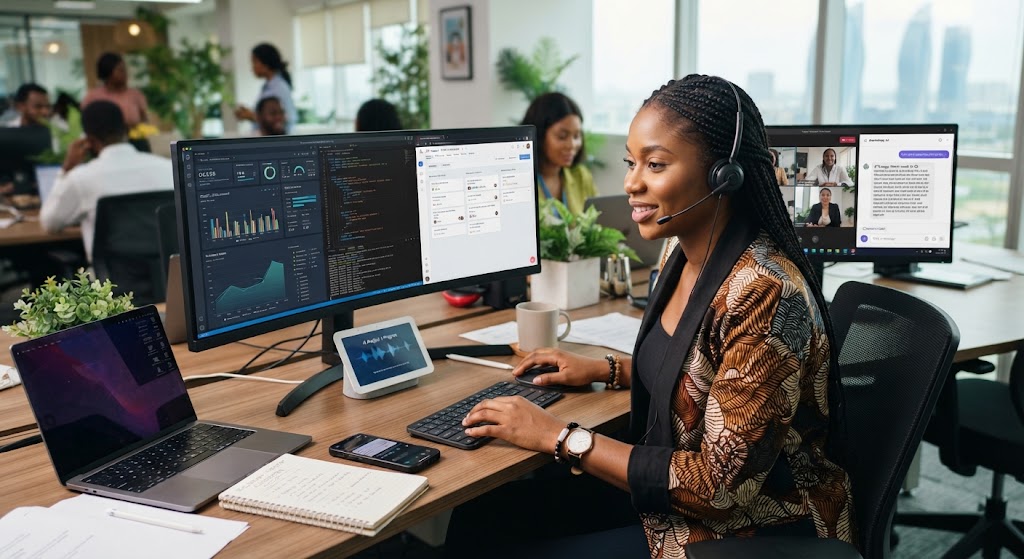







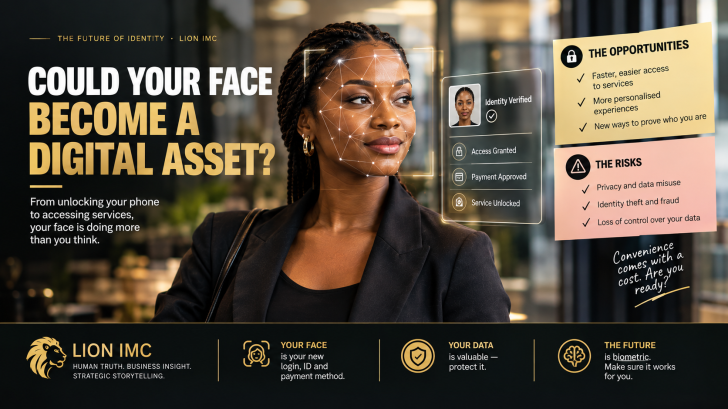
You use your face to unlock your phone. A bank or financial service may ask you to verify your identity. An organisation may use facial recognition to control access to a building, while digital platforms increasingly explore ways to make identity checks faster and more convenient.
Each time, your face does more than help people recognise you. In the right technological system, it can become a way of confirming who you are.
Now consider the bigger possibility: what if your face becomes part of the infrastructure through which you access services, prove your identity, authorise transactions or interact with businesses?
That raises an important question. If your face can help unlock value, who controls the data that makes it possible?
Your face is not a digital asset in exactly the same way as a share, a domain name or a cryptocurrency. But the biometric information derived from it can have significant economic and practical value. Businesses can use that information to verify identities, reduce certain kinds of fraud, personalise services and make transactions more convenient.
The opportunity is real. So is the need to understand what we may be giving up in exchange for that convenience.
Your face is becoming more than a photograph
A photograph captures how you look. A facial recognition system can analyse distinctive features and use them to compare your face with a stored reference or search for a possible match.
These are different things.
When you upload a photograph to a social platform, the image may be used in various ways depending on the service and its policies. When you use a biometric system, technical processing may produce a representation of facial characteristics that can be used for identity verification or recognition.
That information can be useful because your face is always with you. You do not have to remember a password, carry a physical token or necessarily present a document every time a system needs to verify you.
But unlike a password, your face is not something you can simply change if the underlying biometric information is compromised. You can change how you authenticate yourself, and some systems allow biometric templates to be replaced, but you cannot replace your face as easily as you can replace a PIN.
That makes the collection, storage and protection of facial data particularly important.
The business opportunity: identity that moves with you
Think about how many times you prove who you are.
You may present identification at a service point, complete verification before opening an account, confirm a transaction or go through security checks before entering a restricted facility.
Each process can involve time, paperwork and the possibility of fraud. Properly implemented biometric verification may help make some of these interactions faster and more convenient.
For businesses, the potential benefits include:
– Faster verification: reducing friction in selected customer journeys.
– Fraud prevention: helping detect cases where someone is attempting to impersonate another person.
– Convenience: making it easier to access certain services without repeatedly entering credentials.
– New services: enabling businesses to develop identity-based features and authentication options.
For Nigeria, where digital financial services and remote transactions are important parts of everyday commerce, trustworthy identity verification has practical value. But biometrics is not a magic solution to identity fraud, and facial recognition should not be confused with proof that every other aspect of a transaction is legitimate.
A successful match can help establish that a face resembles a stored reference. It cannot, by itself, prove that the person is acting honestly, has authority to conduct a transaction or is entitled to every service being requested.
That is why businesses need to treat facial recognition as one component of a broader security and identity-management system—not as an automatic guarantee of trust.
The hidden risk: your face could be used beyond the purpose you expected
Imagine submitting a facial image to access one service. Later, you discover that the data has been retained longer than you expected, shared with another organisation or used for a different purpose.
The concern is not simply that somebody has seen your photograph. It is that biometric data may be used to identify, authenticate or track a person in ways they did not anticipate.
The risks depend on the system and its deployment, but they can include unauthorised access, data breaches, identity fraud, excessive surveillance and the use of information beyond the original purpose.
There is also the question of accuracy.
The US National Institute of Standards and Technology (NIST) evaluated 189 face-recognition algorithms from 99 developers in its 2019 demographic-effects study. It found that accuracy differences across demographic groups appeared in many of the algorithms tested, although performance varied considerably between systems. The study also distinguished between errors that fail to recognise the right person and errors that incorrectly match different people.
These findings should not be interpreted as proof that every current system is biased or that the same error rates apply to Nigerian users. They demonstrate why systems must be tested in their intended settings, with attention to the people who will actually use them.
An error when unlocking a personal device may be inconvenient. An incorrect identification in a financial, employment, security or law-enforcement context can have far more serious consequences.
The more consequential the decision, the less acceptable it is to treat a facial match as unquestionable evidence.
In Nigeria, your biometric data is not just another piece of personal information
Nigeria already has a legal framework for protecting personal information. The Nigeria Data Protection Act 2023 defines biometric data in terms of technical processing of physical, physiological or behavioural characteristics that allow or confirm unique identification. It also treats biometric data used for uniquely identifying a natural person as sensitive personal data.
Nigeria Data Protection Commission
That distinction matters.
Organisations handling facial data need to consider the applicable legal basis for processing, transparency, security, purpose limitation and the rights of the people whose information they collect. The exact obligations depend on the circumstances and the law’s applicable provisions; a simple request to take a photograph does not, by itself, answer every data-protection question.
For individuals, a practical response is to ask a few questions before handing over biometric information:
– Why is my face being collected, and what specific purpose will it serve?
– Who will store or process the information?
– How long will it be retained?
– Will it be shared with other organisations?
– What happens if I refuse, or if the system fails to recognise me?
– Is there another way to verify my identity?
These questions are not an argument against biometric technology. They are a reasonable way to evaluate whether a service is asking for information proportionate to the benefit it provides.
Businesses, meanwhile, should avoid collecting biometric data simply because the technology is available. They should establish a legitimate need, explain the process clearly, secure the information appropriately and assess the consequences of misuse or failure.
The Nigeria Data Protection Commission provides information on the Act and data-subject rights through its official website.
If your face has value, do you deserve a share of that value?
This is where the idea of a face as a digital asset becomes especially interesting.
Businesses may derive commercial value from biometric systems because they can make identity checks more efficient, support fraud controls or enable new services. But that does not automatically mean every person whose face is processed is entitled to payment.
There is a difference between data having economic value and an individual having a right to commercial compensation for its use. The answer depends on the nature of the data, the purpose of processing, the agreements involved and the applicable law.
The bigger question is whether people have enough information and meaningful control to make informed choices about how their biometric information is used.
Imagine a future in which your facial identity can be used across multiple services: accessing a building, verifying an account, authorising a payment or proving eligibility for a service. Such a system might make everyday transactions easier. It could also create a growing network of organisations that hold or rely on information connected to your identity.
Who is responsible if that network is compromised? Can you withdraw from a service without losing access to something essential? Can you challenge a mistaken match? And can you understand what you have agreed to when the terms are buried in lengthy privacy notices?
These are not merely technical questions. They concern power, choice, accountability and the relationship between individuals and the organisations that process their data.
The most responsible digital economy will not be the one that collects the most information. It will be the one that can demonstrate why collecting it is necessary, how it is protected and what safeguards exist when something goes wrong.
What individuals and businesses should do now
The future of biometric identity does not require everyone to reject facial recognition. It requires more thoughtful decisions about when and how it is used.
For individuals:
– Understand the request. Do not assume that every facial scan serves the same purpose.
– Read the privacy information. Look for the stated purpose, retention period, sharing arrangements and available alternatives.
– Protect your identity accounts. Use additional authentication where available, and report suspicious activity promptly.
– Challenge unexplained requests. Ask why biometric information is necessary, particularly where a less intrusive alternative may be available.
For businesses:
– Start with the purpose, not the technology. Establish why biometric verification is needed and whether a less intrusive method would work.
– Test for accuracy and fairness. Evaluate performance in the real environment and across the population likely to use the system.
– Limit access and retention. Collect only what is necessary, restrict who can access it and establish appropriate deletion procedures.
– Provide a route to human review. People need a way to challenge errors and access essential services when automated verification fails.
– Build privacy into the design. Assess risks before deployment, explain the system clearly and meet applicable data-protection obligations.
Convenience is valuable. But convenience without accountability can leave people carrying risks they never fully understood.
Your face is personal. The data derived from it deserves protection.
The idea of a digital asset usually brings to mind something we can buy, sell, transfer or own. A face does not fit neatly into that category.
Yet the information derived from our faces is becoming increasingly useful to organisations that need to identify people, verify transactions and deliver digital services.
That makes the question more important than the label.
The future may bring faster identity checks, fewer passwords and new ways of interacting with businesses. It may also bring more difficult questions about consent, surveillance, accuracy and control over personal information.
We should not have to choose between useful technology and the protection of our identities. Businesses should be expected to pursue both.
Because when your face becomes a key to accessing the digital world, protecting that key becomes a matter of personal security, commercial responsibility and public trust.
THE LION TAKE
Your face may unlock services. It should not unlock unlimited access to your identity.
The value of biometric technology should be measured not only by how quickly it verifies people, but also by how responsibly it treats them.
The big question: If a company could make your life easier by using your face to verify your identity, would you agree? What would you need to know before saying yes?