






Take in these two marketing professionals, for a moment.
The first can write excellent copy, prepare social media calendars, draft press releases, produce campaign reports and create presentations. These are skills that took years to develop.
The second can do those things too, but also knows how to use AI to complete much of the routine work faster. That professional spends more time understanding customers, challenging business assumptions, negotiating with stakeholders and deciding which marketing problems deserve attention in the first place.
If both are competing for the same job, who has the advantage?
Increasingly, it may be the second professional.
Not because the first has suddenly become incompetent. But because the value of producing marketing materials is changing when technology can generate them at speed and scale.
AI is not simply changing how marketing work gets done. It is changing what employers may be willing to pay people to do.
For Nigerian professionals working in advertising, public relations, brand management, digital marketing, communications, research and content creation, this is no longer a distant conversation about the future. It is a practical question about employability, career progression and the skills worth developing now.
First, let’s separate the fear from the evidence
Predictions about AI and employment can easily become exaggerated. One headline announces that AI will eliminate marketing jobs; another promises that technology will create more opportunities than it destroys.
Neither prediction tells an individual professional what to do on Monday morning.
A more useful starting point is the International Labour Organization’s 2025 research on generative AI and employment. Its global assessment found that approximately one in four workers is in an occupation with some degree of exposure to generative AI. The researchers concluded that job transformation is more likely than complete replacement for most occupations, although some jobs and tasks face greater risks than others.
That distinction matters.
Exposure is not the same as elimination.
A marketing job can be exposed to AI because several of its tasks can be automated, even when the job still requires a human being to make decisions, manage relationships and take responsibility for the outcome.
A brand manager, for example, may use AI to summarise research, generate campaign concepts and compare competitors. But somebody still needs to decide which audience the brand should prioritise, whether the proposed positioning makes commercial sense and what the business is prepared to risk.
The job may survive. Its daily activities, required skills and value to the employer may change considerably.
That is the distinction marketing professionals need to understand.
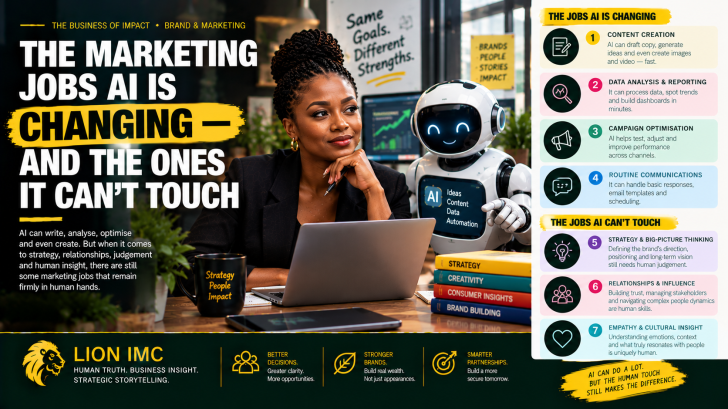
The marketing jobs AI is already changing
1. Content creation and copywriting
AI tools can draft social media captions, blog outlines, email campaigns, product descriptions, headline options and first drafts of marketing copy. They can also rework material for different audiences and platforms.
The pressure is greatest on work that is repetitive, formulaic or judged mainly by how quickly a piece of content can be produced.
The opportunity is to move beyond producing more words. Professionals who understand audience insight, editorial judgement, brand voice, fact-checking and storytelling can use AI as a production assistant rather than compete with it on speed alone.
2. Digital marketing analysis and reporting
AI can help summarise performance data, identify patterns, generate report drafts and turn spreadsheets into explanations that managers can understand.
This could reduce the time spent preparing routine reports, particularly where the data is clean and the questions are predictable.
But a dashboard cannot automatically explain every business outcome. Was a campaign responsible for increased sales? Did a competitor change its pricing? Was the apparent improvement caused by seasonality? Is the data reliable?
The professional who can interpret the evidence, question its limitations and recommend a business decision remains valuable.
3. Advertising operations and campaign optimisation
Advertising platforms already automate parts of targeting, bidding, testing and delivery. AI tools can also help marketers compare creative variations and develop new campaign options.
As these systems improve, some routine optimisation tasks may require less manual intervention.
But someone still has to define the commercial objective, set sensible constraints, understand the customer, evaluate the quality of the results and know when a seemingly successful campaign is not delivering business value.
4. Routine communications and administration
Meeting summaries, basic customer responses, email drafts, content calendars, frequently asked questions and first-pass presentations are increasingly suitable for AI assistance.
This does not mean every communications role disappears. It means the time required to complete some routine assignments may fall.
Professionals whose contribution consists almost entirely of moving information from one format to another may face greater pressure to demonstrate additional value.
5. Research synthesis and competitor monitoring
AI can rapidly summarise documents, organise findings, compare public-facing messages and suggest patterns worth investigating.
Yet a polished summary is not proof that the underlying information is accurate. AI can miss context, misinterpret evidence or produce confident but unsupported claims.
Researchers who know how to verify sources, design meaningful questions, interpret Nigerian consumer behaviour and distinguish a genuine insight from an attractive observation will have an important role to play.
These examples reflect broader findings from the ILO’s task-level assessment and the OECD’s research on AI and skills: technology can change particular activities inside an occupation without making the entire occupation redundant. The effects vary by task, workplace and how the technology is used.
The jobs AI cannot simply take over
There is a tempting way to frame this debate: AI will handle the technical work, while humans retain the creative work.
That distinction is too simplistic.
AI can generate creative concepts, write stories, design images and propose campaign strategies. Human creativity alone is not a guarantee of job security.
The more useful distinction is between producing an output and taking responsibility for what that output means in the real world.
Some marketing responsibilities remain particularly dependent on human judgement, relationships, context and accountability.
1. Brand strategy and business judgement
A brand strategist does more than produce a positioning statement.
The work involves deciding which customers matter most, understanding why they choose one product over another, identifying a defensible market position and connecting marketing decisions to the organisation’s commercial objectives.
An AI system can suggest several positioning options. It cannot independently establish which option is right for a particular Nigerian business without reliable evidence, relevant context and human decisions about priorities and risk.
Consider a consumer goods company deciding whether to compete on affordability, premium quality or local identity.
The decision could affect pricing, distribution, packaging, advertising, sales incentives and profitability.
Generating ten positioning statements is relatively easy. Choosing one that the organisation can credibly deliver and persuading the business to commit to it is a different responsibility.
2. Stakeholder relationships and negotiation
Marketing is rarely conducted in isolation.
Brand managers negotiate with sales teams, procurement officers, distributors, agencies, executives and sometimes regulators or community stakeholders. Public relations professionals must also manage journalists, clients, employees and other audiences whose reactions cannot be reduced to a predictable script.
AI can help prepare a negotiation brief or draft a difficult email. It can suggest likely objections and help a professional rehearse a conversation.
But trust is built through human interaction, credibility, consistency and an understanding of what matters to the people involved.
In a complex negotiation, the crucial information may be what somebody is reluctant to say, the history between the parties or the organisational pressure behind a seemingly unreasonable demand.
Those realities require more than a well-written response.
3. Reputation management and crisis judgement
A company facing a product failure, an employee controversy or a public complaint needs more than a fast statement.
It needs to establish what happened, determine what is known and unknown, identify who has been affected, assess the consequences of different responses and decide what the organisation should do next.
AI can support monitoring, summarise emerging conversations and prepare draft statements. These are useful capabilities.
But an organisation cannot outsource moral responsibility, factual verification or the decision to admit a mistake to a text generator.
A response that sounds polished but is inaccurate, insensitive or premature can make a difficult situation worse.
The communications professional who can challenge management, ask uncomfortable questions and protect long-term credibility is performing a different function from the person who simply writes the statement.
4. Consumer understanding and cultural judgement
A campaign can be grammatically perfect, visually attractive and strategically coherent on paper yet fail because it misunderstands the people it is trying to reach.
Nigeria’s consumers are not one uniform audience. Income, location, language, culture, age, access to technology, trust and purchasing power can all shape how people interpret a message.
AI can help analyse consumer research and generate hypotheses. But its recommendations are only as useful as the information and assumptions behind them.
A professional must still determine whether the evidence represents the intended audience, whether a message will be interpreted as intended and whether a creative idea fits the circumstances in which people will encounter it.
Cultural insight is not simply inserting local expressions into an advert. It is understanding people well enough to know what will matter to them and what might alienate them.
5. Leadership and the ability to align people
Marketing leaders must often persuade people who have different priorities.
A sales director may want immediate revenue. A finance director may want lower costs. A CEO may be concerned about market share. A communications team may be trying to protect reputation. An agency may be recommending a long-term brand investment whose results are not immediately visible.
The leader’s job is to make the trade-offs clear, establish priorities and get people moving in the same direction.
AI can help model options, organise arguments and prepare presentations. It cannot replace the full human responsibility of building trust, resolving organisational conflict and being accountable for the final decision.
This is why leadership, social influence, analytical thinking and creativity continue to feature among the skills employers expect to matter in the changing labour market.
The uncomfortable truth: some marketing professionals may be competing against a different standard
The risk is not simply that AI will take a marketer’s job.
It is that an employer may begin expecting one marketer to deliver work that previously required several people with AI helping to fill the productivity gap.
A small business that once needed outside help for routine copy, basic graphics and monthly reporting may now handle more of that work internally with AI-assisted tools.
An agency may expect its team to produce more campaign variations in the same amount of time.
A communications department may reduce the hours spent drafting routine material and redirect its budget towards other priorities.
These are plausible ways organisations can use the technology, not proof that every Nigerian company is already making such changes. The outcome will depend on adoption, budgets, infrastructure, the quality of the tools and the kind of work being done.
The important point is that job titles may remain the same while the expectations attached to them change.
A content executive may be expected to understand analytics. A digital marketer may need to explain commercial performance rather than simply report impressions. A public relations professional may be expected to connect reputation work to business risks and organisational decisions.
The professional who continues to offer only the tasks that technology makes easier to produce may find it harder to defend their value.
What this means for Nigerian marketing professionals
There is no single career plan that fits every marketer. A social media executive, an experienced brand manager and a public relations consultant will face different opportunities and pressures.
But there are practical steps each can take.
A practical AI-readiness checklist
Use this to assess your next professional development priorities.
Learn to use AI in your current work
Practise drafting, research synthesis, brainstorming and reporting. Check the outputs instead of accepting them blindly.
Build analytical confidence
Learn to interpret campaign results, question assumptions and connect marketing activity to business outcomes.
Strengthen your strategic thinking
Practise explaining why a campaign should exist, whom it should serve and what measurable change it should create.
Develop deeper customer knowledge
Learn how to conduct interviews, interpret feedback, understand buying behaviour and recognise cultural context.
Improve your influence and communication
Practise presenting recommendations, negotiating priorities and explaining complex ideas to decision-makers.
Build a portfolio of evidence
Document problems you solved, decisions you influenced and results you can substantiate — not just content you produced.
Protect your credibility
Verify facts, respect confidentiality, disclose limitations and understand when AI-generated material requires human review.
You do not need to become an AI engineer to remain relevant in marketing. The OECD’s 2026 analysis of AI and skills notes that most workers will not need advanced AI-development expertise. The more broadly useful capabilities include using digital tools, analysing and interpreting data, problem-solving, creativity and managerial skills.
For many marketing professionals, the goal should be to become more capable at their existing work while developing the judgement needed to take on greater responsibility.
That may mean learning to use AI tools well. It may also mean learning financial analysis, consumer research, negotiation, leadership or measurement.
The right combination depends on the career you want to build.
What about junior marketing jobs?
This may be one of the most important questions in the entire debate.
Junior professionals often learn by doing the routine work: drafting copy, preparing reports, monitoring media coverage, compiling research, updating campaign calendars and supporting senior colleagues.
If AI reduces the amount of this work available, how will newcomers gain the experience required to become strategists, managers and leaders?
Organisations cannot reasonably expect employees to arrive with judgement they have never had the opportunity to develop.
If routine tasks are automated, employers may need to rethink how they train junior staff: giving them supervised responsibility for interpreting AI outputs, conducting original research, speaking to customers, evaluating campaign performance and explaining their recommendations.
Young professionals, meanwhile, should avoid treating AI as a shortcut around learning the fundamentals. Understanding why a campaign works is more valuable than knowing how to generate one quickly.
The danger is not just losing entry-level tasks. It is losing the training ground that helps people become experienced professionals.
That is a challenge for employers, educators and the next generation of marketers alike.
The jobs that survive may not look the same
It would be misleading to promise that any marketing role is completely safe from AI.
Strategy can be assisted by AI. Creative work can be generated by AI. Relationship managers can use AI to prepare for conversations. Leaders can use AI to support decisions.
The question is not whether a task has a human element. It is how much of the work can be automated, how much human judgement is needed and whether the organisation still needs a person to take responsibility for the result.
The ILO’s research points towards widespread transformation rather than universal job replacement. But that does not mean every worker will benefit equally, or that employers will preserve every existing role.
For marketing professionals, a sensible response is neither panic nor complacency.
Learn the tools. Understand their limitations. Keep your expertise current. Build evidence of the value you create. And pay attention to the parts of your work that require more than producing an acceptable output.
The most resilient marketer may not be the person who refuses to use AI, nor the person who delegates everything to it.
It may be the professional who knows what to delegate, what to question, what to decide and what must remain a human responsibility.
THE LION TAKE
AI is making some marketing tasks faster, cheaper and easier to reproduce. That changes the value of routine production but it does not remove the need for people who understand customers, make difficult decisions, build relationships and connect marketing to business results.
Do not build your entire career around tasks that a tool can increasingly perform. Build the judgement that helps you decide which tasks matter, whether the results are right and what the business should do next.
The future of marketing is not simply human versus machine.
It is a contest between professionals who adapt to the changing nature of the work and those who assume that the work will remain unchanged.
THE BIG QUESTION
If AI can now produce the content, analyse the data and prepare the campaign report, what should a marketing professional be paid for that a machine cannot reliably deliver?