







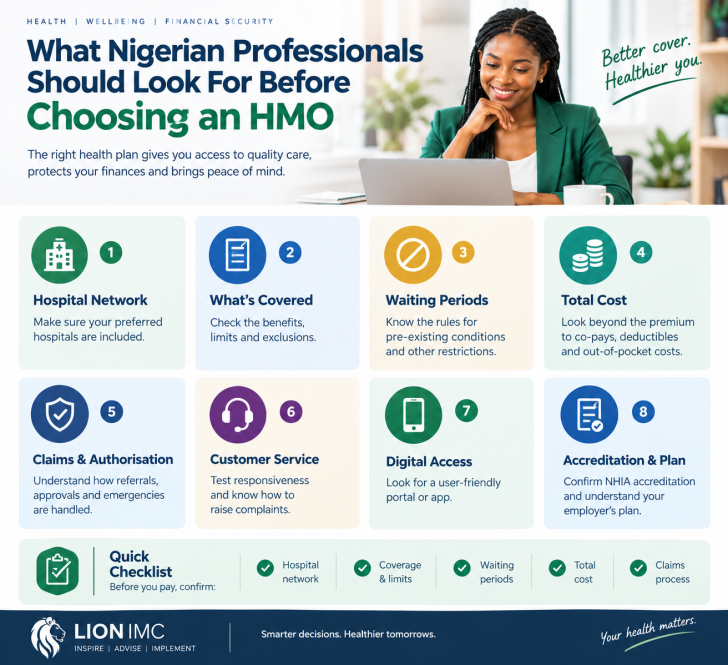
An HMO is only as useful as the care you can actually access when you need it. Before committing your money or relying on your employer’s health plan look beyond the premium and examine the hospitals, benefits, exclusions and service standards behind it.
A health plan can look excellent on a brochure and become frustrating when you need a specialist, a prescribed drug or an urgent medical procedure.
For Nigerian professionals, choosing a Health Maintenance Organisation (HMO) is more than an administrative decision. It affects how quickly you can access care, how much you may have to pay yourself, and whether your healthcare arrangements fit your working life and family responsibilities.
Before choosing an HMO
The National Health Insurance Authority (NHIA) provides a list of accredited HMOs and information about private health plans. But accreditation is a starting point not proof that every plan offered by an HMO will meet your needs. Benefits and access depend on the specific plan and its terms.
Here is what to examine before choosing.
1. Start with the hospitals, not the HMO’s reputation
An HMO may have an impressive name and a long provider list, but that list means little if the hospitals you trust are not included in your particular plan.
Check whether the network includes suitable facilities near your home and workplace. If you travel regularly, ask about access to care in other cities. If you already have a preferred hospital or specialist, confirm directly that the facility accepts the exact plan you intend to buy.
Do not settle for “we have hundreds of hospitals.” Ask which ones you can use, what services are available there and whether referrals are required before you can see a specialist.
The practical test: Identify your three preferred hospitals and ask the HMO to confirm their inclusion in writing.
2. Read the benefit schedule not just the sales brochure
“Comprehensive healthcare” sounds reassuring, but what does it actually mean for you?
Request the current benefit schedule and establish what the plan covers. Depending on the package, this may include:
- General consultations and specialist visits.
- Hospital admission and surgery.
- Laboratory tests, scans and diagnostic investigations.
- Prescription medicines.
- Emergency care.
- Maternity services.
- Dental and optical care.
- Mental healthcare and chronic-condition management.
Do not assume that every benefit is unlimited or automatically included. A service may be covered but subject to a financial cap, a limited number of visits, a referral or prior authorisation. Some services may be excluded altogether.
The question is not simply, “Does the plan cover surgery?” It is, “Which surgeries, at what limit, under what conditions, and at which facilities?”
3. Understand the exclusions and waiting periods
This is where many people make expensive assumptions.
Before paying, ask whether the plan places restrictions on pre-existing conditions, maternity care, chronic illnesses, specialist treatment or particular procedures. Check any waiting periods and the conditions under which benefits become available.
If you or a family member has an ongoing medical need, disclose it accurately and ask for a written explanation of what the plan will cover. Never rely solely on an agent’s verbal assurance.
The NHIA itself confirms that health insurance programmes do not cover every ailment and that exclusions or partial exclusions may apply.
4. Calculate the real cost not just the premium
A cheaper plan is not automatically better value. Nor is an expensive plan necessarily more comprehensive.
Compare the annual premium alongside any co-payments, deductibles, treatment limits, medicine restrictions and charges for dependants. Ask whether the plan has annual limits or separate caps for specific procedures.
Consider this hypothetical comparison:
| What to compare | Plan A | Plan B |
| Annual premium | Lower | Higher |
| Preferred hospital | Not included | Included |
| Specialist access | Restricted | More flexible |
| Your priority treatment | Limited cover | Better-defined cover |
Plan B could be better value for someone who needs regular specialist care—even if the premium is higher. But if Plan A covers your actual needs adequately, paying more may not be necessary.
Your objective is not to buy the most expensive plan. It is to reduce the risk of paying substantial medical bills yourself when you need care.
5. Find out how claims and authorisations work
A health plan is tested when you need to use it.
Ask how the HMO handles referrals, specialist consultations, diagnostic investigations, hospital admission and procedures requiring prior authorisation. Find out how long authorisation typically takes, how emergencies are handled and whom you should contact if a hospital says a service is not approved.
Also establish what happens if a prescribed medicine is unavailable at the hospital pharmacy, or a facility cannot provide a required test.
Get clear answers before enrolment. Questions about covered services, authorisation, referrals, medicines and exclusions can help prevent unexpected bills and disputes later.
6. Test customer service before you buy
Do not wait until you are ill to discover whether your HMO answers its phone.
Call its customer service line. Ask a specific question about a benefit or hospital. Test its email or WhatsApp channel, if available. Notice whether the response is clear, timely and consistent.
Useful questions include:
- Is there a dedicated emergency contact?
- Can I reach a support representative outside normal working hours?
- How do I escalate a rejected authorisation?
- How do I report a hospital that refuses to honour my plan?
- Is there a formal complaints process?
The NHIA says complaints can be lodged with HMOs, NHIA offices or the Authority’s call centre. Keep relevant enrolment documents, bills, messages and complaint reference numbers if a dispute arises.
7. Check the digital experience
For professionals juggling deadlines, meetings and family responsibilities, digital access can make healthcare easier to manage.
Find out whether the HMO offers a usable portal or app, digital enrolment information, an accessible provider directory, online consultations or telemedicine, electronic claims support and convenient access to test results where supported.
Do not choose a plan simply because it advertises an app. Ask which functions actually work and whether they are available to members on your specific package.
The best digital experience is one that removes friction when you need care not another platform you struggle to use.
NHIA list of accredited HMOs
8. Verify accreditation and understand your employer’s plan
Before paying an individual HMO, check the current NHIA list of accredited HMOs. Confirm that the provider is listed and ask for the exact terms of the plan being offered.
If you are employed, do not assume you must personally purchase another plan. First request your employer’s existing benefit schedule and establish:
- Which HMO and package cover you?
- Which hospitals can you use?
- Are your spouse and children included?
- Can you select or change your primary hospital?
- Can you upgrade the plan at your own expense?
- What happens to your cover when you leave the organisation?
For self-employed professionals and people between jobs, compare individual or family plans with the options available through NHIA programmes. The Authority provides information on private health plans and programmes for individuals, families and groups.
Your HMO decision checklist
Use this checklist before making a commitment.
Before you pay
0 of 9
I have confirmed that the HMO is currently accredited.
My preferred hospitals are included in this specific plan.
I have read the benefit schedule and exclusions.
I understand waiting periods and restrictions on existing conditions.
I know the limits for medicines, specialist care and hospitalisation.
I understand co-payments and other possible out-of-pocket costs.
I know how referrals, authorisations and emergencies are handled.
I have tested customer service and know how to escalate complaints.
I have confirmed dependant eligibility and the renewal terms.
Copy checklist
THE LION TAKE
Your health plan should be judged by what it enables you to do when you need medical attention not by the size of its brochure, the popularity of its brand or the confidence of the salesperson.
For professionals, healthcare is also a financial-planning decision. A suitable plan can help manage covered medical expenses, but only if you understand its limits and choose a package that reflects your real needs.
Before you choose an HMO, ask one question: If I or someone in my family needed care tomorrow, would I know where to go, what is covered and what I might still have to pay?
If you cannot answer that confidently, you need more information before you commit.