








Your salary tells you what you earn. Your financial buffer determines how much breathing room you have when life refuses to follow the plan.
The money you should not be spending
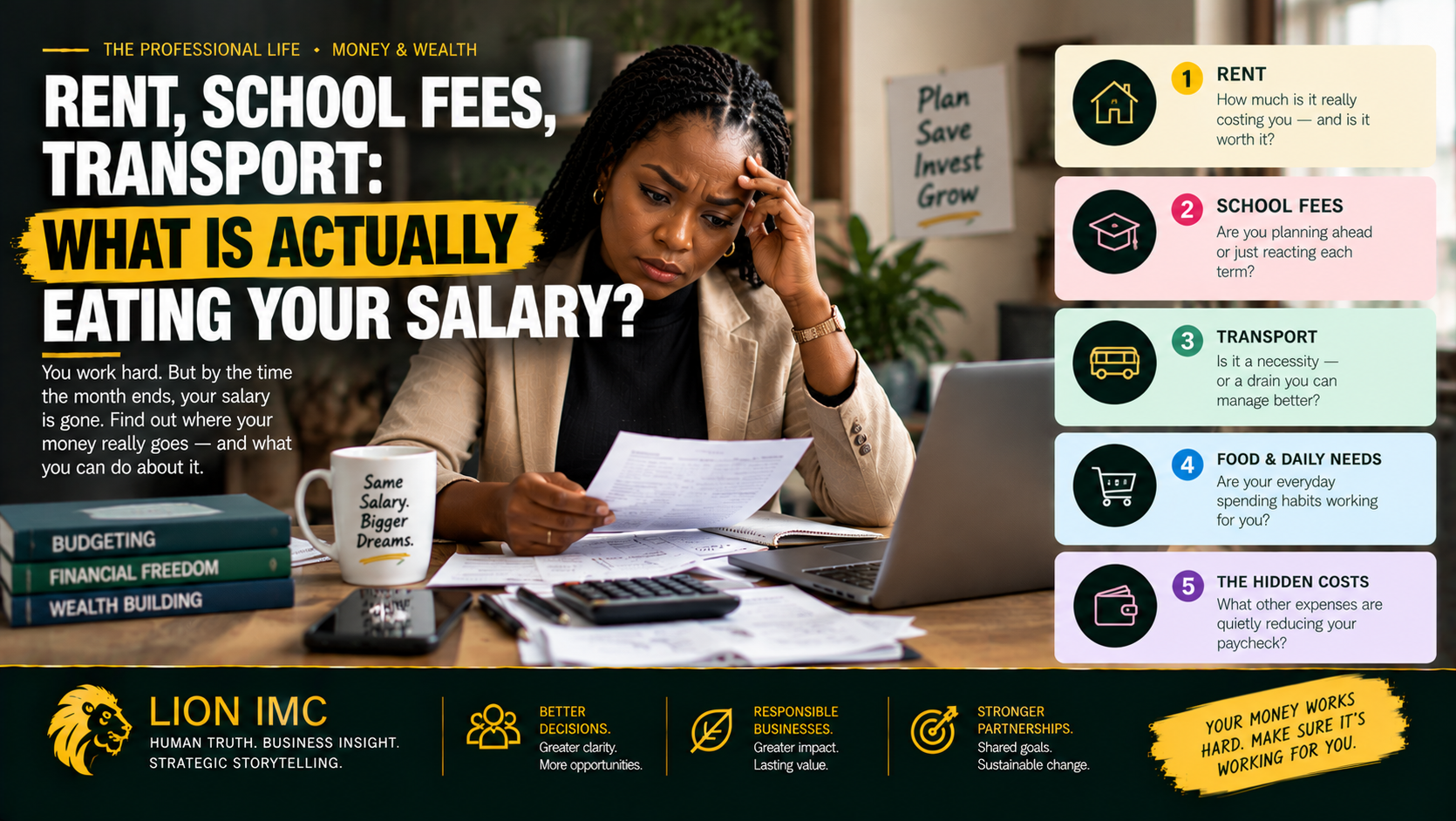
You receive your salary. You pay rent, buy food, settle transport costs, support family, pay school fees, service a loan and handle the bills that seem to multiply every month.
Whatever remains feels like money you can finally use.
But there is a question worth asking before you spend it: how much of your money could you leave untouched and still be able to handle an unexpected financial shock?
Imagine your employer delays salaries. You lose a client. Your car develops a fault just as your child needs medical attention. A family emergency requires you to travel urgently. Or you need to leave a job that has become untenable before you have secured another one.
These situations are different, but they share one financial question: how long can you keep your life running if your normal income is interrupted?
That is what emergency savings are meant to help answer.
The conventional rule of thumb is to build an emergency fund covering three to six months of essential living expenses. However, this is a planning guideline, not a universal law. The US Consumer Financial Protection Bureau advises people to determine their target based on their own circumstances and points out that even a small amount set aside can provide some financial security.
For Nigerian professionals, where family obligations, housing costs, medical expenses and income uncertainty can vary widely, the more useful question is not simply how much you earn.
It is how much it costs to keep your life functioning when your income stops.
Start with your expenses, not your salary
Suppose two professionals each earn ₦800,000 monthly.
The first spends ₦350,000 on essential expenses. The second needs ₦650,000 to cover rent provisions, food, transport, utilities, debt commitments and dependants.
Although they earn the same amount, they do not need the same emergency fund.
Using the three-to-six-month guideline, their targets would look like this:
| Essential monthly expenses | 3 months | 6 months |
| ₦200,000 | ₦600,000 | ₦1,200,000 |
| ₦350,000 | ₦1,050,000 | ₦2,100,000 |
| ₦500,000 | ₦1,500,000 | ₦3,000,000 |
| ₦650,000 | ₦1,950,000 | ₦3,900,000 |
| ₦800,000 | ₦2,400,000 | ₦4,800,000 |
These are illustrative calculations, not prescribed savings amounts. Your actual target depends on the expenses you would still need to cover during a crisis.
Include essentials such as housing, food, utilities, basic transportation, medication, insurance, minimum debt repayments and unavoidable responsibilities towards dependants.
Separate these from spending you could temporarily reduce, such as holidays, expensive outings, nonessential shopping and upgrades.
The point is not to maintain your usual lifestyle at all costs. It is to preserve your ability to meet essential obligations while you recover financially.
What the Nigerian savings picture tells us
The challenge is not simply that professionals need to become more disciplined. Sometimes, the money genuinely is not there after essential bills have been paid.
The PiggyVest Savings Report 2025, published in March 2026, surveyed more than 26,000 Nigerians across the country’s six geopolitical zones. It reported that 53% of respondents did not save, while six in ten said they had no emergency savings. Among those who did have an emergency fund, most reported having reserves covering one to three months of expenses.
Those findings offer an important distinction: earning a salary, saving money and being financially prepared are three different things.
A professional may earn a relatively good income but have little cash left after rent, family responsibilities and debt repayments. Another may earn less but have lower fixed expenses and a modest reserve.
The goal is not to judge either person. It is to recognise that financial security depends on the relationship between income, obligations, savings and risk.
How much should you aim to keep untouched?
Rather than treating the entire three-to-six-month target as something you must achieve immediately, build towards it in stages.
Stage 1: Build a starter buffer
Start with an amount that could handle a realistic urgent expense without forcing you to borrow. This could be an unexpected medical bill, an essential repair or a short disruption in income. Set the target based on your circumstances rather than copying someone else’s figure.
Stage 2: Work towards one month of essentials
This is a useful intermediate milestone. If income stops, you have some breathing room to adjust spending, pursue another job or client, and respond to urgent needs.
Stage 3: Build towards three to six months
This is a commonly used emergency-fund target. Lean towards the higher end if your income is irregular, you support several dependants, your job is insecure or finding replacement work could take time.
If you are starting from zero, do not interpret this as a reason to give up. A smaller reserve is more useful than no reserve at all.
What does “untouched” really mean?
It does not mean money that must never be spent under any circumstances.
It means money reserved for a specific purpose: protecting you when something important goes wrong.
A genuine emergency might include a sudden loss of income, an urgent medical expense, essential home repairs or a necessary trip arising from a family crisis.
A discounted phone, a holiday, a friend’s celebration or an investment opportunity may feel urgent in the moment. They do not automatically qualify as emergencies.
This distinction matters because savings become difficult to maintain when the fund is repeatedly used for expenses that could have been planned for.
Consider keeping separate pots for separate purposes:
- Emergency fund: unexpected costs and income interruptions.
- Sinking funds: predictable but irregular costs, such as annual rent, school fees, vehicle maintenance and festive spending.
- Investment funds: money intended for long-term growth that you can afford to leave invested.
Annual rent is a particularly important example in Nigeria. It can be a large expense, but if you know when it is due, it should ideally be planned for separately. Otherwise, you may spend months rebuilding an emergency fund that gets depleted every time rent falls due.
Where should you keep the money?
The emergency fund has a different job from an investment portfolio.
An investment is generally intended to help your money grow. Emergency savings are intended to be available when you need them.
That means you should prioritise:
- Accessibility: Can you withdraw the money when an emergency occurs?
- Capital preservation: Is the balance exposed to substantial market losses?
- Security: Is the institution or provider legitimate, and what protections apply?
- Costs and restrictions: Are there withdrawal penalties, notice periods or fees?
- Separation: Is the money kept apart from the account you use for everyday spending?
A suitable savings account or another low-risk, accessible option may serve this purpose. Understand the terms before committing money to any product.
Do not lock your entire emergency fund into an investment that may fall in value or take weeks to access. And do not assume that every product advertised as a savings plan provides the same liquidity or protection.
Inflation also matters. Keeping money accessible does not mean ignoring its declining purchasing power. It means accepting that the emergency fund’s first job is protection, not maximum returns.
The savings plan that works with your actual life
If you cannot set aside a large amount each month, begin with a contribution you can sustain.
You might transfer a fixed amount immediately after receiving your salary, even if it is modest. When you receive a bonus, an extra payment or income from a side project, you could direct part of it towards your buffer.
Review the amount periodically, especially after changes in rent, school fees, dependants, debt or income.
Most importantly, do not build a savings target by pretending that essential bills do not exist. If nearly all your income is already committed to necessities, you may need to address the size of those commitments, increase income where possible, renegotiate debt or set a longer timeline. Budgeting can help you make decisions, but it cannot manufacture money that is not available.
Calculate your own untouched-money target
Emergency savings calculator
Essential monthly expenses (₦)
Include essential living costs and unavoidable monthly obligations, not your entire lifestyle budget.
Target coverage
1 month — intermediate milestone
3 months — common starting target
6 months — larger safety buffer
Emergency savings already set aside (₦)
Your target
₦1,050,000
Already saved
₦0
Remaining gap
₦1,050,000
This is a planning estimate, not personalised financial advice. Your actual target may need to account for irregular income, dependants, health needs and job security.
The money you keep is buying you options
A financial buffer is not just money sitting in an account. It can give you the option to leave a damaging work environment without making a desperate decision. It can give a freelancer time to find another client. It can help a parent handle an unexpected expense without immediately taking a costly loan.
It may even help you say no to an opportunity that is wrong for you because you are not under immediate financial pressure.
That does not mean savings can solve every financial problem. A prolonged loss of income or a major medical crisis can overwhelm even a carefully built reserve. Insurance, manageable debt, reliable income and longer-term planning all matter too.
But an emergency fund gives you something valuable: time to think before you act.
THE LION TAKE
Do not measure your financial strength only by what you earn, own or invest. Measure part of it by how long you can meet your essential obligations if your income suddenly stops.
Your first target does not have to be millions. It has to be realistic enough to start building and meaningful enough to protect you.
The money you keep untouched is not money doing nothing.
It is money keeping your options open.