







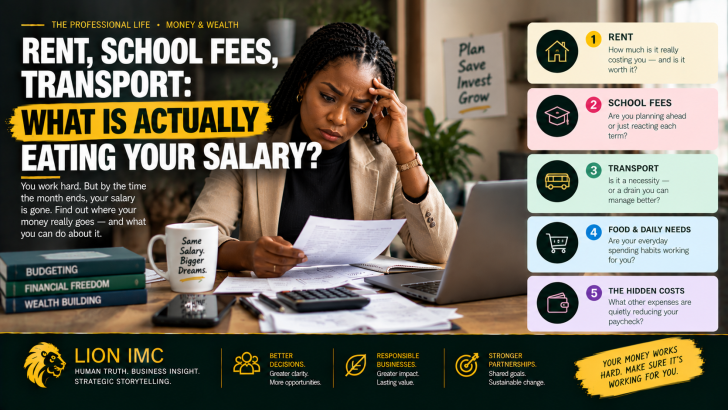
The salary disappears in pieces
You receive your salary and immediately start allocating it.
Rent needs attention. School fees are due. Transport takes its share. Food must be bought, electricity paid for and data renewed. Then someone needs help, a prescription needs filling, a birthday comes up or a household item suddenly needs replacing.
None of these expenses necessarily feels outrageous on its own.
But by the middle of the month, the money you thought would last begins to look inadequate. You have not bought a luxury car or booked an expensive holiday. You have simply been living.
This is one of the most frustrating financial experiences for Nigerian professionals: earning an income without feeling financially secure.
The question is not only whether your salary is enough. It is also how much of it is already committed before you receive it, which costs are increasing, and whether your current spending pattern leaves anything for the future.
1. Rent: the bill that can consume an entire season of earnings
Rent is particularly difficult because it is often paid in a large lump sum, even when the tenant earns money monthly.
A professional may manage monthly expenses reasonably well but struggle when an annual rent payment arrives. The pressure becomes worse when the landlord increases the rent, relocation becomes necessary or the tenant must pay agency, legal and other applicable charges.
The real cost of housing also extends beyond the rent itself.
A cheaper apartment far from work may increase transport expenses. A more expensive apartment closer to the office may reduce commuting costs but leave less money for savings. Poor infrastructure can introduce additional spending on water, power, security and repairs.
This means the cheapest rent is not necessarily the cheapest housing arrangement.
Calculate your annual housing cost, divide it by 12 and treat that amount as a monthly commitment—even if you pay once a year. If your rent is ₦1.2 million annually, for example, the equivalent monthly cost is ₦100,000.
That simple calculation helps reveal how much of your income housing actually absorbs.
2. School fees: the expense that arrives on its own calendar
For parents, school fees can turn an apparently manageable budget into a difficult one.
Tuition may be only part of the bill. Books, uniforms, transport, meals, extracurricular activities, examination fees and other school requirements can add to the total.
The challenge is that education expenses often arrive in concentrated periods, while salary arrives in smaller monthly instalments.
A household that does not plan for the term may resort to borrowing, divert money from other essential expenses or use savings intended for emergencies.
The solution is not necessarily to choose the cheapest school. Education involves important considerations about quality, location, the child’s needs and the family’s circumstances.
Instead, calculate the full annual cost for each child. Divide it into monthly savings targets, and begin setting money aside as early as possible. If school fees are due three times a year, work backwards from each payment date.
A cost that is predictable should not repeatedly become a financial emergency.
3. Transport: the daily expense that can quietly become a major bill
Transport is easy to underestimate because it is paid in small amounts.
A professional pays for a bus, taxi, ride-hailing trip or fuel today. The next trip feels like a separate expense. By the end of the month, however, the cumulative amount may be substantial.
The cost can include more than fares or fuel:
- Transport between home and work.
- Additional trips caused by traffic or changing work schedules.
- Fuel, parking, tolls and vehicle maintenance.
- Ride-hailing when public transport is inconvenient or unreliable.
- Extra journeys for school runs, shopping and family responsibilities.
The location of a home and the location of a job therefore affect more than convenience. They influence how much disposable income remains after commuting.
Try recording every transport expense for four weeks. Separate regular commuting from optional journeys and work-related travel that your employer should reimburse.
You may discover that transport is taking more money than you realised—or that the apparent problem is actually a combination of distance, unpredictable schedules and the absence of a workable alternative.
4. Food: the expense that changes almost every day
Food spending is difficult to manage because it combines necessity with frequent purchasing decisions.
There is the main grocery shop, the extra ingredients bought during the week, lunch at work, takeaway after a tiring day and the unplanned purchase made because there is nothing convenient to eat at home.
Each decision may appear reasonable. Together, they can create a large and unpredictable expense.
The Central Bank of Nigeria’s January 2025 Household Expectations Survey identified food and other household items as the leading category in respondents’ planned expenditure, ahead of education and transportation. The survey reflects consumer expectations rather than a precise breakdown of every Nigerian professional’s actual spending, but it illustrates how prominently essential consumption features in household budgets.
A useful starting point is to distinguish between food purchased for the household and money spent on meals outside the home. Track both for a month before deciding where changes are realistic.
Meal planning, bulk purchasing where economical, preparing food at home and reducing avoidable waste may help. But it is important to recognise that food costs are also shaped by market prices, household size, dietary needs and access to affordable options.
Budgeting can improve decisions. It cannot make essential goods affordable when income is simply too low.
5. The hidden costs: where the budget becomes difficult to explain
Rent, school fees, transport and food are visible expenses. The smaller, less predictable costs can be harder to identify.
Consider the expenses that appear throughout an ordinary month:
- Data subscriptions, airtime and internet access.
- Electricity, water, cooking gas and household supplies.
- Bank charges, loan repayments and interest.
- Medication, medical appointments and health-related transport.
- Support for parents, siblings, relatives and friends.
- Religious contributions, social events, birthdays and ceremonies.
- Clothing, personal care and professional appearance.
- Streaming subscriptions, app payments and other recurring deductions.
Some of these expenses are essential. Others reflect personal priorities or social expectations. Many sit somewhere in between.
The problem is not that every small expense is irresponsible. It is that spending becomes difficult to control when it remains invisible.
A ₦5,000 payment may not appear significant. Several such payments across different categories can add up to a meaningful amount over a month.
The answer is to identify the pattern, not to blame every purchase.
6. Sometimes, the problem is not spending. It is the structure of your income
Personal finance advice often focuses on cutting expenses. Spend less on lunch. Reduce subscriptions. Stop buying things you do not need.
These suggestions can help, but they have limits.
A professional supporting children, paying rent, commuting long distances and helping relatives may already be spending carefully. If essential expenses consume most of their income, eliminating occasional treats will not solve the underlying problem.
There are two different situations to recognise.
Situation one: Money is leaking through unexamined spending. You have some flexibility, but recurring purchases, unplanned expenses or poorly timed payments are reducing what you can save.
Situation two: Essential commitments exceed what your income can comfortably support. Even after careful budgeting, little remains because the income is inadequate for the obligations you carry.
The first situation calls for better visibility and spending decisions. The second may require a different housing arrangement, renegotiated commitments where possible, additional income, a job change, shared household costs or a longer-term adjustment to financial responsibilities.
Sometimes both situations exist together.
It is important not to mistake a structural income problem for a personal discipline problem. A budget is a diagnostic tool, not a substitute for adequate earnings.
7. Try a salary autopsy: follow the money before the next payday
Instead of guessing where your salary goes, examine one complete month of spending.
Start with your actual take-home pay—the amount that reaches your account after deductions. Then record where the money goes, including cash withdrawals and transfers that might otherwise disappear from the picture.
Use this simple structure:
| Category | What to include |
| Housing | Rent, service charges, repairs and related costs |
| Education | Tuition, school supplies, transport and other school expenses |
| Transport | Fares, fuel, parking and vehicle maintenance |
| Food | Groceries, work lunches, takeaway and other meals |
| Utilities | Electricity, water, gas, internet and household services |
| Debt | Loan repayments, interest and other debt obligations |
| Family and social commitments | Support, ceremonies, gifts and contributions |
| Health and personal needs | Medical costs, medication, clothing and personal care |
| Savings and investments | Money deliberately set aside for future needs |
| Other | Expenses that do not fit elsewhere |
Then ask three questions about every category:
- How much did I actually spend? Use transactions and receipts where available, not memory.
- Was the expense essential, flexible or irregular? This helps distinguish necessities from choices and occasional commitments.
- Can I plan, reduce, share or change this cost? Not every expense can be cut, but some can be made more predictable.
Pay particular attention to annual or irregular bills. Divide their expected total by 12 and set aside a monthly amount where possible.
The objective is to create a realistic picture of your financial life not an ideal budget that works only on paper.
8. What should happen after you find the biggest expense?
Finding the largest expense is only the first step. The next step is deciding whether it is a problem you can realistically change.
If rent dominates your budget, investigate whether the location, apartment size or payment arrangement is sustainable. Include the cost of moving before assuming relocation will save money.
If school fees are the largest commitment, plan across the academic year, explore available payment arrangements and review the full cost of schooling.
If transport is consuming too much, examine commuting patterns, work arrangements, routes and the true cost of living farther from work.
If food and everyday purchases are the problem, track them more closely and plan around your actual routine.
If debt repayments leave you with little money, list the balances, interest rates and repayment obligations. Avoid taking new expensive loans merely to cover recurring shortfalls.
And if almost all your salary goes to essential expenses, focus on the bigger financial picture. You may need more income, fewer unavoidable commitments or a longer-term change in your circumstances.
There is no universal percentage that every Nigerian professional should spend on rent, food or transport. The appropriate balance depends on income, location, family size, debt, health needs and other responsibilities.
A useful budget reflects the life you actually live.
The salary question worth asking
When your salary finishes before the month does, it is tempting to conclude that you simply need to be more disciplined.
Sometimes, that is true. Sometimes, the problem is that too much money has already been committed to bills before the month begins. Sometimes, rising prices and insufficient income leave little room for adjustment.
You cannot make a good financial decision until you know which problem you are facing.
Track your spending. Identify the biggest pressures. Separate expenses you can change from those you cannot easily avoid. Then decide what needs to change your habits, your commitments, your income or some combination of all three.
The purpose of knowing where your salary goes is not to feel guilty about spending it. It is to understand whether your money is supporting the life you want or merely keeping you afloat.
THE LION TAKE
If you do not know where your salary goes, it is difficult to decide what needs to change. But if you discover that essential expenses already consume most of your income, do not blame yourself for a problem that budgeting alone cannot fix.
THE BIG QUESTION
When your salary runs out before the month does, which expense usually takes the biggest bite and is it something you can realistically change?