





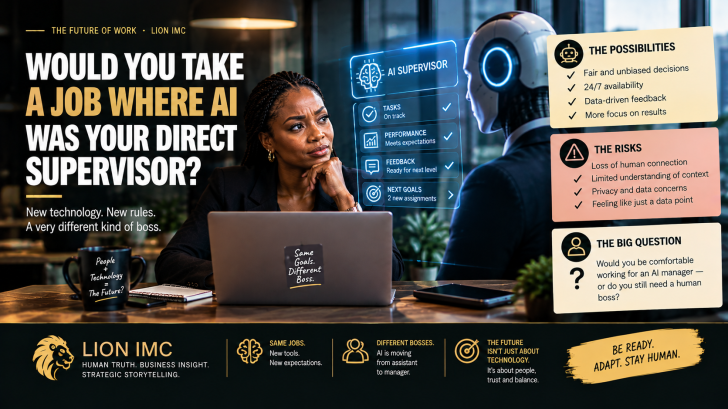
Dear Lion, you started a new job on Monday morning.
Before you have met your manager, an AI system has already reviewed your performance targets, assigned your first tasks, scheduled your deadlines and analysed your previous work.
By lunchtime, it has flagged you for falling behind.
At 2 p.m., it recommends additional training.
Before you close your laptop, it has updated your performance score, compared your output with that of your colleagues and assigned you a new target for the following week.
You have not had a disagreement with your boss. You have not received a warning from HR. Nobody has called you into an office.
Your supervisor is software.
It does not get tired. It does not forget a deadline. It may even apply the same rules to everyone.
But can it understand why you missed a deadline when your child was ill? Can you explain yourself when its assessment is wrong? And if the system recommends that you should not be promoted, who gets to challenge that decision?
Welcome to one of the more uncomfortable questions emerging from the future of work: would you accept a job where artificial intelligence was your direct supervisor?
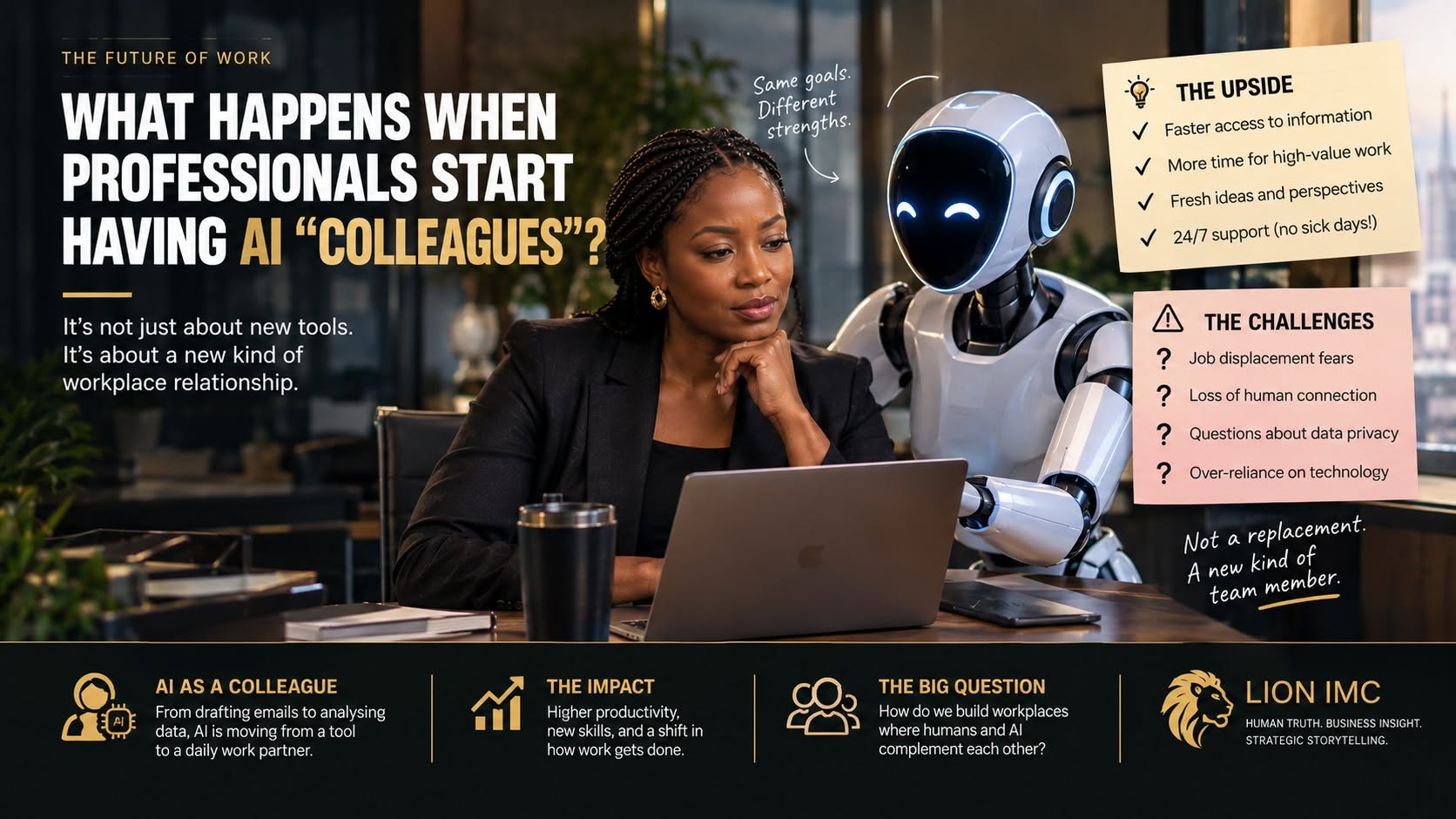
Your next boss may already be part machine
The idea sounds futuristic, but parts of it are already happening.
Organisations use software to allocate tasks, monitor productivity, evaluate performance, recommend decisions and manage workflows. The International Labour Organization describes these arrangements as algorithmic management: using data-driven systems to organise, assign, monitor, supervise or evaluate work. Some systems use AI; others rely on predefined rules and algorithms.
Consider a delivery worker whose app determines which jobs to accept, a customer-service representative whose dashboard measures response times, or an employee whose performance targets are automatically generated from output data.
These workers may still have human managers. But software increasingly influences the instructions they receive, the way their work is assessed and the consequences of their performance.
The next step is not necessarily a robot sitting in the manager’s chair.
It could be an AI system that assigns your workload, gives you feedback, decides when you need training and recommends whether you deserve a reward.
Your human manager may remain in the organisational chart while the software increasingly shapes your working day.
That is a meaningful change in the relationship between employees and employers.
The case for an AI boss: perhaps it would be fairer
Let us consider the argument in favour.
Human managers have limitations. They forget things, misinterpret situations, favour employees they personally like and sometimes allow their moods to influence their decisions.
One manager may reward the employee who stays late, even when another employee consistently delivers better results within normal working hours.
Another may remember one visible mistake while overlooking months of good performance.
An AI supervisor could, in principle, apply agreed criteria consistently, analyse large amounts of work-related information and identify patterns a manager might miss.
Imagine a sales team in which performance is evaluated using clearly defined measures rather than personal relationships. Or a customer-service operation where employees receive timely feedback instead of waiting until an annual appraisal to discover that something is wrong.
A well-designed system might help managers identify training needs, distribute work more consistently and reduce some forms of arbitrary decision-making.
There is evidence that organisations see value in these tools. An OECD survey of more than 6,000 firms across France, Germany, Italy, Japan, Spain and the United States found that managers using algorithmic management tools often perceived improvements in decision-making quality. However, the survey also found concerns about accountability, transparency and worker health. These are findings from the countries surveyed, not proof that the same outcomes would occur in every Nigerian workplace.
The important qualification is that consistency is not the same as fairness.
A system can apply the same rule to everyone and still produce an unfair result if the rule is inappropriate, the data are incomplete or the performance measure ignores important differences between employees.
An AI supervisor is only as defensible as the decisions it makes, the information it uses and the process available to challenge it.
But what happens when the AI gets it wrong?
Imagine that your manager asks you to resolve 100 customer complaints a day.
You resolve 85 because several cases are unusually complicated. You spend additional time helping customers whose problems cannot be solved with standard responses.
Another employee resolves 110 complaints, but handles the simplest cases first.
The AI system ranks the second employee higher.
On paper, the result looks straightforward. One person handled more cases than the other.
But the numbers may not capture the complexity of the work, the quality of the solutions or the long-term value of the customer relationships.
This is one of the central problems with automated management: what can be measured easily is not always what matters most.
The same issue could arise in marketing, banking, healthcare, journalism, sales, public administration and countless other professions.
A system that measures how many articles a journalist produces may overlook the quality of the reporting. A sales algorithm may reward immediate revenue while ignoring whether customers were misled. An employee dashboard may measure how quickly a task was completed without recognising the judgement required to complete it properly.
And when the AI’s assessment is wrong, the employee needs more than a button labelled Submit Appeal.
They need a meaningful explanation, a fair review and a person with the authority to correct the decision.
The hidden danger: becoming a number instead of a professional
There is another risk that deserves attention.
A human manager can sometimes recognise that an employee’s performance has changed because of a difficult assignment, a workplace conflict, a personal crisis or a need for additional support.
A well-designed AI system may identify patterns that deserve attention, but it cannot automatically understand every circumstance behind those patterns.
Even when a system can process additional information, that does not mean it should collect every detail of an employee’s life.
The more data an employer gathers, the more important questions arise about privacy, consent, accuracy, access and how long the information should be retained.
The OECD’s research on workplace AI has highlighted concerns about work intensity, employee monitoring, privacy and reduced autonomy in some settings. The effects depend on how the technology is implemented; AI does not inevitably make every workplace more stressful or less humane.
Imagine an employee whose productivity drops for two weeks.
An AI system might flag a performance problem. A good organisation would use that information as a reason to investigate and offer appropriate support, rather than immediately treating the employee as a liability.
A poorly governed system could do the opposite: increase monitoring, issue automated warnings and intensify targets without understanding what is happening.
The difference is not simply the sophistication of the technology.
It is the philosophy of management behind it.
Is the system being used to help people perform better—or to extract more work from them?
Would an AI supervisor understand Nigerian workplaces?
This question becomes particularly interesting in Nigeria, where workplace realities can differ considerably across industries and organisations.
Consider a sales representative dealing with a delayed delivery, a disrupted route or a stock shortage. A system that evaluates sales results without accounting for these constraints may judge the employee unfairly.
Consider a communications professional whose campaign is delayed because a client has not approved the content. A system that evaluates delivery dates without understanding the approval process could assign responsibility to the wrong person.
Or consider a junior employee who needs guidance that a performance dashboard cannot provide.
These are examples of potential problems, not claims that every AI management system currently behaves this way. They illustrate why the context surrounding work matters.
A responsible AI supervisor would need to distinguish between an employee’s performance and the conditions under which that performance occurred.
It would also need to accommodate the different ways people contribute. Some professionals produce measurable output directly; others coordinate teams, manage relationships, prevent problems or make decisions whose value becomes visible only over time.
If an organisation cannot explain how its system evaluates these contributions, it should be cautious about allowing that system to make consequential employment decisions.
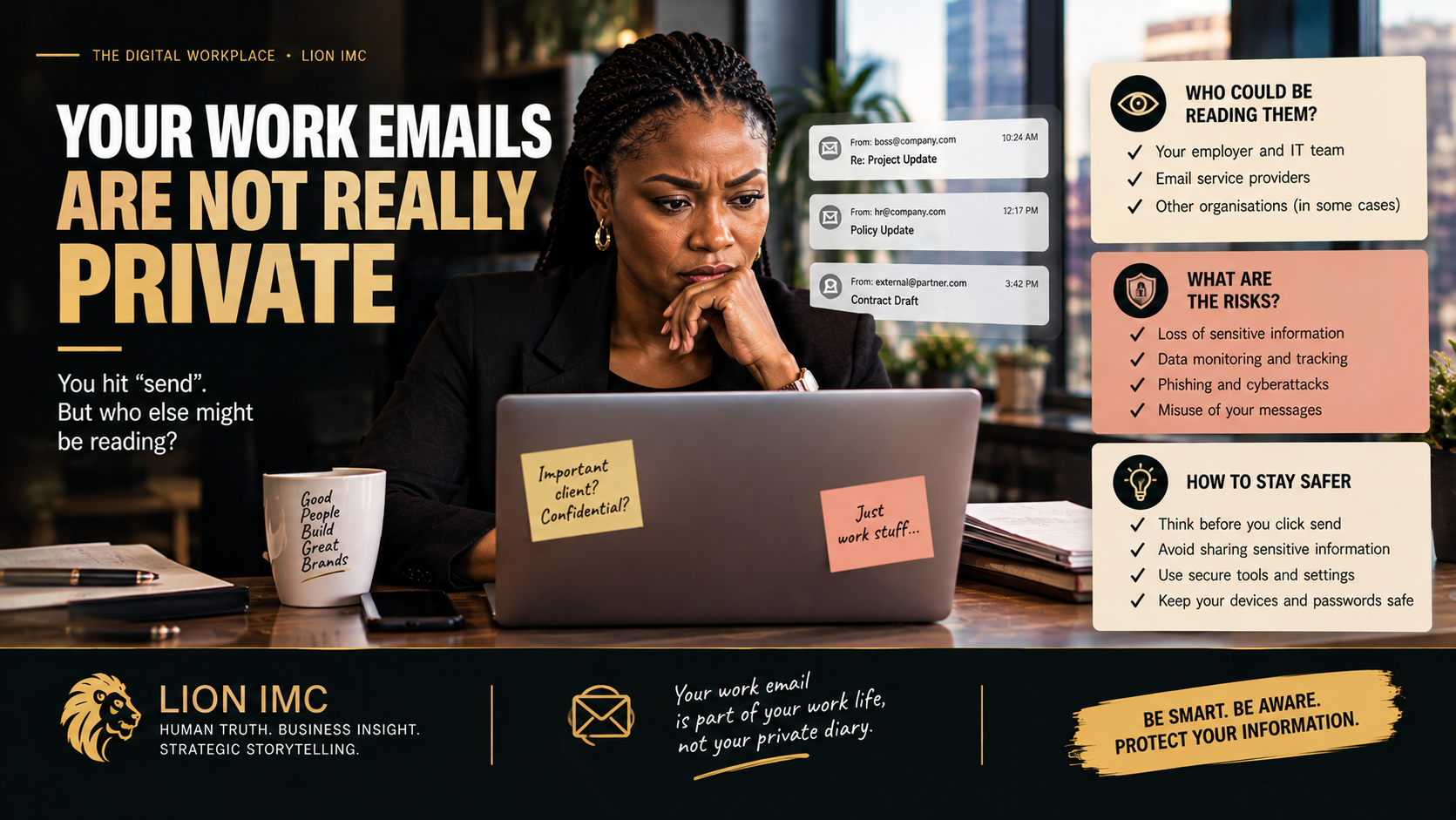
What if the AI is always watching?
Now imagine that your AI supervisor can analyse your working hours, keyboard activity, response times, messages, completed tasks and time spent away from your desk.
It might identify bottlenecks and help distribute work. It could also create the feeling that every pause requires an explanation.
Would you feel comfortable taking a short break if the system recorded it as inactivity?
Would you feel safe experimenting with a new approach if every unsuccessful attempt affected your performance score?
Would you challenge a manager’s instruction if you knew the AI was recording your response and assessing your attitude?
Monitoring can create a particularly difficult contradiction: a company introduces AI to improve productivity but designs the system in a way that discourages the judgement, creativity and initiative that make employees valuable.
The ILO and the European Commission’s Joint Research Centre examined algorithmic management in sectors including logistics and healthcare across France, Italy, India and South Africa. Their 2024 report identified potential efficiency gains alongside concerns about job quality and intrusive worker surveillance. The inclusion of India and South Africa makes the research relevant to a wider range of workplace settings than studies focused exclusively on Europe or North America, although it does not establish how Nigerian workers would experience the same systems.
A workplace should not have to choose between accountability and dignity.
It should be able to set clear expectations, monitor legitimate work outcomes and protect its business without turning every aspect of an employee’s day into a surveillance exercise.
The most important question: who is accountable?
Suppose an AI supervisor recommends that an employee be denied a promotion.
The employee asks why.
The manager says the system generated the recommendation. The technology provider says the organisation configured it. The HR department says the model’s assessment is part of the established process.
Who takes responsibility?
This is not a minor administrative issue. It goes to the heart of whether employees can trust the system governing their careers.
The OECD’s 2025 research on algorithmic management identified unclear accountability and difficulty understanding how systems reached their decisions among the concerns reported by managers using these tools.
A responsible organisation should be able to answer five questions:
- What information does the system use to evaluate employees?
- Which decisions can it make independently, and which require human approval?
- Can an employee understand the reason for an adverse decision?
- Is there a genuine process for challenging errors or unfair outcomes?
- Which human manager is ultimately accountable for the decision?
These are not questions that can be answered by saying the AI is advanced or highly accurate.
Accuracy matters, but so do context, explainability, oversight and the ability to correct mistakes.
If an AI system can influence your income, career progression or continued employment, there should be a clear line of accountability that does not disappear behind the technology.
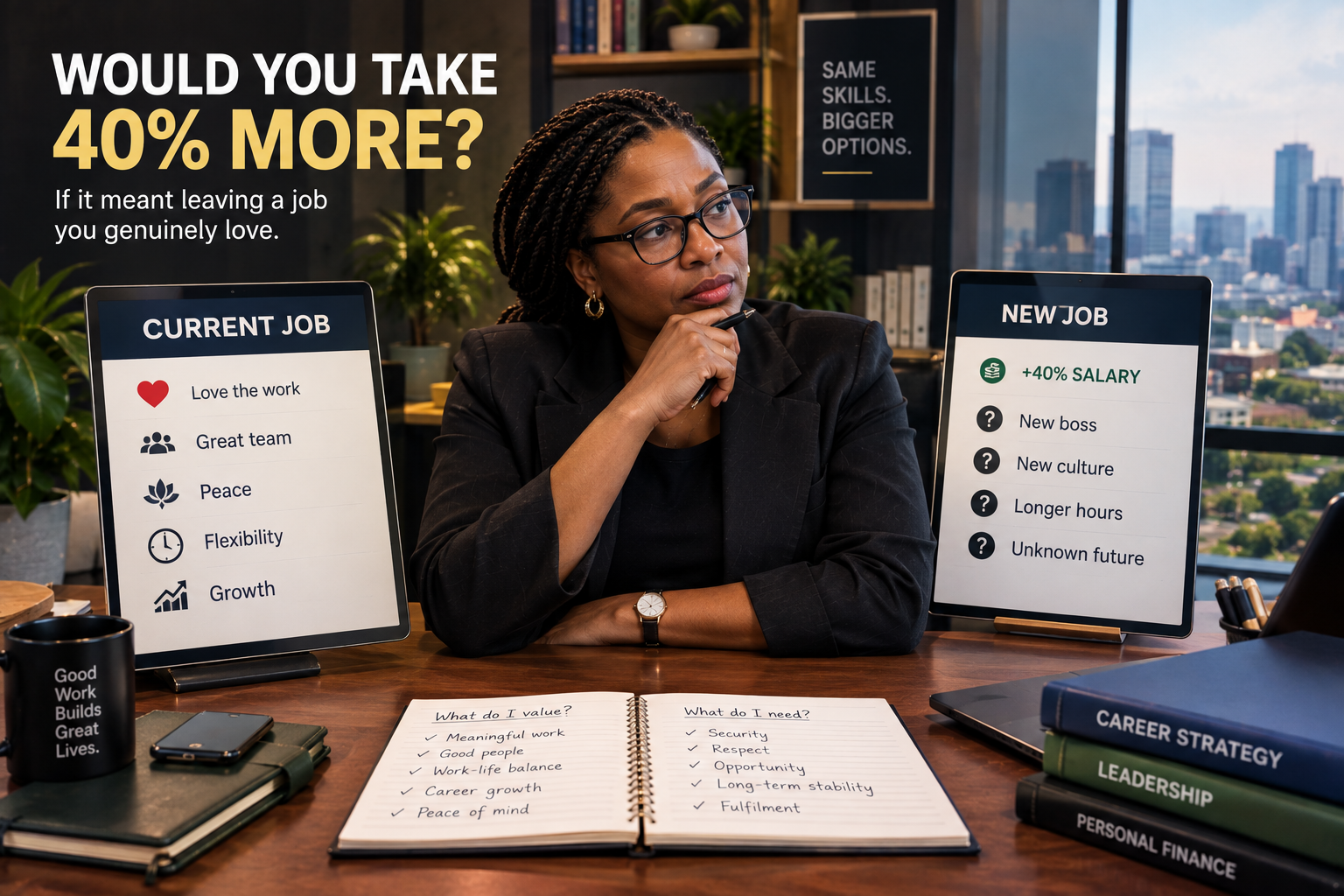
Would you take the job? It depends on the kind of AI boss.
There is a significant difference between an AI supervisor that helps you organise your work and one that controls your professional future.
The AI coach
It helps you prioritise tasks, provides feedback and recommends training. You retain discretion over how you work, and a human manager is available when you need support.
Potentially useful
The AI performance manager
It allocates work, tracks targets, scores performance and recommends rewards or corrective action. Its value depends heavily on whether its criteria are transparent, relevant and open to challenge.
Requires strong safeguards
The AI authority
It controls assignments, evaluates behaviour and makes consequential decisions with little explanation or meaningful human review.
High-risk arrangement
These are illustrative scenarios, not a formal classification of existing products. Real workplaces may combine elements of all three.
But the distinction offers a useful way to evaluate a job offer involving AI management.
Before accepting, ask what the system actually controls. Find out whether it merely recommends decisions or has the authority to make them. Ask how your performance will be measured, whether a human manager can review a disputed assessment, what employee data will be collected and how the company protects that information.
Most importantly, ask what happens when the AI is wrong.
The answer may tell you more about the employer than the technology itself.
What employers should understand before appointing an AI boss
For organisations considering AI-led management, the goal should not be to remove humans from management simply because automation is possible.
It should be to determine which management tasks benefit from automation and which require human judgement, empathy, negotiation or accountability.
That means starting with the problem the organisation is trying to solve.
If managers spend too much time scheduling routine tasks, automation may help. If performance reviews are inconsistent, a system could support more structured assessments. If employees lack timely feedback, AI might provide useful guidance.
But if the underlying problem is poor leadership, unclear targets or a culture of distrust, introducing an AI supervisor may simply automate those weaknesses.
Organisations should test systems before relying on them, consult affected employees, examine outcomes across different groups and establish procedures for human review. They should also avoid collecting unnecessary personal information and ensure that employees understand how their data will be used.
An AI system should support management responsibility, not become an excuse to avoid it.
And where decisions affect pay, promotion, discipline or termination, human accountability must be real—not a ceremonial approval after the algorithm has already decided.
The Lion Take
An AI supervisor might be more consistent than a difficult human boss. But consistency alone does not make a good manager.
Good management requires more than tracking output. It involves setting appropriate expectations, understanding context, developing people, making difficult judgements and taking responsibility when decisions go wrong.
AI may be able to perform some of these tasks or help humans perform them better. That does not mean every management responsibility should be handed over to a system simply because it can be automated.
For professionals, the question is not whether AI belongs in management. It increasingly does.
The real question is whether it will be used to make work more intelligent and fair or to make employees easier to measure, monitor and control.
And for employers, the challenge is to prove that an AI supervisor can do more than manage numbers.
It must contribute to a workplace where people can understand expectations, challenge mistakes, exercise judgement and remain accountable to one another.
The Big Question: Would you accept a job where AI assigned your tasks, monitored your performance and recommended your promotion or dismissal as long as a human could review its decisions? Or is having a human supervisor an essential part of a healthy working relationship?