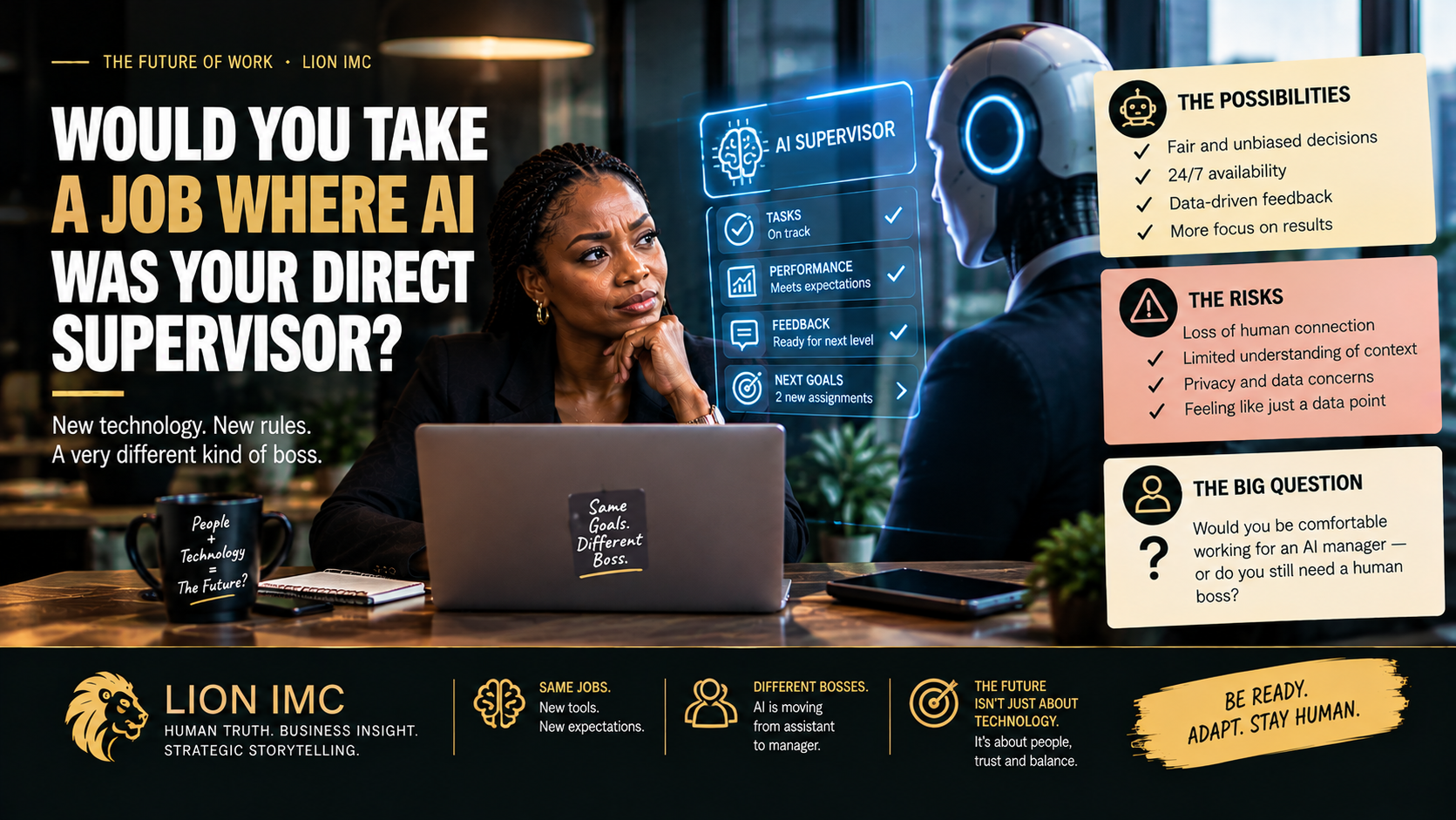






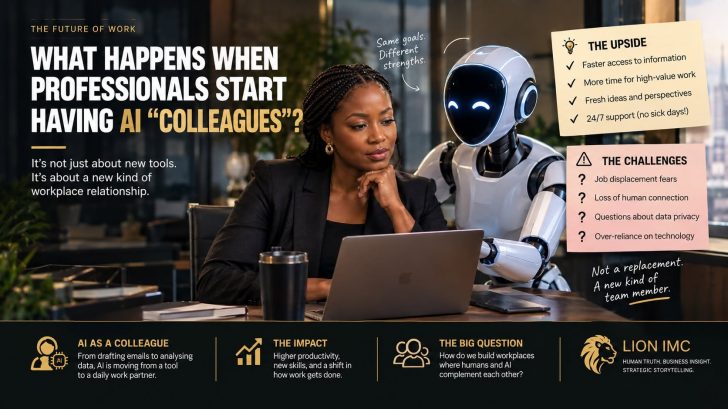
AI is no longer just a tool people open when they need help. It has become something they work with drafting, analysing, researching, planning and sometimes making decisions alongside them.
But there is a bigger question beneath the productivity conversation: What happens to professional judgement, workplace relationships, accountability and job security when your new “colleague” is not human?
Imagine arriving at work on Monday with a research assistant who never complains about your deadline, a writing partner who can produce a first draft in seconds, an analyst who can sift through hundreds of pages, and a planning assistant who can help organise your next project.
You have not hired four people. You have opened four AI tools.
Now imagine that your colleagues have similar assistants, your manager expects everyone to deliver faster, and the company begins asking whether the team still needs as many people to complete the same amount of work.
Suddenly, AI is no longer just a clever application on your laptop. It has become part of your working environment and a new question emerges: what does it mean to be a professional when some of the work traditionally associated with professional expertise can be delegated to a machine?
From using a tool to working with a “colleague”
For years, workplace technology has helped people do their jobs. Spreadsheets made calculations easier. Search engines made information more accessible. Collaboration platforms connected colleagues across offices and time zones.
Generative AI introduces a different kind of assistance. It can help draft a proposal, summarise a lengthy report, compare options, generate campaign ideas, write code, analyse information or prepare a presentation. More advanced AI agents are being developed to carry out sequences of tasks with varying degrees of human direction.
That changes the nature of the relationship between a professional and the technology.
Instead of simply operating a tool, the professional increasingly gives instructions, evaluates the output, corrects mistakes and decides what happens next. In some workflows, the professional may even delegate a task to an AI system and return to review the result.
Microsoft’s 2025 Work Trend Index described the emerging workplace in terms of human-agent teams, with employees increasingly expected to build, direct and manage AI agents. Its survey drew on 31,000 people across 31 countries, alongside workplace data and other research.
The shift is significant, but the word colleague deserves quotation marks. An AI system can contribute to a task without possessing human understanding, personal responsibility or the lived experience of the people affected by its output.
It may feel like a colleague. It may perform some tasks associated with one. But it is not a human colleague in the full sense of the word.
And that distinction matters.
The upside: professionals could do more of the work that really matters
Consider a communications manager preparing for a product launch. Previously, the work might involve starting research from scratch, reviewing background documents, drafting messages, developing questions for interviews and coordinating several versions of the same material.
An AI assistant could help organise the research, propose initial messages, identify gaps in a draft and adapt content for different audiences.
The manager still needs to establish the strategy, understand the brand, judge the audience’s likely reaction and ensure the communication is accurate. But the time required to reach a workable first draft may shrink.
A lawyer could use AI to help organise documents for review. An accountant might use it to explain financial patterns that require further investigation. A lecturer could develop teaching materials more quickly. A small-business owner could explore customer feedback without first assembling a large research team.
The opportunity is not simply to work faster. It is to redirect human attention towards work that requires judgement, relationships, creativity, context and responsibility.
A 2024 research paper published in Proceedings of the ACM on Human-Computer Interaction examined different models of human-AI collaboration. Its experimental findings suggested that people experienced greater work meaningfulness when they interacted directly with AI while remaining involved in decisions and accountable for actions, compared with arrangements that positioned them primarily as supervisors of an automated process.
That offers an important insight: the way AI is introduced into a job may matter almost as much as the technology itself.
If AI removes repetitive work and gives professionals more room to think, create and solve problems, it could improve the experience of work. If it merely accelerates the production of tasks that nobody has time to review, the benefit becomes less convincing.
The catch: when everyone becomes faster, does anyone actually gain time?
Here is where the workplace conversation gets interesting.
Suppose an employee previously needed three hours to produce a report. With AI assistance, the first draft can be prepared in 30 minutes. That sounds like a clear productivity gain.
But what happens next?
The manager may expect three reports instead of one. The employee may be assigned additional responsibilities because the task is now considered easy. Deadlines may become shorter. Other departments may demand more versions, more analysis and more output.
The saved time disappears into a larger workload.
This is not an inevitable outcome of AI adoption. It is a management choice. Yet it exposes a question organisations should confront before celebrating productivity gains: are we using AI to improve work, or simply to increase the amount of work people are expected to produce?
A professional who uses AI to finish a task earlier should not automatically be rewarded with an endless queue of additional tasks. Sometimes the gain should mean more time for thoughtful work, better service, professional development or simply a more manageable working day.
If every efficiency improvement becomes a reason to raise expectations, employees may become more productive on paper without feeling any better off.
The organisation gains speed. The employee gains another deadline.
That is not the only possible future but it is one worth avoiding.
The uncomfortable question: who gets replaced, and who gets promoted?
It is tempting to treat AI and job security as a simple contest between humans and machines. The reality is more complicated.
Some tasks may be automated. Some jobs may shrink or disappear. Others may change substantially, while new responsibilities and occupations emerge. The outcome will depend on the work involved, the technology available, how organisations deploy it and whether workers receive opportunities to adapt.
The International Labour Organization’s 2025 update on generative AI estimated that one in four workers globally is in an occupation with some degree of exposure to generative AI. Crucially, its analysis concluded that transformation of jobs is generally more likely than outright replacement, because most occupations still require human input.
That is a global assessment, not a guarantee about any particular profession or a Nigeria-specific forecast. It does, however, challenge the idea that the only relevant question is whether AI can do someone’s job.
A more useful question is: which parts of that job can AI perform, which parts still require a person, and how will the balance change?
For a junior professional, this could mean fewer opportunities to learn through routine assignments if those assignments are increasingly automated. For a senior professional, it could mean managing AI-assisted work while spending more time on decisions, client relationships and accountability. For a business owner, it could mean accomplishing more with a small team but also needing to rethink training, supervision and quality control.
There is a risk that organisations will expect experienced employees to become more productive without investing in their development, while reducing the entry-level tasks through which less experienced workers traditionally gain practical knowledge.
If the routine work disappears, where will the next generation of experienced professionals learn to do the difficult work?
That question deserves attention from employers, professional bodies and educational institutions. A workplace that automates today’s training ground without creating tomorrow’s learning opportunities may solve a short-term efficiency problem while creating a longer-term talent problem.
The World Economic Forum’s Future of Jobs Report 2025, based on employer expectations across 55 economies, likewise highlighted the importance of both technological capabilities and human skills. Its projections are not a prediction for every country or company, but they reinforce the need to prepare people for changing work rather than assuming that a technology purchase alone will prepare an organisation.
Your AI colleague can be useful and still be wrong
There is another difference between an AI assistant and a human colleague: the confidence with which an answer is delivered does not necessarily indicate how reliable it is.
An AI system can produce a polished report containing inaccurate information. It can misunderstand a brief, miss important context, reproduce bias or suggest an answer that sounds reasonable but is unsuitable for the situation.
A professional who copies and submits the output without checking it has not delegated responsibility. They have delegated the work while retaining the consequences.
Consider a Nigerian company preparing a public response to a customer complaint. AI might produce a beautifully worded apology in seconds. But it may not know the full history of the complaint, the company’s contractual obligations, the sensitivities of the customer relationship or the implications of admitting a particular failure.
A human professional must establish what happened, verify the facts, determine what the organisation can honestly promise and decide whether the response is appropriate.
The same principle applies to financial analysis, recruitment, legal work, healthcare, journalism and other settings where errors can affect people’s money, rights, reputations or wellbeing.
AI can help produce the answer. It does not automatically make the answer right.
The emerging professional skill is therefore not simply knowing how to prompt a chatbot. It is knowing how to brief it, question it, verify its work, recognise its limits and decide when not to use it.
That may sound less glamorous than building an AI-powered workforce, but it is central to making one dependable.
Can you trust an AI team member?
Trust in a human colleague develops through experience. You learn whether the person meets deadlines, protects confidential information, admits mistakes and can be relied upon when the pressure rises.
Trust in AI requires a different kind of assessment.
A 2024 study published in the Journal of Occupational and Organizational Psychology examined trust in teams involving humans and AI through two experiments involving 828 participants. The findings were nuanced: trustworthiness perceptions mattered, and some differences between human-only and human-AI teams appeared in two-person teams but not in the same way in three-person teams. The results suggest that trust in AI-enabled teamwork depends partly on the team context, rather than following one universal rule.
For a workplace, this means employees need more than instructions to “embrace AI.” They need to know what a system is permitted to access, which tasks it can carry out, how its output should be checked and who is accountable when something goes wrong.
Confidentiality is particularly important. A professional might be tempted to paste a client’s proposal, an employee’s personal information, an unpublished business strategy or internal financial records into a convenient AI tool. Whether that is appropriate depends on the tool’s terms, the organisation’s policies, applicable law and the sensitivity of the information.
A company that encourages AI use without setting clear rules may unintentionally expose its employees and clients to risks they do not fully understand.
The sensible approach is neither blind trust nor blanket rejection. It is earned, bounded trust: use AI where it has demonstrated value, verify what matters, limit its access appropriately and retain human oversight where the consequences warrant it.
The human skills may become more valuable, not less
When a machine can produce a draft, a summary or a list of ideas, the value of a professional may shift towards deciding what deserves to be written, what the information means and what action should follow.
A marketer still needs to understand customers. A communicator still needs judgement about tone, timing and public sentiment. A manager still needs to resolve conflict and earn trust. An analyst still needs to understand what the numbers mean in context. A leader still has to make decisions that people will live with.
AI may help with the preparation. It cannot automatically supply the wisdom required to use the preparation well.
This does not mean every human skill is immune to automation or that technical competence will become less important. It means professionals will increasingly need a combination of capabilities: the ability to work with AI, the expertise to judge its output, and the interpersonal skills to work effectively with other people.
For Nigerian professionals, the practical implications are immediate. It is worth experimenting with relevant AI tools, but experimentation should be connected to actual work: Can the tool improve the quality of a proposal? Help analyse customer feedback? Reduce time spent on repetitive administration? Support learning in a new field?
The next step is to learn how to check the output and understand the risks—not simply to count how many tasks the tool can perform.
And employers should make AI training accessible across levels, rather than treating it as a privilege for senior staff or expecting employees to master new systems in their own time without guidance.
What should employers do before AI becomes everyone’s “colleague”?
Organisations do not need to wait for a perfect AI strategy before beginning. But they should be deliberate about the workplace they are creating.
- Redesign work, not just workloads. Identify where AI genuinely removes friction and decide how the recovered time should be used.
- Set clear accountability. Specify which decisions require human approval and who is responsible for the final output.
- Protect confidential information. Establish approved tools, access rules and practical guidance on sensitive data.
- Train people to judge, not just operate, AI. Prompting is useful; verification, critical thinking and subject expertise are essential.
- Preserve pathways for junior talent. If routine tasks are automated, create other ways for less experienced employees to practise, receive feedback and develop expertise.
- Measure outcomes beyond speed. Examine accuracy, customer experience, employee workload, cost, risk and business results—not output volume alone.
- Talk honestly about job changes. Employees should not have to rely on rumours to understand whether automation will change their responsibilities, training or employment prospects.
These are not merely technical decisions. They are choices about management, workplace culture, professional development and the distribution of the benefits of productivity.
The real question is what kind of colleague we are becoming
The arrival of AI “colleagues” will not mean the same thing to everyone.
For one professional, it may be the assistance that makes a previously overwhelming workload manageable. For another, it may create uncertainty about whether their skills will remain valuable. For a business owner, it may open the door to work that was once too expensive or time-consuming. For a manager, it may demand a new understanding of delegation and accountability.
The technology itself does not determine which of these outcomes becomes the dominant experience. Organisational choices will play a major role.
If AI helps people think more clearly, learn faster, serve customers better and spend more time on work that requires human judgement, it can become a valuable partner in professional life.
If it is used mainly to squeeze more output from employees, conceal workforce reductions behind the language of innovation or remove opportunities for people to develop their expertise, the workplace may become more automated without becoming better.
Perhaps, then, the most important question is not whether AI will become our colleague.
It is whether organisations will learn to work with it in ways that make work more productive and more worthwhile for the people doing it.
The Lion Take
AI may become part of your team. But your judgement, integrity and responsibility cannot simply be outsourced with the task.
The professionals best prepared for this shift will not necessarily be those who use the most AI. They will be those who know where it adds value, where it falls short and how to combine its capabilities with sound human judgement.
The big question: If AI could take over 30% of your current workload tomorrow, what would you want to spend that recovered time doing and would your employer let you?