







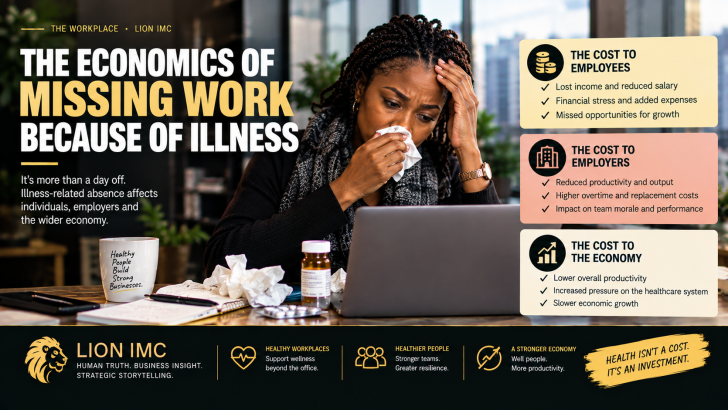
The real economic question is not simply how much work is lost when an employee stays home sick. It is also what happens when someone cannot afford to miss work, comes in unwell, performs below capacity, infects colleagues, or delays treatment until a manageable illness becomes a more serious problem.
The World Health Organization and International Labour Organization estimate that depression and anxiety alone account for 12 billion working days lost globally each year, costing the global economy approximately US$1 trillion annually in lost productivity. These are global estimates, not figures specific to Nigeria.
The day an employee stays home is only the beginning
Imagine a sales executive in Lagos who wakes up with a fever. She has an important client presentation, a monthly target to meet and bills that will not wait.
She considers staying home. Then she remembers the work piling up, the possibility of being labelled unreliable and the money she might lose if her absence affects her earnings.
So she gets dressed, travels through traffic and arrives at work.
On the attendance register, she is present. In reality, she may be operating at a fraction of her normal capacity.
This is where the economics of illness becomes more complicated than counting sick days.
1. The employee pays more than the cost of treatment
Illness can create several financial pressures at once: consultation fees, medication, transport to a health facility and additional care responsibilities at home.
Depending on the person’s employment terms, sickness may also mean lost earnings, exhausted leave days or pressure to make up missed targets.
For a professional supporting children, parents or other relatives, the consequences can extend beyond the workplace. One missed day may mean rearranging household expenses. A prolonged illness can put savings, school fees and rent under pressure.
There is another cost that rarely appears on a payslip: the career anxiety associated with being absent.
Employees may worry that they will miss a promotion opportunity, lose a client, disappoint their manager or be seen as less committed than colleagues who are always available.
The result is a troubling incentive: the employee may feel compelled to protect their income by making decisions that prolong their illness or reduce their ability to work effectively.
That does not mean every employee who attends work while sick is making an unwise decision. Some illnesses are mild, and individual circumstances differ. The problem is a workplace culture that makes people feel they cannot recover without paying a professional price.
2. When showing up becomes more expensive than staying home
Economists and workplace researchers distinguish between two related problems:
- Absenteeism: time away from work because of illness.
- Presenteeism: being at work while ill or otherwise unable to perform at one’s usual capacity.
Absence is relatively easy to see. Presenteeism is harder to measure because the employee may be physically present while struggling to concentrate, make decisions, serve customers or complete tasks.
The WHO’s guidelines on mental health at work recognise that lost productivity while people remain at work can be a substantial part of the economic burden of poor mental health.
Consider a simple illustration. An employee whose normal daily output is worth ₦40,000 to the business works while ill but manages only half that output. The business has not necessarily lost the entire ₦40,000, but it may have lost ₦20,000 in productive capacity that day.
That is only an illustration, not a universal measure. Actual losses depend on the role, illness, tasks, support available and how output is valued.
Now consider a different scenario: the employee stays home, rests, receives appropriate care and returns sooner in better condition. In some circumstances, that absence may be less costly than several days of impaired performance.
The cheapest-looking option in the attendance register is not always the cheapest option for the business.
3. What illness costs an employer
For employers, the bill can extend far beyond the salary paid during an absence.
Lost output
Projects slow down, sales opportunities may be missed, deadlines shift and decisions wait for someone to return.
Pressure on colleagues
Other employees absorb additional duties. If this continues, it can contribute to fatigue, resentment and further absences.
Customer and commercial risk
Missed appointments, delayed responses and inconsistent service can weaken customer confidence and affect revenue.
Replacement and recovery costs
Temporary cover, overtime, rescheduling, recruitment and training can add to the expense, particularly when illness contributes to prolonged absence or staff turnover.
There is also the risk of transmission when an employee with a contagious illness works in close contact with others. In that situation, the decision to work while unwell can turn one person’s illness into a wider operational problem.
This is why managers should not treat every sick day as an individual inconvenience. Some absence is unavoidable, but the way an organisation manages health can influence how costly the consequences become.
4. Why the Nigerian context deserves attention
In Nigeria, the economics of sickness absence cannot be understood without considering differences in income security, access to healthcare, employment arrangements and the realities of household financial obligations.
A salaried employee with paid sick leave may face a very different financial decision from a contract worker, daily-paid employee, trader or self-employed professional whose income depends on working that day.
For an informal worker, missing a day may mean losing the day’s earnings entirely. For a small business owner, it may mean postponing deliveries, losing customers or paying someone else to keep operations moving.
For a company, the impact also depends on whether essential tasks can be reassigned, whether staff are cross-trained and whether there is a realistic plan for covering absences.
It would be misleading to assign one financial figure to all Nigerian workers. The available global estimates demonstrate the scale of the issue, but they do not establish the precise cost of sickness absence across Nigerian industries.
What is clear is that the financial consequences of illness are not distributed equally. Workers with fewer financial buffers may have less freedom to rest when they need to, while businesses with limited staffing may find it harder to absorb an employee’s absence.
That is a workplace and economic issue, not simply a question of individual discipline.
5. The hidden cost of treating health as a personal problem
Some organisations approach employee illness as though it begins and ends with the employee: a person is absent, a manager records it, and work continues.
But work itself can affect health. Excessive workloads, poor management, bullying, job insecurity and unhealthy working conditions can contribute to psychological distress and other risks.
The WHO and ILO recommend addressing workplace risks, improving managers’ ability to support mental health and making appropriate accommodations for workers who need them.
This matters because employers cannot always prevent illness, but they can influence some of the conditions that make illness more likely, recovery harder or returning to work more difficult.
A company that routinely rewards exhaustion, discourages medical appointments or makes staff fear reporting illness may save time on paper while accumulating costs elsewhere.
There is a difference between managing attendance responsibly and creating an environment in which employees hide health problems.
The former supports business continuity. The latter can undermine it.
6. Is investing in employee health economically sensible?
The question for management is not whether every wellness initiative will produce a measurable return. It is whether the organisation understands the causes and consequences of ill health well enough to make sensible decisions.
Depending on the workforce, useful measures may include:
- Clear, fair sickness-absence policies that employees understand.
- Reasonable access to healthcare and appropriate health benefits.
- Workloads and staffing arrangements that allow essential duties to continue when someone is absent.
- Managers who respond to illness with discretion and consistency rather than automatic suspicion.
- Safe working conditions and attention to preventable physical and psychological risks.
- A sensible return-to-work process, including temporary adjustments where appropriate.
- Tracking patterns in absence, turnover, overtime and workload without compromising employee privacy.
Employers should also distinguish between occasional illness, repeated short-term absences and prolonged health-related absence. Each may require a different response, and absence data alone cannot establish the cause.
The goal is not to pressure sick employees to return sooner. It is to reduce preventable illness, support appropriate recovery and make work resilient enough to accommodate genuine human needs.
7. What should employees do?
Employees also have practical decisions to make, although their options depend on their circumstances.
Know your organisation’s leave policy and reporting process. Seek appropriate medical advice when necessary. Communicate about your capacity to work without disclosing more private medical information than is required. Where possible, document urgent handovers and agree on priorities before stepping away.
Most importantly, do not assume that working through every illness is proof of commitment.
There are circumstances where continuing to work may be reasonable. There are others where rest, treatment or staying away from the workplace is the more responsible decision for the employee, colleagues and customers.
Workers should not be expected to solve a structural workplace problem through personal sacrifice alone.
The Lion Take
Illness has a human cost before it becomes an economic one. Someone is in pain, worried about money, caring for a family member or trying to recover enough to resume normal life.
But businesses cannot ignore the economics either. Lost output, disrupted service, replacement costs and the consequences of working while unwell all affect performance.
The real management challenge is to avoid a false choice between employee wellbeing and business productivity. A healthy workforce is not a guarantee against disruption, and every health investment will not pay for itself in a neat spreadsheet. But preventing avoidable harm and supporting recovery can protect both people and organisational performance.
A sick day has a cost. So does making a sick person feel they cannot afford to take one.
The Big Question
When an employee misses work because of illness, does your organisation treat it as a personal inconvenience or as a business issue that deserves a thoughtful, humane and economically informed response?