







And let’s say the real story underneath it is not “insurance companies are simplifying their language.” It is bigger: For years, insurance has often asked customers to understand the industry before the industry understands the customer. That is beginning to change.
The interesting question is why now?
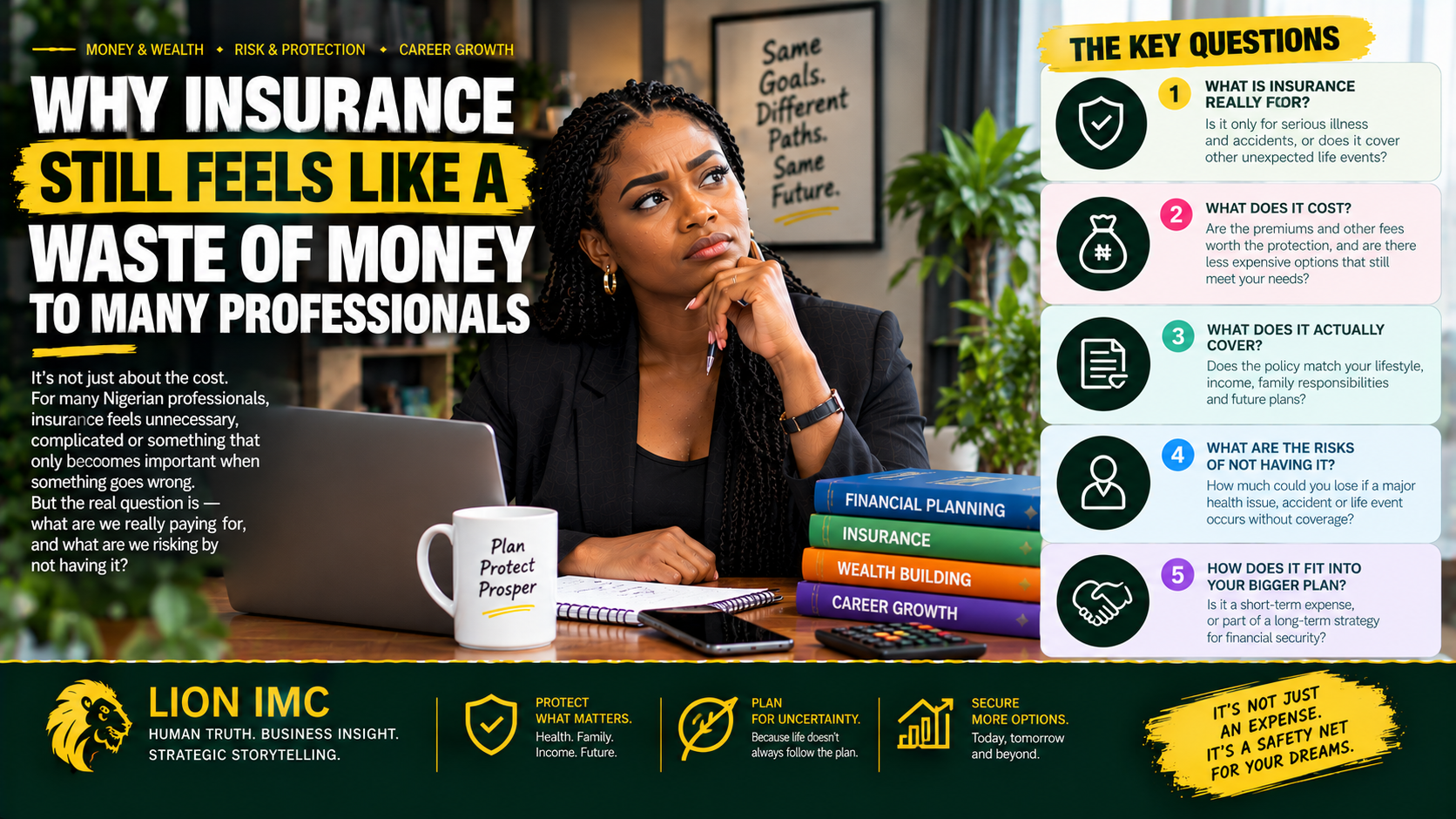
Insurance is moving into a world where customers compare products online, expect instant explanations, interact with fintechs and digital banks, and increasingly want to understand what they are buying, what it costs, what it covers and what happens when something goes wrong.
We found something especially useful in the current Nigerian insurance sphere: NAICOM itself is now explicitly calling for simpler insurance documentation and communication, more relatable public engagement, and clearer claims processes. So the title isn’t just an observation, there is a real industry shift underneath it.
Come to think of it. Insurance has always sold protection. The problem was that too many people needed a dictionary to understand the promise.
It is supposed to provide peace of mind.
The language can feel like anything but peace of mind.
Premiums.
Exclusions.
Sum assured.
Underwriting.
Indemnity.
Beneficiaries.
Policy conditions.
Terms and conditions.
All perfectly legitimate insurance language.
But there is a difference between language that is technically correct and language that a customer actually understands.
And the Nigerian insurance industry appears to be taking that distinction more seriously.
At Insurance Week 2026, the National Insurance Commission (NAICOM) made an unusually direct call for the sector to rethink how it communicates with the public.
The Commission said awareness campaigns need to become more targeted and relatable, using languages people understand, platforms they trust and real-life scenarios that connect with everyday experiences.
It also specifically called for insurance documentation and communication to become simpler, more transparent and easier to navigate.
That matters.
Because insurance has never had only an awareness problem.
It has an understanding problem.
And understanding is where trust begins.
THE CUSTOMER DOESN’T SPEAK INSURANCE
Imagine someone buying motor insurance.
The insurer may know exactly what “third-party liability” means.
The customer may simply want to know:
“If I hit somebody’s car tomorrow, what happens?”
Those are not two different questions.
They are two different ways of asking the same question.
The insurer starts with the product.
The customer starts with the situation.
That distinction explains much of the communication challenge in insurance.
People don’t wake up thinking about “comprehensive motor insurance.”
They wake up thinking:
What happens if my car gets damaged?
They don’t necessarily think about “life assurance products.”
They think:
What happens to my children if something happens to me?
A small-business owner may not be thinking about “business interruption insurance.”
They may be thinking:
If this shop burns down, how do I start again?
The language of insurance often begins with the policy.
The language of the customer begins with life.
The opportunity is to meet somewhere in the middle.
“SPEAKING HUMAN” IS NOT DUMBING INSURANCE DOWN
This is important.
Simplifying insurance does not mean removing technical accuracy.
It means explaining technical things without forcing the customer to become an insurance professional first.
There is a difference between saying:
“The policy provides indemnification subject to applicable exclusions.”
And saying:
“If a covered loss happens, we pay according to the terms of your policy. Here are the situations we don’t cover.”
The second statement doesn’t necessarily make the contract less rigorous.
It makes the promise easier to understand.
And when money, health, property or a family’s future is involved, understanding is not a nice-to-have.
It is part of the product experience.
NAICOM’s current position reflects precisely this concern: the regulator has linked public understanding with trust and has called for simpler communication around both products and claims.
THE CLAIM IS WHERE “HUMAN” REALLY MATTERS
Insurance advertising is easy when everything is going well.
The customer is smiling.
The family is protected.
The car is gleaming.
The business owner is confidently looking into the future.
Everybody is happy.
Then something happens.
The accident.
The fire.
The death.
The theft.
The hospital bill.
That is when insurance stops being an advertisement and becomes a relationship.
NAICOM described the claims experience as the “moment of truth” because that is where the promise of insurance is either fulfilled or undermined. The Commission has also called for customers to be clearly informed about claims documentation, timelines and expectations.
That may be the most important communication lesson in the entire industry.
Don’t only explain how to buy insurance. Explain what happens when you need it.
Tell the customer:
What do I submit?
Where do I submit it?
How long should it take?
What happens after I submit it?
Who do I contact?
What could cause a delay?
Why could a claim be rejected?
What happens if I disagree with the decision?
That is human language.
Not because it contains simpler words.
Because it answers the questions a human being is actually likely to ask.
THE DIGITAL CUSTOMER IS MAKING THE OLD LANGUAGE HARDER TO DEFEND
There is another reason this shift is happening.
The insurance customer has changed.
Nigerians increasingly encounter financial products through apps, websites, digital platforms, WhatsApp and other channels.
They can open accounts without visiting a bank branch.
They can transfer money without speaking to anyone.
They can compare products online.
They can track transactions from their phones.
So when they encounter insurance, they bring those expectations with them.
The question is no longer simply:
“Can I buy this insurance?”
It is increasingly:
“Why can’t I understand and manage this as easily as everything else?”
The industry is responding.
In 2025, Cornerstone Insurance introduced an AI-powered virtual assistant designed to provide faster responses and personalised guidance to customers.
FSL Insurance Brokers launched a digital platform allowing customers to explore, compare, purchase and manage insurance products digitally.
Leadway has also been deploying digital and AI-enabled tools intended to reduce friction in processes such as vehicle inspection and claims.
And in May 2026, NAICOM issued Nigeria’s first operational licence to a fully licensed partnering insurtech, another sign of the industry’s movement toward technology-enabled insurance services.
Technology alone, however, doesn’t make insurance human.
A chatbot can deliver confusing information very quickly.
A beautifully designed app can still hide important exclusions.
A digital claims process can still leave customers wondering what happens next.
The real transformation is not digital insurance. It is understandable insurance.
Technology is simply one of the tools that can make that possible.
THE INDUSTRY HAS A TRUST PROBLEM — AND LANGUAGE IS PART OF IT
Insurance is an unusual product.
You pay for something you hope never to need.
That already requires a considerable amount of trust.
Then add complicated language, unfamiliar products, exclusions and uncertainty about claims.
The customer is being asked to make a financial decision today about an event that may happen years from now.
That is a difficult proposition.
NAICOM has repeatedly placed consumer trust, policyholder protection and better service delivery at the centre of the industry’s current reform agenda. In August 2026, following completion of the sector’s recapitalisation exercise, the Commission said the transformation of the industry should strengthen consumer protection and public confidence.
That is significant because stronger capital alone cannot make insurance trusted.
Neither can bigger offices.
Neither can louder advertising.
Neither can a celebrity endorsement.
Trust grows when the customer’s experience repeatedly confirms the promise.
You said you would protect me.
You explained what protection meant.
You told me what it would cost.
You told me what wasn’t covered.
Something happened.
You told me what to do.
You did what you said you would do.
That sequence is far more powerful than any advertising slogan.
SPEAKING HUMAN MEANS TALKING ABOUT PEOPLE’S LIVES
Perhaps the biggest opportunity for insurers is to stop beginning every conversation with insurance.
Start with life.
Instead of:
“Get comprehensive motor insurance.”
Talk about what happens when a family’s only car is suddenly unavailable.
Instead of:
“Protect your business against unforeseen risks.”
Talk about what happens when the business that took ten years to build is interrupted by one unexpected event.
Instead of:
“Secure your family’s financial future.”
Talk about the practical financial consequences when the person paying the school fees, rent or business loan is suddenly gone.
The product hasn’t changed.
The entry point has.
And that is what good communication does.
It doesn’t make the product sound different.
It makes the product matter.
BUT THERE IS A DANGER
Insurance companies should be careful not to confuse sounding human with being customer-centric.
A warm Instagram caption is not customer experience.
A smiling customer in an advert is not proof of satisfaction.
A chatbot that says “We’re sorry you’re experiencing this” is not necessarily empathy.
And the phrase “We’ve got you covered” means very little if the customer discovers later that the situation was excluded.
This is where insurance communication must become more honest.
If something is not covered, say it clearly.
If a claim requires five documents, explain why.
If processing takes 10 working days, say so.
If the customer has a responsibility under the policy, explain it before the crisis rather than after it.
Clarity is not bad marketing.
It may be one of the strongest forms of marketing an insurance company can have.
THE BEST INSURANCE COMMUNICATION MAY ACTUALLY REDUCE SALES PRESSURE
This sounds contradictory.
It isn’t.
A customer who understands a product can make a better decision.
Sometimes that decision will be to buy.
Sometimes it will be to buy a different product.
Sometimes it will be to ask more questions.
That is not necessarily a marketing failure.
It can be evidence of trust.
Because the long-term value of insurance is not simply the number of policies sold.
It is whether customers understand what they bought, remain confident in the product and are willing to recommend the institution after experiencing it.
The industry therefore has an opportunity to move from:
“How do we convince Nigerians to buy insurance?”
to:
“How do we make insurance easier for Nigerians to understand, evaluate and trust?”
Those are different questions.
The second one may produce better answers.
THE NEW INSURANCE CUSTOMER DOESN’T WANT A LECTURE
They want an answer.
What does this cover?
What doesn’t it cover?
How much do I pay?
What happens if something goes wrong?
What do I need to do?
How long will it take?
Who is responsible?
Can I actually afford this?
Is this product right for me?
These questions are not signs that the customer doesn’t understand insurance.
They are signs that the customer is trying to understand the purchase.
The smartest insurers will not treat those questions as obstacles.
They will build their communication around them.
SO, ARE INSURANCE COMPANIES FINALLY LEARNING TO SPEAK HUMAN?
There are encouraging signs.
The regulator is explicitly calling for simpler communication, relatable scenarios and better claims transparency. Insurers and brokers are investing in digital platforms, AI-enabled assistance and technology intended to reduce friction. The broader regulatory reform agenda is also placing policyholder protection and trust more prominently in the conversation.
But the real test has little to do with advertising.
It is what happens when the customer needs the insurer.
Because insurance is not really tested when somebody buys a policy.
It is tested when something goes wrong.
That is when the customer discovers whether the company was merely good at explaining insurance —
or whether it actually understood the person it was selling to.
THE LION TAKE
You can make insurance sound human without making insurance human.
Real customer-centricity goes further.
It means designing products around real situations.
Explaining them in language people understand.
Making the buying process easier.
Making exclusions visible.
Making claims understandable.
Communicating delays honestly.
And giving customers a clear path when something goes wrong.
The future of insurance communication may therefore not belong to the company with the cleverest slogan.
It may belong to the company that can answer the customer’s simplest question without making the customer feel stupid for asking:
“What exactly happens to me if something goes wrong?”
Because the customer never really wanted to learn insurance.
The customer wanted to know whether the insurance would work when life stopped going according to plan.
And perhaps that is the most human conversation an insurance company can have.