






Many corporate workers believe paying premiums is pointless. However, before dismissing it entirely, it helps to understand the actual types of insurance in Nigeria and how they protect your wealth.”
Before then, let’s even establish this reality: It is easy for an insurance company to explain the promise. It is harder for a customer to know, before buying, what the experience will be when that promise is tested.
Nigeria’s insurance sector has had visible problems with claims disputes. In March 2025, reports on complaints published by the National Insurance Commission (NAICOM) highlighted 1,571 insurance-related complaints against insurers. The complaints covered several types of insurance, including motor, life, education and other policies.
That matters because people do not judge insurance only by its brochures. They judge it by stories from colleagues, relatives and friends who say they paid premiums but struggled to receive what they believed they were entitled to.
These experiences can damage trust well beyond the individual dispute.
But there is an important distinction: A complaint is not automatically proof that an insurer wrongly rejected a valid claim. Some disputes concern policy exclusions, missing documents, disclosure failures or disagreements about the circumstances of a loss. Others may reflect poor service, unreasonable delays or failure to honour obligations.
The customer needs to understand the policy. The insurer needs to communicate clearly and handle valid claims fairly.
NAICOM’s market-conduct guidelines require insurers to define and communicate claims procedures, explain relevant timeframes and maintain fair, transparent claims-handling and dispute-resolution processes.
For a professional deciding whether to buy cover, the practical lesson is simple: do not assess an insurance policy by the premium alone. Assess the insurer, the wording and the claims process too.
Understanding the Types of Health Insurance in Nigeria
For the average corporate professional, health coverage usually comes bundled as a workplace benefit. However, to truly maximize your coverage, it helps to understand how the different types of health insurance in Nigeria actually operate. Broadly, these are split into public schemes like the National Health Insurance Authority (NHIA) and private Health Maintenance Organizations (HMOs). Most professionals deal exclusively with private HMOs, which are further divided into tiers ranging from basic plans that cover malaria treatments to premium, international plans covering complex surgeries and maternal care.
Despite having these benefits, many corporate workers still feel they aren’t getting real value from their plans. This frustration usually stems from a lack of transparency regarding what your specific tier actually covers. It is incredibly common for a professional to walk into a hospital, expecting seamless care, only to be told that their plan doesn’t cover dental, optical, or specific diagnostic tests like CT scans. This mismatch between expectation and reality makes monthly health premiums feel like a financial drain rather than a safety net.
Furthermore, the rigid administrative bottlenecks of some Nigerian HMOs add to this skepticism. Waiting for hours at a clinic reception just to get an “authorization code” for a basic lab test leaves busy professionals feeling that paying out-of-pocket would have been faster. When you combine limited hospital networks with slow customer service, it is easy to see why many corporate workers dismiss health insurance as an unnecessary corporate formality instead of a critical wealth-protection tool.
What About Car Insurance in Nigeria?
If health insurance feels passive, vehicle coverage is where many professionals actively cut corners. For a vast majority of corporate workers, dealing with car insurance in Nigeria begins and ends at the licensing office or through a quick registration agent. The goal is rarely actual protection; instead, it is about obtaining a cheap, N15,000 third-party policy simply to pass police and vehicle inspection (VIO) checkpoints without getting fined. Because this minimum legal requirement offers zero financial coverage for your own vehicle, it feels like an annual tax you pay just to keep law enforcement off your back.
This “checkpoint mentality” is exactly why comprehensive coverage feels like an absolute waste of money right up until the moment an accident actually happens. In a country where road infrastructure can be unpredictable and reckless driving is common, a minor fender bender can instantly morph into a massive, unexpected out-of-pocket expense. When a corporate professional refuses to pay for comprehensive insurance, they are essentially gambling their hard-earned monthly salary against the chaos of Nigerian traffic.
The real shift in perspective happens when you experience a major hit. Paying a regular premium suddenly stops looking like a financial drain when your insurance company steps in to foot a N1.5 million repair bill after a collision. Moving away from treating car insurance in Nigeria as a mere law-enforcement shield and viewing it as asset protection is a critical milestone in a professional’s financial maturity.
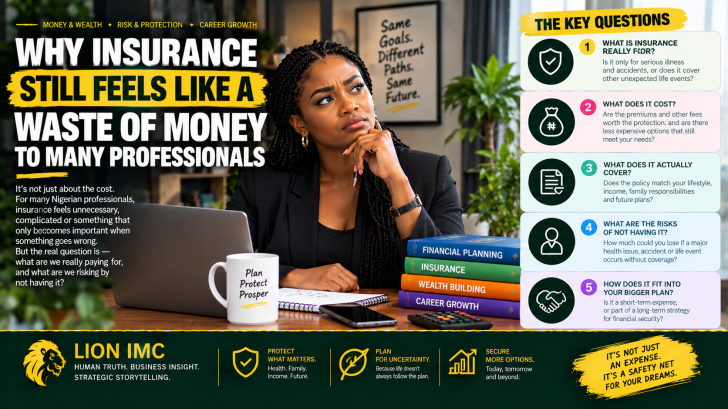
Five questions to ask before paying an insurance premium
Before committing to an insurance policy, ask questions that go beyond the sales pitch.
1. What specific financial loss am I protecting myself against?
Identify the risk and estimate what it would cost you or your dependants if it happened. Do not buy a policy simply because someone says every responsible professional must have one.
2. What exactly is covered and what is excluded?
Check limits, exclusions, waiting periods, deductibles, conditions and documentation requirements. If the salesperson’s explanation differs from the written policy, seek clarification before paying.
3. Can I afford the premium consistently?
A policy that lapses because the premium becomes unaffordable may not deliver the protection you expected. Compare the cost with your budget and understand the consequences of missed payments.
4. Is the provider properly licensed, and how are claims handled?
Verify the provider through NAICOM and ask how claims are submitted, what evidence is required and where disputes can be escalated. NAICOM provides online tools for checking operators and policy validity.
5. Do I already have some of this protection?
Check employer-provided benefits, existing life or health cover, motor insurance and any other policies you hold. Avoid paying twice for overlapping benefits unless the additional cover serves a clear purpose.
Insurance is not a substitute for savings
A professional needs both protection and accessible cash, but they solve different problems.
Savings can cover an unexpected expense without requiring an insurance claim. Insurance can protect against certain losses that would be too large to fund comfortably from savings alone.
For example, you might be able to save towards a laptop replacement. Rebuilding your home after a major fire or supporting dependants after the death of a principal breadwinner could be financially overwhelming without suitable protection.
The right balance depends on your circumstances, the risks you face, the policy terms and what you can afford.
Nor does every insurance product automatically make sense for every person. A policy with unsuitable cover, excessive cost or restrictions that do not fit your needs may be poor value. The answer is not to buy everything. It is to understand which financial risks you cannot comfortably carry yourself.
The bigger insurance question for Nigerian professionals
Insurance companies have a responsibility to earn trust through transparent terms, understandable products and fair claims handling. Professionals also need better information to make informed decisions.
Neither side benefits when insurance is sold through fear, when customers buy products they do not understand, or when valid claims become a battle.
The question is not whether you will ever receive more in claims than you pay in premiums. You might not. If the insured event never happens, that can be a good outcome.
The question is whether the protection is worth the cost given the financial consequences you would face if the covered event occurred.
THE LION TAKE
Insurance can feel like wasted money when nothing goes wrong. But the real cost of being uninsured becomes visible only when something does.
You do not need to insure every possible inconvenience. You need to understand which risks could seriously damage your financial life, which ones you can absorb yourself, and which ones are worth transferring to a suitable insurer.
The best policy is not necessarily the cheapest or the most expensive but the one you understand, can afford, and can rely on to provide the protection it actually promises.