




Lion, this is exactly the kind of sustainability convo we should be having not “save the planet” preaching.
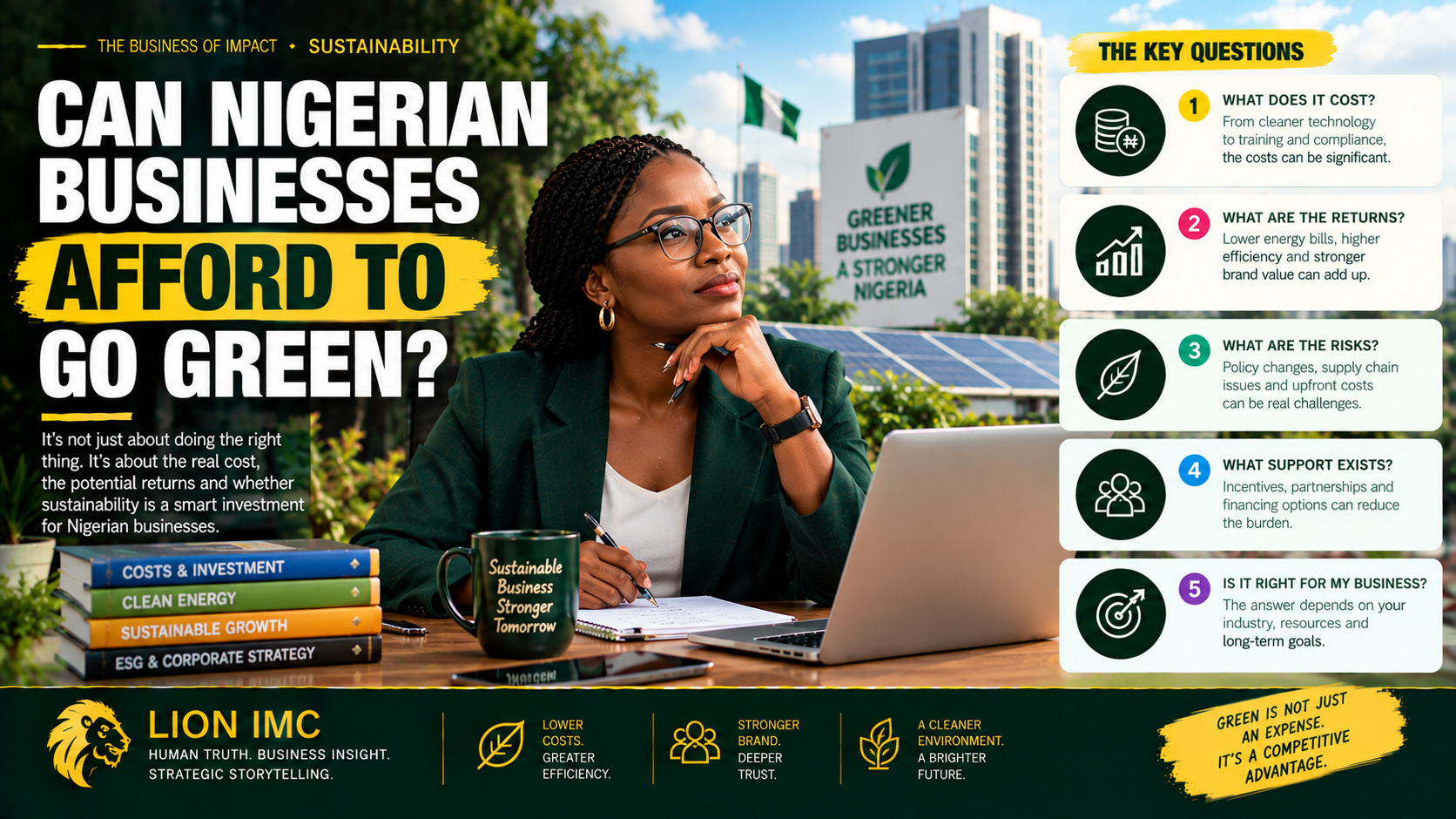
What happens when sustainability starts affecting cost, capital, risk, reporting, supply chains and competitiveness?
And there is a particularly timely Nigerian development: on 23 September 2026, Nigeria’s SEC directed public companies and significant public-interest capital-market operators to submit implementation plans for IFRS S1/S2 sustainability reporting by 15 October 2026. Nigeria’s roadmap provides for mandatory application by public-interest entities from 2028 and SMEs from 2030.
For years, sustainability lived in a particular corner of corporate life.
There was the sustainability report.
The tree-planting photograph.
The recycling initiative.
The solar-panel project.
The community donation.
The annual CSR event.
And then there was the business.
Revenue.
Costs.
Capital.
Operations.
Risk.
Growth.
Investment.
Profit.
The two worlds were often presented as if they were related but separate.
That separation is becoming harder to maintain.
Because sustainability is increasingly turning up in places that have nothing to do with corporate photo opportunities.
It is showing up in risk management.
In energy costs.
In supply chains.
In access to capital.
In regulation.
In investor decisions.
In operational resilience.
And increasingly, in the information companies are expected to disclose.
In Nigeria, that shift has just become considerably more tangible.
On 23 September 2026, the Securities and Exchange Commission directed public companies and significant public-interest capital-market operators to submit implementation plans for adopting the IFRS Sustainability Disclosure Standards, including IFRS S1 and IFRS S2, by 15 October 2026. The SEC says the move is intended to strengthen sustainability reporting and produce more transparent, comparable and decision-useful information.
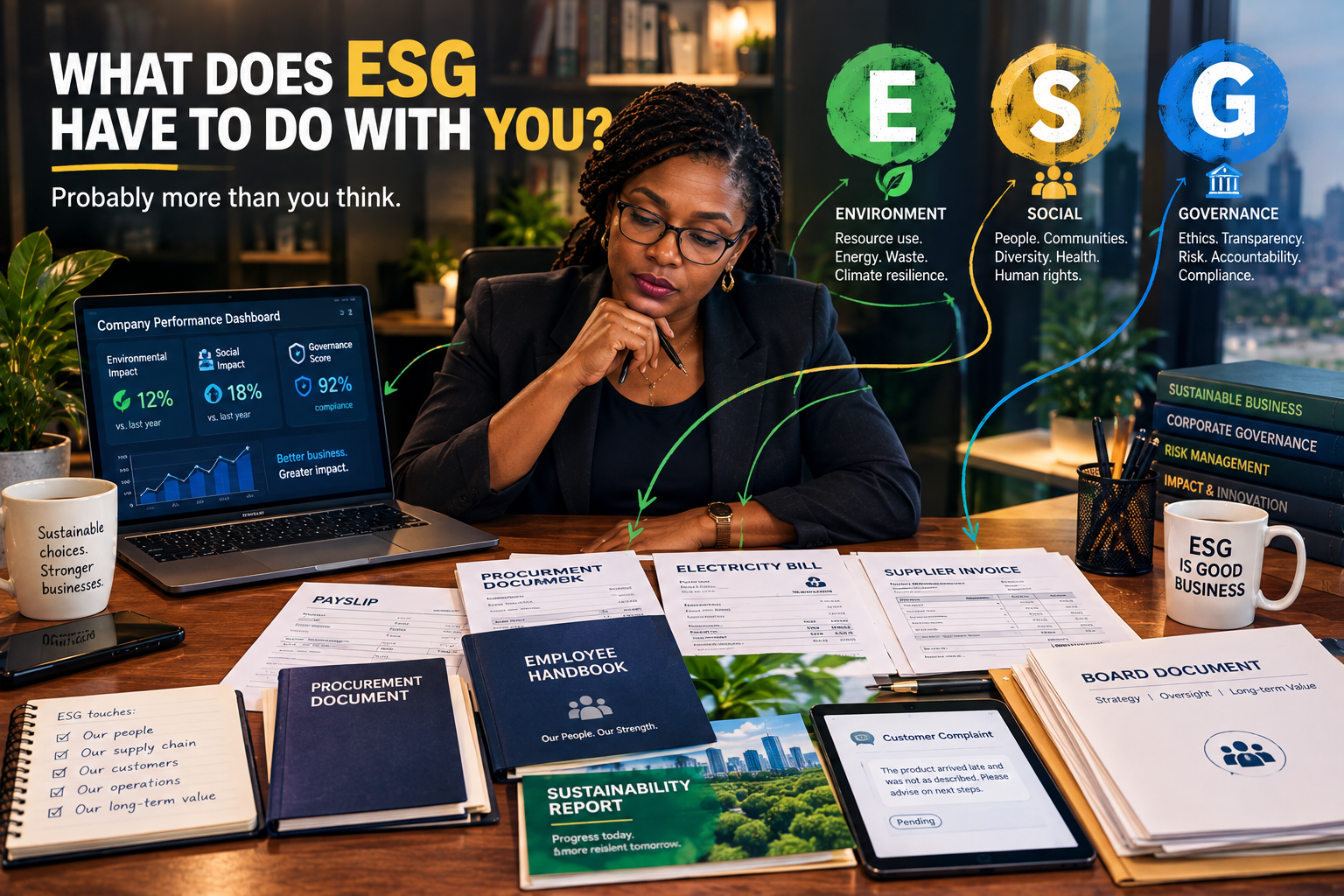
Suddenly, sustainability is not simply something the Corporate Affairs or CSR department can discuss.
It is becoming a boardroom issue.
THE QUESTION IS CHANGING
The old sustainability question was often:
“What are we doing for the environment?”
The business question is becoming:
“What sustainability-related risks and opportunities could affect our business?”
That is a very different question.
IFRS S1 is built around sustainability-related risks and opportunities that could reasonably be expected to affect a company’s cash flows, access to finance or cost of capital over the short, medium or long term. It also requires attention to governance, strategy, risk management, and performance and targets.
Notice what happened there.
Sustainability moved into the vocabulary of:
cash flow.
finance.
capital.
strategy.
risk.
Those are not traditionally environmental words.
They are business words.
SUSTAINABILITY IS NOT JUST ABOUT TREES ANYMORE
Consider a manufacturer.
Energy is a sustainability issue.
But energy is also a cost issue.
A company dependent on unreliable or expensive energy has an operational problem.
A company that can reduce energy consumption, diversify its energy sources or improve efficiency may potentially change its cost structure and resilience.
Now consider agriculture.
Climate conditions are an environmental issue.
But for a food company, they can become a raw-material issue.
For an insurer, they can become a risk issue.
For a bank, they can become a credit issue.
For a logistics company, they can become an operational issue.
For a retailer, they can become a supply issue.
For investors, they can become a financial issue.
The same sustainability issue can therefore travel through an entire economy.
That is why the business conversation is changing.
THE BOARDROOM DOES NOT SPEAK “GOOD INTENTIONS”
A sustainability initiative can be admirable.
But a board eventually has to ask:
What problem are we solving?
How much does it cost?
What risk does it reduce?
What opportunity does it create?
What happens if we do nothing?
What happens if regulation changes?
What happens to our supply chain?
What happens to our customers?
What happens to our access to capital?
What happens to our reputation?
What happens to the value of the business?
Those questions do not make sustainability less important.
They make it more serious.
Because once sustainability enters business decision-making, it has to compete for resources like everything else.
And that means it needs evidence.
THE ACCOUNTING OF SUSTAINABILITY IS GETTING HARDER TO IGNORE
This is perhaps one of the most important developments.
Sustainability reporting is moving toward information that investors and other capital providers can actually use to make economic decisions.
The ISSB’s standards are explicitly designed around sustainability-related information that can affect a company’s prospects, including cash flows, access to finance and cost of capital.
Nigeria’s adoption roadmap is therefore not simply about producing another glossy corporate report.
According to the IFRS Foundation’s current Nigeria profile, public-interest entities are scheduled to be required to apply the standards for annual reporting periods beginning on or after 1 January 2028, while SMEs are scheduled for 2030.
And now the SEC is asking affected organisations to explain how they intend to get ready.
That means companies have to start thinking about something many organisations have historically struggled with:
How do we actually collect the data?
BECAUSE “WE ARE SUSTAINABLE” IS NOT A METRIC
This is where sustainability becomes uncomfortable.
A company can say:
We care about the environment.
Fine.
But what does that mean?
How much energy did you use?
How much did you reduce?
What emissions are associated with your operations?
What risks have you identified?
What targets have you set?
Who is responsible?
What did you achieve?
What did you fail to achieve?
What changed financially?
The direction of modern sustainability reporting is pushing organisations away from broad statements and toward information that can support decision-making.
That requires systems.
Controls.
Governance.
Data.
People who understand the data.
People who can challenge the data.
And ultimately, leadership that is willing to make decisions based on it.
The SEC’s September 2026 directive specifically asks entities to address governance arrangements, gap assessments, implementation roadmaps, data collection and reporting systems, internal controls and assurance, capacity building and expected reporting timelines.
That is not a CSR checklist.
That is organisational infrastructure.
THE CFO HAS ENTERED THE SUSTAINABILITY CONVERSATION
For a long time, sustainability could be treated as primarily a communications exercise.
A sustainability team did something.
Corporate affairs told the story.
The company published photographs.
Stakeholders applauded.
But if sustainability affects cash flow, capital expenditure, operational risk, financing or business continuity, the finance function cannot remain outside the conversation.
Neither can procurement.
Neither can operations.
Neither can risk.
Neither can the board.
And that changes the politics of sustainability inside an organisation.
The question is no longer:
“Which department owns sustainability?”
It becomes:
“Which business decisions have sustainability implications?”
The answer may be:
Almost all of them.
THE SUPPLY CHAIN IS WHERE THIS GETS REAL
A company can make impressive sustainability commitments at headquarters and still depend on a supply chain that creates substantial environmental, social or operational exposure.
That creates a difficult question:
How sustainable is a company if its sustainability stops at its office door?
Suppliers matter.
Raw materials matter.
Transportation matters.
Packaging matters.
Energy matters.
Waste matters.
Labour practices matter.
And increasingly, the resilience of those systems matters.
A company may discover that its sustainability strategy is also a supply-chain strategy.
Or a procurement strategy.
Or a business-continuity strategy.
Or all three.
THERE IS ALSO A MONEY QUESTION
Sustainability is sometimes discussed as though companies have an unlimited pot of money from which they can simply fund good things.
They don’t.
Every major sustainability investment competes with another possible use of capital.
A manufacturer considering a major energy-efficiency investment might ask:
How much will this cost?
But it should also be able to ask:
What will it save?
What risk does it reduce?
How resilient does it make the operation?
How long before the investment pays back?
What happens to the economics if energy prices change?
That does not reduce sustainability to money.
It acknowledges that business decisions have economics.
And sustainability decisions increasingly have economics too.
THE BIGGEST CHANGE MAY BE THAT “DO NOTHING” HAS A COST
This is where the conversation gets particularly interesting.
Businesses often compare:
Cost of doing something
against
Cost of doing nothing.
But historically, the second number has been easier to ignore when sustainability risks appeared distant.
That is becoming harder.
Regulation can change.
Customer expectations can change.
Investor information requirements can change.
Technology can change.
Supply chains can become more vulnerable.
Physical climate risks can affect operations.
And competitors can discover opportunities before everyone else does.
So the sustainability decision is no longer simply:
“Can we afford to do this?”
It can also be:
“Can we afford not to understand this?”
That is a much more powerful business question.
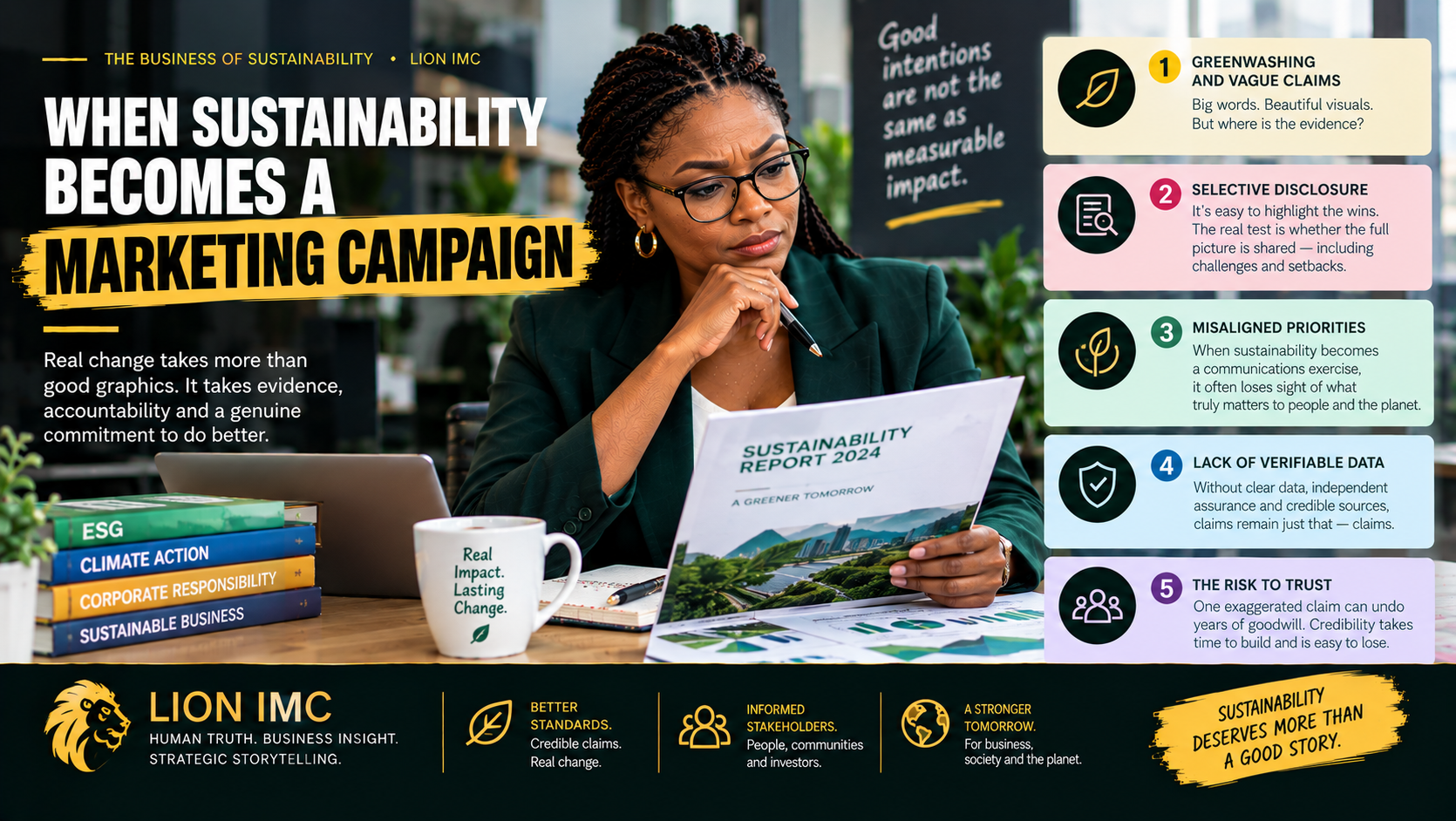
BUT LET’S NOT TURN SUSTAINABILITY INTO CORPORATE FASHION
There is another danger.
Once sustainability becomes fashionable, companies can start doing sustainability theatre.
A new report.
A new slogan.
A new logo.
A new sustainability committee.
A new campaign.
A new photograph.
But very little changes underneath.
That is where the distinction between communication and transformation becomes important.
A company can communicate sustainability without changing its business model.
It can announce targets without changing incentives.
It can publish commitments without changing procurement.
It can sponsor environmental programmes without reducing operational waste.
It can produce beautiful reports without producing useful information.
Sustainability reporting is not the same thing as sustainability performance.
And a sustainability campaign is not automatically a sustainability strategy.
THE GREENEST THING A COMPANY CAN DO MAY SOMETIMES BE BORING
This is another uncomfortable truth.
Sustainability can look glamorous from the outside.
But inside a business, some of the most important sustainability decisions may be painfully ordinary.
Reducing waste.
Improving energy efficiency.
Changing procurement standards.
Reducing unnecessary travel.
Improving equipment.
Measuring consumption.
Changing packaging.
Training employees.
Redesigning processes.
Improving supply-chain resilience.
Collecting better data.
Checking whether targets are actually being met.
Nobody may take a dramatic photograph of these things.
But they can change how a business operates.
And that is the point.
WHAT THIS MEANS FOR NIGERIAN BUSINESSES
The Nigerian conversation around sustainability has often been strongly connected to CSR, community investment and environmental responsibility.
Those remain important.
But the business case is becoming broader.
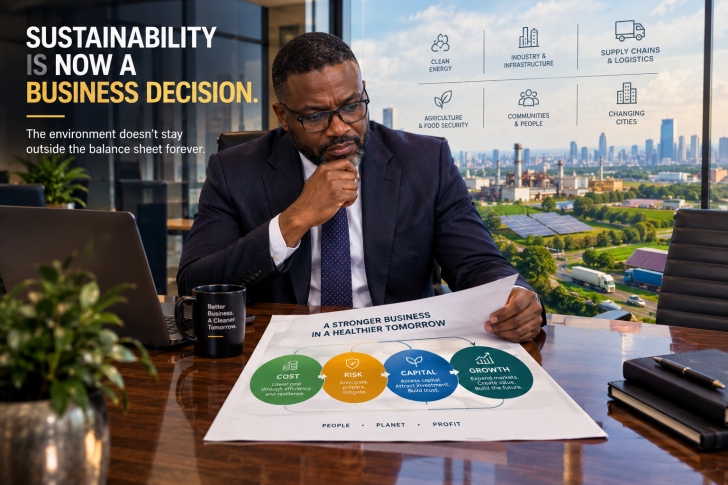
A Nigerian company now has to think about sustainability through several lenses:
COST
Can resource efficiency reduce avoidable costs?
RISK
What environmental or social factors could disrupt the business?
CAPITAL
What sustainability information may matter to investors and lenders?
REGULATION
What disclosure or operating requirements are emerging?
CUSTOMERS
Are expectations changing?
SUPPLY CHAIN
How resilient are critical inputs?
REPUTATION
Can the company substantiate what it says?
COMPETITIVENESS
Could a sustainability challenge become a competitive opportunity?
That is no longer simply an environmental conversation.
It is a strategy conversation.
AND THIS CHANGES WHO NEEDS TO CARE
If sustainability were simply about recycling, perhaps the conversation could remain in one department.
But if sustainability affects:
capital;
risk;
operations;
reporting;
procurement;
reputation;
resilience;
investment;
regulation;
then it belongs to the CEO.
The CFO.
The COO.
The Chief Risk Officer.
The board.
The investor-relations team.
Procurement.
Operations.
Human resources.
Corporate affairs.
And, increasingly, the data people.
Sustainability is becoming everybody’s business because business itself is increasingly exposed to sustainability-related risks and opportunities.
SO, IS SUSTAINABILITY STILL ABOUT THE ENVIRONMENT?
Of course.
The environmental dimension has not disappeared.
The point is that businesses are beginning to understand that environmental conditions do not remain outside the balance sheet forever.
Energy becomes cost.
Scarcity becomes supply risk.
Climate exposure becomes operational risk.
Regulation becomes compliance cost.
Investor expectations become disclosure requirements.
Customer expectations become market pressure.
And innovation can turn an environmental problem into a business opportunity.
That is why sustainability is becoming more interesting to business leaders.
Not because companies have suddenly become environmental organisations.
But because the environment is increasingly interacting with the economics of the organisation.
THE LION TAKE
Sustainability used to be easy to misunderstand.
Some companies treated it as charity.
Some treated it as reputation management.
Some treated it as a report.
Some treated it as a public-relations obligation.
The smarter question now is different:
What sustainability-related issues could change the economics of this business?
That question belongs in the boardroom.
It belongs in the risk register.
It belongs in the strategy document.
It belongs in the investment discussion.
It belongs in the supply-chain conversation.
And increasingly, it belongs in the financial reporting process.
Because sustainability is no longer simply about whether a company is doing good.
It is increasingly about whether the company understands the conditions under which it will continue to do business.
And that may be the biggest shift of all.
When your company discusses sustainability, where does the conversation actually happen, CSR, Corporate Affairs, Operations, Finance, Risk or the Board? And where do you think it should happen?