






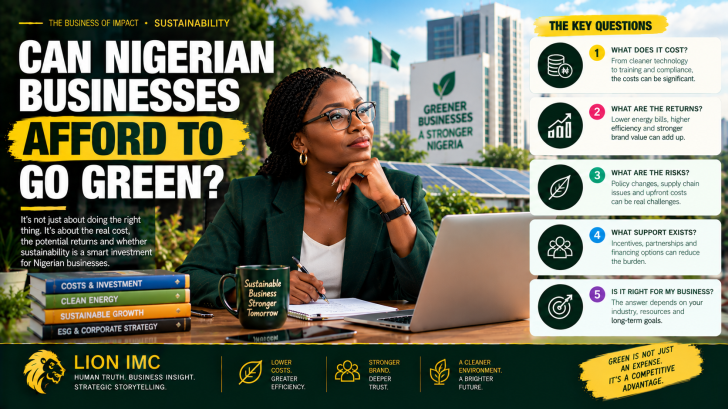
For businesses battling energy costs, foreign-exchange pressures and tight margins, sustainability can look like another expensive obligation. But the right investments may also reduce operating costs, improve resilience and open doors to new markets. The challenge is knowing what to change, what it will cost and whether the returns justify the investment.
A Nigerian business owner is considering installing solar power, replacing inefficient equipment and reducing waste. The ideas make commercial sense. But there is a problem: the business also needs to pay salaries, buy inventory, maintain equipment and keep the lights on.
So sustainability goes onto the list of things to consider later.
This is a familiar dilemma. Businesses are increasingly encouraged to adopt cleaner technologies, manage environmental risks and demonstrate responsible practices. Yet for a company operating on thin margins, even a worthwhile investment can be difficult to finance upfront.
The question, therefore, is not simply whether Nigerian businesses should go green.
It is whether they can afford the transition and whether they can afford the costs of doing nothing.
Going green does not have to begin with an expensive transformation
One reason sustainability can seem inaccessible is that people often associate it with large solar installations, electric vehicles, expensive certifications and elaborate environmental reporting.
Those investments may be relevant to some businesses. They are not the only starting points.
A small manufacturer might begin by identifying where electricity is being wasted. A restaurant could review food spoilage and packaging. A retailer might reduce unnecessary lighting and cooling costs. A logistics company could examine fuel consumption and delivery routes. An office-based business could reduce paper use and improve equipment efficiency.
These changes are not equally valuable in every setting, and some will produce only modest savings. The point is to begin with the business’s actual costs and environmental impacts rather than an expensive sustainability wish list.
The International Labour Organization’s February 2026 ESG State of Play Report in Nigeria examines the adoption of environmental, social and governance practices by Nigerian companies, including the challenges and opportunities for scaling these practices among small businesses and larger organisations.
For a business owner, a sensible first step is not to ask, “How do we become a green company?”
It is to ask, “Where are we losing money, creating avoidable waste or exposing the business to risks that we could manage better?”
The energy question: can cleaner power make commercial sense?
For many Nigerian businesses, electricity is one of the most immediate connections between sustainability and the bottom line.
Unreliable grid supply can mean generator use, fuel purchases, maintenance, interruptions and uncertainty about operating costs. Cleaner energy solutions may help, but the economics depend on the business’s electricity demand, operating hours, financing terms and the reliability of the proposed system.
A 2025 study published in Renewable Energy, examining solar photovoltaic adoption among 412 small and medium-sized enterprises in Nigeria, found that reliability of supply and total setup cost were significant factors in businesses’ preferences. It also found differences between manufacturing and service businesses, underlining that energy solutions should reflect how each business operates.
That finding matters because it challenges the idea that every business should adopt the same solution.
A factory running machinery for long hours has different energy requirements from a small shop that needs lighting, refrigeration and a point-of-sale terminal. A hotel may need power around the clock, while a consultancy may have more flexibility.
Before investing, businesses should compare the full costs of the alternatives.
| What to examine | Why it matters |
| Current electricity and fuel spending | Establishes the cost of the existing arrangement |
| Equipment and installation costs | Shows the initial investment required |
| Maintenance and replacement costs | Captures expenses beyond installation |
| Financing and repayment terms | Reveals the effect on monthly cash flow |
| Expected operating savings | Helps estimate the financial benefit |
| Reliability and backup requirements | Tests whether the solution meets actual business needs |
| Payback period and useful life | Helps determine whether the investment is worthwhile |
A solar installation that looks attractive in a sales presentation may be unsuitable if the financing is too expensive or the system cannot meet the business’s requirements. Conversely, an investment with a substantial upfront cost may be commercially attractive if it produces reliable savings over a reasonable period.
Going green is not automatically cheaper. The business case has to be demonstrated.
The evidence from Nigerian MSMEs: ambition meets financing constraints
In January 2026, the Bank of Industry released its ESG Adoption by Nigerian MSMEs report, based on primary data from more than 300 micro, small and medium-sized enterprises across Nigeria’s six geopolitical zones.
The report describes growing awareness of environmental, social and governance practices, alongside continuing barriers including limited funding, inadequate technical capacity and insufficient ESG-linked incentives.
That is an important distinction. A business may understand the value of sustainability and still lack the money, expertise or suitable financing to implement it.
For a small enterprise, committing capital to a cleaner production system can compete directly with buying stock, expanding a sales team or meeting payroll. A business may also struggle to assess suppliers’ claims, calculate expected savings or compare financing offers.
This is why telling every business to “be sustainable” is not enough.
The transition also requires practical information, affordable technology, financing options and support that reflect the circumstances of smaller firms.
Five ways businesses can make the transition more affordable
1. Start with an energy and waste audit
Review electricity bills, generator fuel, equipment usage, water consumption, spoilage and material waste. Identify the largest avoidable costs before spending on new technology.
Even a basic review can reveal opportunities to improve efficiency. More complex operations may need a qualified energy or environmental assessment.
2. Prioritise investments with a clear business case
Compare possible improvements by cost, expected savings, maintenance requirements and operational risk. Fixing an inefficient process may be more affordable than replacing an entire system.
Where the benefits are uncertain, pilot the change on a smaller scale before committing more capital.
3. Explore financing and partnerships
Ask equipment providers, banks and relevant development-finance programmes about leasing, instalment payments, energy-as-a-service arrangements, guarantees or other suitable financing models.
A business should compare the full repayment cost and contractual obligations rather than assume that every product described as green finance is affordable.
4. Work with suppliers and other businesses
Businesses can investigate shared logistics, reusable packaging, improved inventory management and collective purchasing where these arrangements make commercial sense.
Smaller firms may also benefit from industry associations or business networks that help them access technical advice and compare supplier offers.
5. Measure the result before making big claims
Track actual energy consumption, fuel costs, waste volumes, maintenance expenses and other relevant indicators before and after a change.
This helps management determine whether the investment is delivering the expected benefit and provides evidence for customers, lenders or other stakeholders when sustainability information is requested.
Is green finance available in Nigeria?
There are financing initiatives intended to support cleaner energy and climate-related investments in Nigeria. But the existence of a fund does not mean that every business can access it, or that the terms will suit every project.
For example, the federal government’s Distributed Access through Renewable Energy Scale-up programme (DARES) has been backed by up to US$750 million in World Bank support to expand distributed and off-grid renewable energy access. Its benefits are delivered through programme structures and participating providers; businesses should verify which solutions and locations are covered rather than assume that the headline funding is a direct grant available to any applicant.
The International Finance Corporation and Norfund also announced a financing package of up to US$83.2 million in April 2026 to support renewable-energy service companies expanding electricity access to underserved communities in Nigeria. That is relevant to the broader energy-access ecosystem, but it is not a blanket loan offer to all Nigerian SMEs.
For businesses exploring finance, the practical questions are:
- Does the facility support my sector and type of investment?
- Can my business apply directly, or must I use a participating provider?
- What are the interest rate, fees, repayment period and collateral requirements?
- Is the funding a loan, lease, guarantee, grant or blended-finance arrangement?
- What technical assessments or documentation are required?
- What happens if the expected savings take longer to materialise?
The Bank of Industry’s 2026 MSME report also describes its work on sustainable financing and partnerships intended to expand support for green enterprises. Businesses interested in these options should consult the institution’s current programme information and confirm eligibility and terms directly.
Treat green finance as an option to investigate, not money already available to your business.
What about regulation, customers and the supply chain?
The financial case for sustainability is not limited to electricity savings.
Some businesses may face expectations from customers, lenders, investors or supply-chain partners to provide information about environmental and social practices. Larger organisations may also need to understand reporting requirements and the risks associated with their suppliers.
Nigeria’s sustainability-reporting landscape is developing. The International Labour Organization’s 2026 report examines the country’s ESG frameworks and adoption gaps, while the wider Nigerian policy environment includes work to align corporate sustainability disclosures with international standards. The specific obligations depend on the organisation, sector and applicable rules; businesses should verify their requirements rather than assume that every small company has identical reporting duties.
For a small supplier seeking a contract with a larger company, being able to explain basic practices such as waste handling, worker safety, energy management or governance may help answer due-diligence questions.
That does not mean every business needs an expensive ESG report immediately. It means owners should understand what their important customers and financing partners require and build the ability to provide credible information.
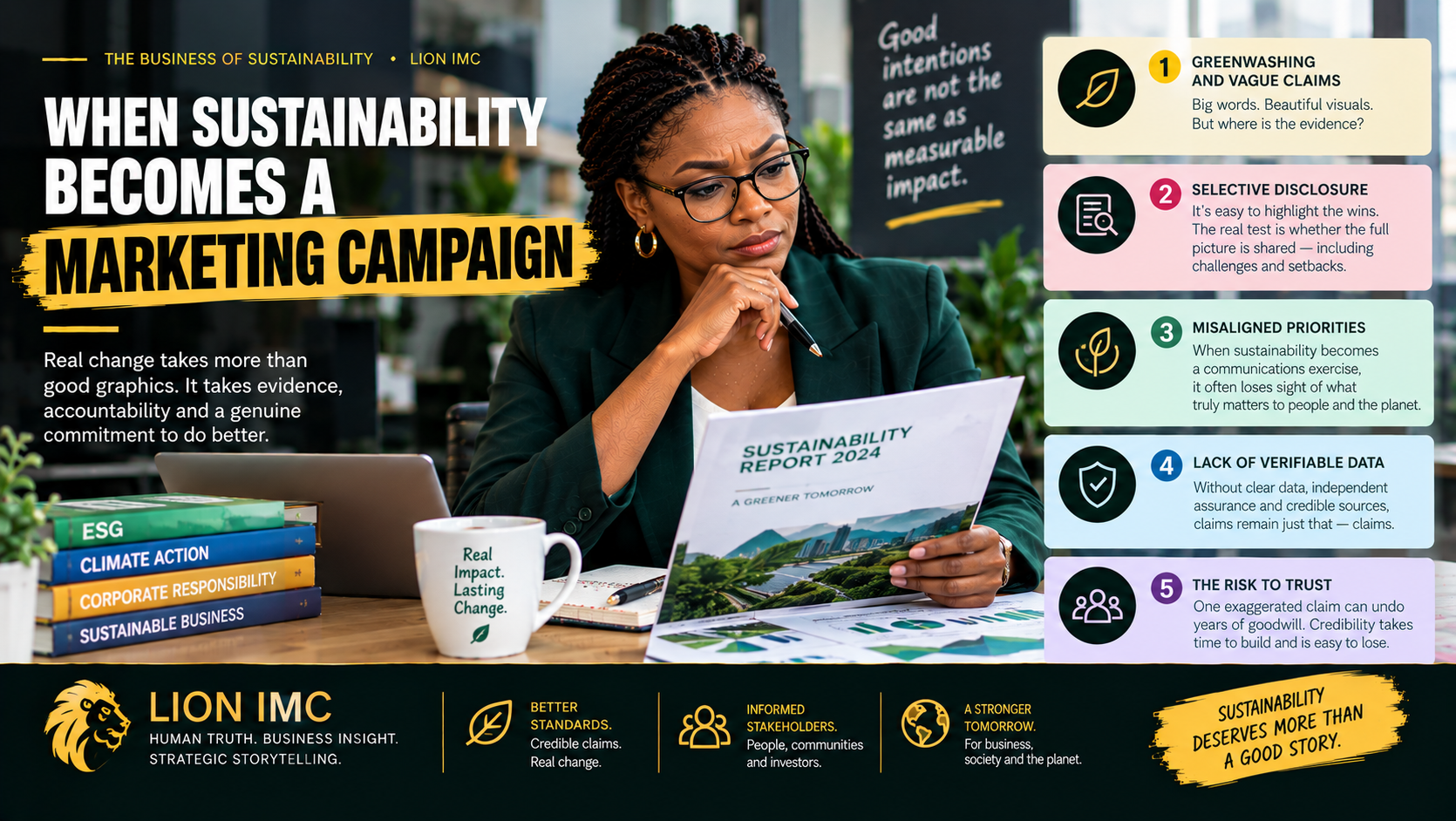
The danger of going green for appearances
There is another cost businesses should consider: investing in sustainability claims that they cannot substantiate.
A company might advertise that its products are environmentally friendly, announce a carbon-reduction commitment or describe an operation as sustainable without having the evidence to support the claim.
This can damage credibility, particularly when customers, investors or other stakeholders ask how the claims were measured.
The better approach is to communicate what has actually changed. If a business has reduced fuel consumption, explain the period and measurement. If it has introduced a recycling process, describe what is collected and how it is handled. If a target has not been achieved, do not present it as a completed result.
Sustainability is a management practice, not a marketing label. A modest, measurable improvement is more credible than a sweeping green claim without evidence.
So, can Nigerian businesses afford to go green?
Some can make worthwhile changes immediately. Others will need financing, technical support or a longer investment horizon. Some proposed investments will not make commercial sense under current conditions, and businesses should be able to say so after examining the evidence.
The right question is not whether every company can afford a complete green transformation today.
It is whether each business can identify the changes that are financially realistic, operationally relevant and proportionate to its impacts then build from there.
For one business, that may mean improving energy efficiency. For another, it may mean changing packaging, reducing waste, upgrading equipment or gathering better information about its environmental footprint. For a capital-intensive operation, the transition may require a multi-year investment plan.
Going green should not mean sacrificing the financial survival of the business. Nor should financial pressure be an excuse to ignore every practical opportunity to reduce waste, improve resilience or manage risk.
THE LION TAKE
For Nigerian businesses, sustainability is not a simple choice between spending money on the environment and spending money on growth. Some sustainability investments can support growth by reducing operating costs, improving resilience or meeting customer requirements. Others are expensive, uncertain or unsuitable without better financing.
The responsibility of management is to distinguish between the two.
Start with the costs and impacts you can measure. Compare options carefully. Verify financing terms. Invest where the evidence supports the decision, and communicate results honestly.
The green transition does not have to begin with the biggest investment. It should begin with the clearest business case.
THE LION QUESTION
If a sustainability investment could reduce your business’s long-term operating costs but strain cash flow today, what evidence would you need before committing the money?