






A company announces a major sustainability initiative. The photographs are beautiful. Executives stand beside newly planted trees. Employees wear branded T-shirts. A video captures smiling community members, and the corporate website publishes a report filled with green landscapes, impressive commitments and promises of a better tomorrow.
The campaign looks convincing.
But somewhere beyond the cameras, the questions remain.
How many of those trees survived? Has the company reduced its environmental footprint? Are the communities it operates in experiencing meaningful improvements? Can anyone independently verify the claims being made?
And perhaps the most uncomfortable question of all: if the cameras disappeared tomorrow, would the sustainability work continue?
These questions sit at the heart of a growing challenge for businesses: the difference between communicating sustainability and using sustainability to sell a better corporate image.
When the story becomes bigger than the action
Sustainability communication is not the problem. In fact, organisations doing meaningful environmental and social work should communicate their progress. Customers, employees, investors, regulators and communities need to know what businesses are doing, what they are learning and where they are falling short.
The trouble begins when communication stops reflecting progress and starts compensating for its absence.
A company may promote a recycling initiative while saying little about the waste generated by its wider operations. A manufacturer may celebrate a reduction in plastic packaging without explaining whether the change affects its overall environmental footprint. An organisation may announce a net-zero ambition without presenting a credible pathway for achieving it.
The United Nations identifies these patterns as forms of greenwashing: misleading people into believing an organisation is doing more to protect the environment than its actions demonstrate. Tactics include vague environmental language, exaggerated benefits, selective disclosure and ambitious climate promises unsupported by credible plans.
Not every imperfect sustainability programme is greenwashing, and not every company that communicates its achievements is attempting to mislead the public. Organisations can make genuine progress while still having work to do.
The distinction is whether their claims accurately reflect the evidence—or create an impression the evidence cannot support.
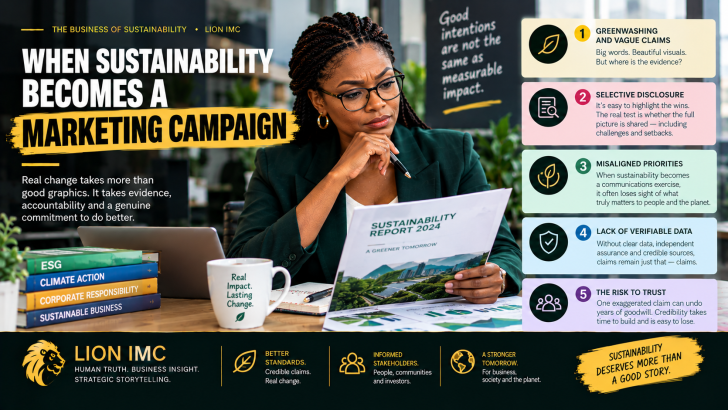
Five warning signs that sustainability has become a marketing exercise
1. Big promises, little explanation
Words such as green, eco-friendly, responsible and sustainable sound reassuring. But what do they actually mean?
A company claiming to be environmentally responsible should explain the specific activity, product or business operation involved, the improvement achieved and the evidence supporting the claim. Without that detail, the language may create more confidence than the facts justify.
2. The achievements are public. The setbacks are missing.
The organisation highlights its solar installation, community project or reduced packaging. But what happened to its other environmental commitments? Were targets missed? Did the programme reach fewer people than expected? Were there unintended consequences?
No business needs to pretend that every initiative succeeds. Credibility comes from explaining progress honestly, including the limitations and the work still required.
3. The publicity budget appears more ambitious than the operational change.
An organisation can spend considerably on videos, media coverage, branded merchandise and events. Those activities may help people understand a programme, but they do not establish that the programme is effective.
The more important questions concern operational decisions: what changed in procurement, energy use, production, waste management, employee welfare or community engagement? Communications should help explain those changes—not stand in for them.
4. Nobody can verify the claims.
A report may contain impressive percentages and confident statements without making clear how the figures were calculated, what period they cover or what they are being compared against.
Credible reporting requires clear definitions, relevant baselines, appropriate evidence and transparent methods. Independent review or assurance can strengthen confidence where appropriate, although its scope and limitations should also be disclosed.
5. The campaign speaks about people without listening to them.
Communities may appear in photographs and corporate videos, yet have little influence over which problems the company addresses or how success is measured.
Genuine sustainability work requires more than documenting participation. It involves listening to affected stakeholders, understanding their priorities, responding to concerns and assessing whether the intervention has made a meaningful difference.
The evidence problem is bigger than one company
This is not merely a debate about corporate image. It is also a question of whether the information people receive is useful enough to guide decisions.
The European Commission’s green-claims guidance reports that, in its assessment of claims in the European market, 53% of green claims provided vague, misleading or unfounded information, while 40% had no supporting evidence. These are European findings, not estimates of the proportion of Nigerian companies engaging in greenwashing.
The significance is broader than geography: when sustainability language is difficult to verify, customers may struggle to distinguish meaningful improvements from marketing claims.
The UK Competition and Markets Authority offers a practical standard through its Green Claims Code. Its six principles state that environmental claims should be truthful and accurate, clear, should not omit important information, should use fair comparisons, should consider the relevant product or service life cycle and should be supported by evidence.
These principles provide a useful checklist for Nigerian businesses too, even though UK guidance should not be mistaken for Nigerian law.
The message for communications teams is straightforward: a claim should be tested before it is published, not defended only after someone challenges it.
What this means for Nigerian businesses
For Nigerian organisations, sustainability communication can involve everything from energy efficiency and waste reduction to employee wellbeing, responsible sourcing, community investment and corporate governance.
The difficulty is that these activities can easily become disconnected from one another. A company may celebrate a community project while overlooking whether its wider operations create concerns for that same community. Another may promote environmental commitments without having reliable internal systems for measuring progress.
A sustainability narrative is only as credible as the underlying decisions, processes and evidence.
Nigeria’s reporting environment is also evolving. On 23 September 2026, the Securities and Exchange Commission issued a circular directing public companies and significant public-interest capital-market operators to prepare for implementing the IFRS Sustainability Disclosure Standards, IFRS S1 and IFRS S2. The circular requires the relevant entities to submit implementation plans by 15 October 2026. Under the stated roadmap, mandatory adoption is scheduled for accounting periods beginning on or after 1 January 2028 for public-interest entities, including public companies, and on or after 1 January 2030 for SMEs.
These standards concern sustainability-related financial disclosures, including climate-related disclosures. They are not, by themselves, a universal certification that every sustainability claim made by a company is true. But the direction is significant: sustainability information is increasingly a matter of governance, risk, data and accountability—not simply public relations.
For boards and executive teams, this creates an important management question: can the organisation produce reliable information about its sustainability commitments, and can it explain how those commitments connect to its actual operations and business risks?
For communications professionals, it means sustainability claims cannot be treated as a copywriting exercise alone. The people producing the message need access to the people responsible for the work, the underlying data and the limitations of the results.
The role of PR and marketing: tell the truth better
There is a temptation to treat sustainability communication as a battle for attention. Which company has the most impressive report? Which campaign generates the strongest engagement? Which initiative produces the best photographs or headlines?
Those measures may tell us whether a campaign reached people. They cannot, on their own, tell us whether the sustainability initiative worked.
A more responsible approach begins with a different sequence:
- Start with the work. Identify the environmental or social issue the organisation is addressing.
- Define the intended change. Establish what should improve, for whom and within what period.
- Measure the results. Record a credible baseline, track relevant indicators and explain the methods used.
- Listen to stakeholders. Include the perspectives of the people affected by the activity.
- Communicate the evidence. Explain what has improved, what remains unresolved and what happens next.
- Keep checking. Revisit the commitments and report progress over time.
This does not make communication less persuasive. It gives persuasion a stronger foundation.
A sustainability report that acknowledges a missed target and explains the corrective action may be more useful than one that presents a flawless story. A company that clearly describes the limits of its environmental progress gives stakeholders a more accurate basis for judging its performance.
Honesty is not a weakness in the narrative. It is part of what makes the narrative credible.
The questions every leadership team should ask
Before approving a sustainability campaign, a board, CEO, marketing director or corporate affairs leader should be able to answer the following:
- What measurable change are we claiming to have achieved?
- What evidence supports that claim, and who has checked it?
- Are we presenting a complete and fair picture, including relevant limitations?
- Do our operational decisions support the public commitments we are making?
- Have affected communities and other stakeholders had a meaningful voice?
- What will we do if the evidence shows that we have fallen short?
If the organisation cannot answer these questions, the next step may not be another campaign. It may be better measurement, stronger internal controls, more stakeholder engagement or a more realistic commitment.
And if the organisation has made genuine progress, the answers can help communications teams tell a more specific, credible and compelling story.
The real cost of getting it wrong
A sustainability campaign can generate attention quickly. Trust takes longer to establish.
When stakeholders discover a gap between a company’s promises and its conduct, the consequences may extend beyond one advertisement or report. Customers may become more sceptical. Employees may question leadership’s sincerity. Investors may seek better information. Communities may become less willing to believe future commitments.
None of these outcomes is automatic, and not every criticism proves that a company has misled anyone. But the possibility of reputational damage makes credible evidence a business consideration, not merely an ethical preference.
There is also a wider cost. When exaggerated claims make sustainability harder to trust, organisations that are doing meaningful work may find it more difficult to demonstrate the value of their efforts.
That is why sustainability communication must be held to a higher standard than attractive storytelling. It influences decisions, expectations and the confidence people place in businesses.
The strongest sustainability campaigns do not ask the public to believe simply because the visuals are beautiful or the language is reassuring. They show what changed, explain how the change was measured and remain accountable for what comes next.
Because a greener-looking brand and a more sustainable business are not necessarily the same thing.
THE LION TAKE
Sustainability deserves more than a good story. It deserves evidence, transparency and accountability.
The role of communication is not to make a company’s sustainability performance look better than it is. It is to help people understand what the company is doing, what the evidence shows and what still needs to change.
A good campaign can make people notice the work. Only credible action can give them a reason to trust it.
THE BIG QUESTION
If your company removed the photographs, slogans and sustainability video from its latest campaign, what evidence would remain to show that it had made a meaningful difference?