






ESG is slowly becoming part of ordinary professional life without most professionals calling it ESG.
You may never attend an ESG meeting.
You may never prepare a sustainability report.
You may never calculate a company’s carbon emissions.
You may not even be completely sure what the three letters stand for.
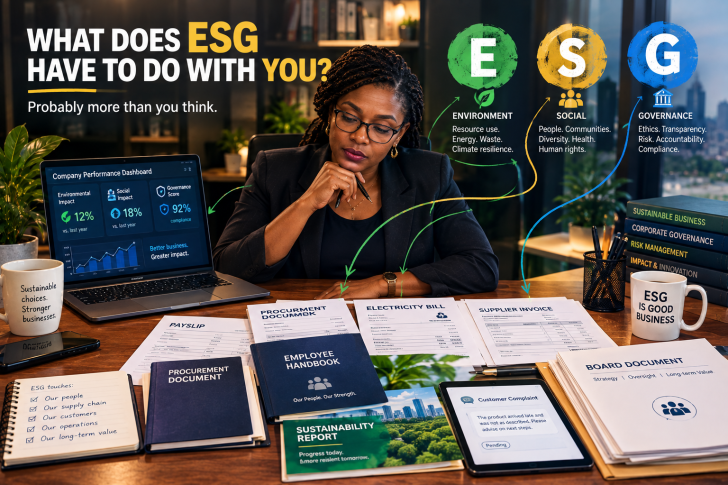
Environmental. Social. Governance.
Yet ESG may already be affecting your professional life.
It can influence what your company reports.
What investors ask about.
What risks management worries about.
How suppliers are selected.
How employees are treated.
What information companies need to collect.
Which skills organisations need.
And increasingly, how businesses think about their future.
So perhaps the more useful question is not:
“What is ESG?”
It is:
“What does ESG have to do with me?”
Quite a lot, actually.
FIRST, FORGET THE CORPORATE JARGON
ESG can sound like one of those concepts that was invented to make PowerPoint presentations longer.
A company announces its ESG strategy.
There are photographs of tree planting.
A sustainability report appears.
Someone mentions carbon.
Someone else mentions governance.
Everybody nods.
And the ordinary employee goes back to work.
But the underlying questions are much simpler.
How does this company affect the world around it?
How does the world around it affect the company?
And is the company being properly managed while all this is happening?
That is where ESG becomes interesting.
Because sustainability is no longer only about looking responsible.
Increasingly, companies are being asked to understand sustainability-related risks and opportunities that could affect their cash flows, access to finance or cost of capital.
That is the logic behind IFRS S1, the global sustainability disclosure standard issued by the International Sustainability Standards Board.
Suddenly, sustainability has a financial vocabulary.
And once something enters the financial conversation, it rarely remains somebody else’s problem.
SO WHAT DOES THE “E” HAVE TO DO WITH YOUR JOB?
The E is Environmental.
People often reduce this to trees, plastic bottles and carbon emissions.
But think about it from the perspective of a business.
What happens when electricity becomes more expensive?
What happens when extreme weather disrupts a supply chain?
What happens when water becomes more difficult or expensive to obtain?
What happens when a company depends on agricultural inputs whose availability changes?
What happens when a factory needs to invest in new equipment because its current processes are becoming too expensive or environmentally risky?
Those are not merely environmental questions.
They are business questions.
IFRS S1 specifically recognises that sustainability-related risks can arise from a company’s dependencies on resources and relationships, and can affect its prospects over time.
So the employee in procurement may encounter ESG.
The operations manager may encounter it.
The accountant may encounter it.
The engineer may encounter it.
The marketer may encounter it.
The communications professional may certainly encounter it.
You do not need to work in a “green” company.
THE “S” MAY BE EVEN CLOSER TO YOU
The S is Social.
And this is where ESG suddenly stops sounding like an environmental conference.
Employees are social.
Customers are social.
Communities are social.
Suppliers are social.
Human rights, labour practices, health and safety, diversity, community relationships and stakeholder expectations can all become business issues.
Think about something as ordinary as staff turnover.
Why are people leaving?
Is the company paying competitively?
Are managers behaving responsibly?
Are employees safe?
Are workers given the tools to do their jobs?
Is there discrimination?
Is the organisation dependent on vulnerable workers?
Does the company have a credible way to handle complaints?
These may look like HR questions.
They can also become business-risk questions.
A company that repeatedly loses good people may eventually pay for it through recruitment costs, lost knowledge, weaker execution and damaged customer relationships.
ESG does not magically turn every workplace issue into a sustainability metric.
But it encourages organisations to look more seriously at how relationships and dependencies affect long-term value.
AND THEN THERE IS THE “G”
This may be the least glamorous letter.
It may also be one of the most important.
Governance.
Who makes decisions?
Who is accountable?
What controls exist?
How are risks monitored?
Does the board actually know what management knows?
Can employees report problems?
Are conflicts of interest managed?
Are decisions documented?
Is there transparency?
Can a company make a beautiful sustainability promise while its internal systems cannot prove whether the promise is true?
That last question matters.
Because ESG without governance can become storytelling.
And companies increasingly need data, controls and processes behind their sustainability disclosures.
Nigeria’s Securities and Exchange Commission said in September 2026 that public companies and significant public-interest capital-market operators must prepare for IFRS S1 and S2 sustainability reporting, with mandatory adoption for public-interest entities beginning with accounting periods from 1 January 2028. The SEC also requires implementation plans covering governance, data systems, internal controls, assurance and staff capacity building.
That is a very different conversation from planting trees for a photograph.
HERE IS WHERE ESG BECOMES YOUR PROBLEM
Imagine you work in marketing.
Your company wants to claim that a product is sustainable.
Who verifies the claim?
Who has the data?
Who approves the wording?
What happens if the claim cannot be substantiated?
Suddenly ESG has entered marketing.
Imagine you work in procurement.
Your company wants to choose the cheapest supplier.
But the supplier has serious labour, environmental or governance risks.
Do you look only at price?
Suddenly ESG has entered procurement.
Imagine you work in finance.
Management wants to understand how an environmental risk could affect future costs.
Suddenly ESG has entered finance.
Imagine you work in HR.
The company wants to demonstrate responsible employment practices.
Suddenly ESG has entered HR.
Imagine you work in communications.
The company wants to publish a sustainability report.
Suddenly ESG has entered your desk.
This is why ESG should not be treated as the exclusive property of a sustainability manager.
ESG MAY CHANGE THE SKILLS COMPANIES LOOK FOR
This is perhaps the part ordinary professionals should pay the most attention to.
If companies increasingly need to identify, measure, manage and communicate sustainability-related risks and opportunities, somebody has to do the work.
Not everybody needs to become an ESG specialist.
But professionals may increasingly benefit from understanding how sustainability connects to their own function.
A marketer may need to understand responsible claims.
A finance professional may need to understand sustainability-related financial risks.
A supply-chain professional may need to understand supplier risk.
An HR professional may need to understand workforce data.
A communications professional may need to understand sustainability reporting and evidence.
A lawyer may need to understand regulatory exposure.
A data professional may need to understand where sustainability information comes from and whether it can be trusted.
The interesting professional is no longer necessarily the person who can say:
“I work in ESG.”
It may be the person who can say:
“I understand what ESG changes about my job.”
ESG IS ALSO ABOUT YOUR COMPANY’S FUTURE
There is another reason professionals should care.
Your employer is not operating in isolation.
Its customers change.
Technology changes.
Regulations change.
Costs change.
Investor expectations change.
Suppliers change.
Employees change.
Climate-related risks change.
And all of these things can affect the business.
The IFRS Foundation’s approach is particularly useful here because it does not ask companies to report every environmental or social issue imaginable.
It focuses on sustainability-related risks and opportunities that could reasonably be expected to affect the company’s prospects — including cash flows, access to finance and cost of capital.
That distinction matters.
ESG is not simply:
“Is this company good?”
It is increasingly also:
“What sustainability-related issues could materially affect this company’s ability to create value?”
That is a business question.
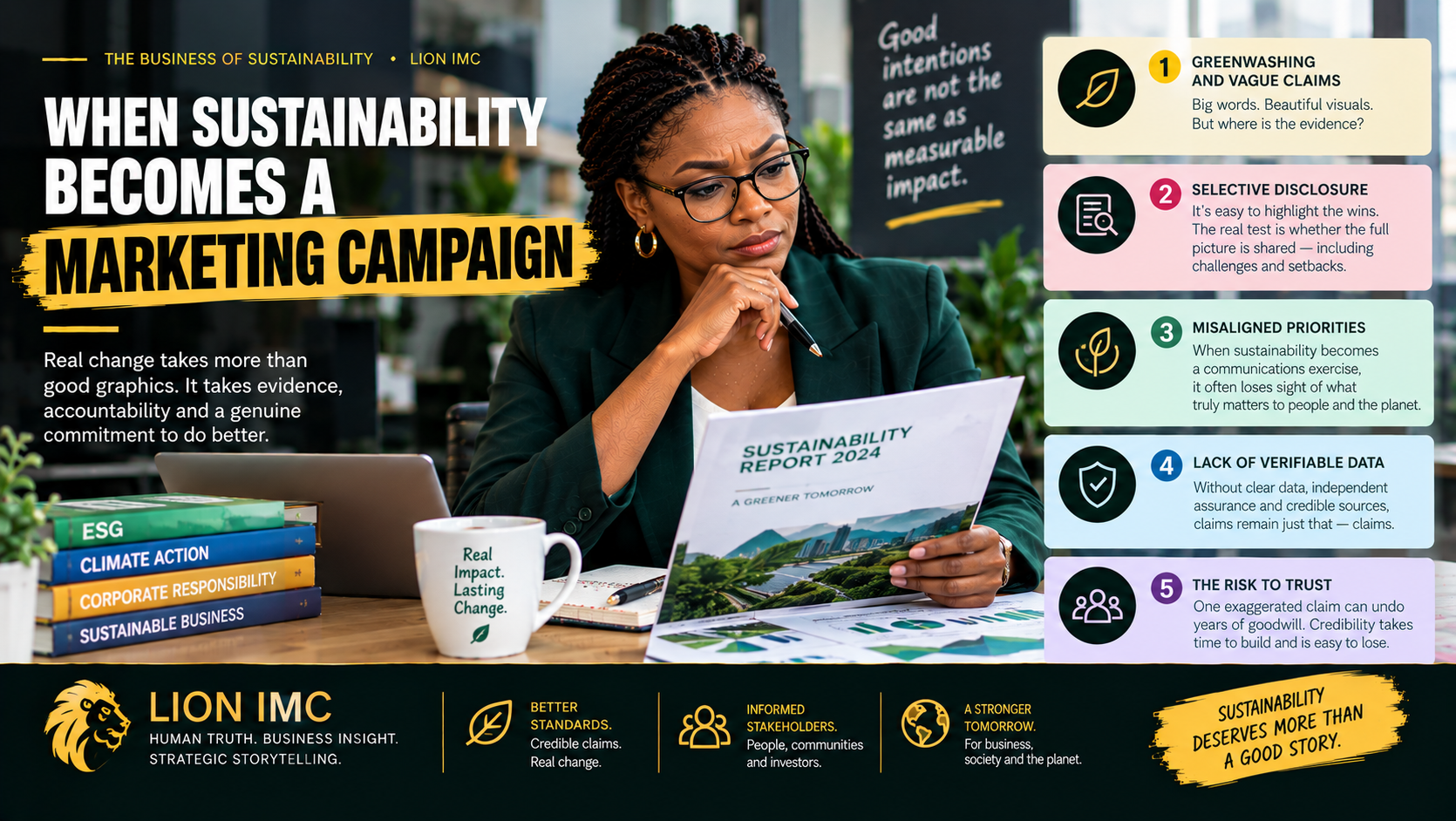
THIS IS WHY ESG SHOULD NOT BECOME CORPORATE THEATRE
There is a danger here.
Once a concept becomes fashionable, companies can learn to perform it.
Beautiful sustainability reports.
Impressive photographs.
Large promises.
A few tree-planting events.
A campaign around inclusion.
Then business continues exactly as before.
That is where ESG can become disconnected from reality.
A sustainability report cannot compensate for poor governance.
A recycling campaign cannot repair a broken supply chain.
A community donation cannot automatically resolve a community relationship.
An employee diversity photograph does not tell you whether people actually experience an inclusive workplace.
And a sustainability slogan is not evidence.
The deeper value of ESG is not the acronym.
It is the discipline of asking:
What are we dependent on?
What are we affecting?
What could become a material risk?
What opportunity are we missing?
Who is accountable?
What evidence do we have?
WHAT SHOULD AN ORDINARY PROFESSIONAL ACTUALLY DO?
You don’t need to start wearing an ESG badge.
Start with your own job.
Ask five questions.
- What sustainability issue could affect my work?
Energy?
Data?
People?
Supply chains?
Regulation?
Customer trust?
Resources?
- What does my organisation currently measure?
If something matters but nobody measures it, how does the company know whether it is improving?
- What claims does my organisation make?
And can those claims be supported?
- What skills would make me more useful in this conversation?
Data?
Reporting?
Risk?
Communication?
Compliance?
Technology?
Stakeholder management?
- Can I explain ESG in the language of my own profession?
That may be the most valuable question of all.
THE PROFESSIONAL WHO UNDERSTANDS THE CONNECTION MAY HAVE AN ADVANTAGE
Consider two marketing professionals.
One says:
“I understand social media, campaigns and brand strategy.”
The other can say:
“I understand how sustainability claims affect brand trust, customer communication, reputation and regulatory risk.”
Neither statement automatically makes one person better.
But the second professional has connected marketing to a business issue that increasingly crosses functions.
That is the real lesson.
Professional relevance is often created at the intersection of disciplines.
ESG IS NOT JUST ABOUT SAVING THE PLANET
It is about understanding how organisations create, preserve or lose value while depending on people, resources, communities, systems and the environment around them.
And that makes it relevant to far more people than the sustainability department.
The accountant.
The marketer.
The HR manager.
The engineer.
The lawyer.
The procurement officer.
The communications professional.
The entrepreneur.
The CEO.
And eventually, perhaps, the ordinary employee who simply wants to understand why the company is suddenly asking questions it never used to ask.
THE LION TAKE
ESG is not somebody else’s acronym.
It is increasingly becoming a way businesses think about risk, opportunity, resources, people, accountability and long-term value.
You don’t need to become an ESG expert tomorrow.
But you should probably understand where ESG touches your profession.
Because the future professional may not be the person who knows every sustainability framework.
It may be the person who can answer a much more practical question:
“What does sustainability have to do with the work I do?”
If you can answer that clearly, ESG has stopped being a corporate acronym.
It has become part of your professional intelligence.