






A business owner in Lagos is considering solar because electricity bills have become difficult to manage. A manufacturer in Ogun is exploring gas because its production lines cannot afford interruptions. A hotel in Abuja wants a hybrid system because guests expect uninterrupted electricity. A retail chain is wondering whether it should simply remain connected to the national grid and improve its backup arrangements.
All four businesses have a legitimate energy problem. But they may not need the same solution.
The mistake is assuming that one energy source is automatically the cheapest, most reliable or most sustainable option for every organisation.
Solar has advantages, but it depends on sunlight, system design and storage arrangements. Gas can provide controllable power, but fuel supply and generator maintenance introduce their own risks. Grid electricity may offer a useful source of supply, but reliability, tariffs and the cost of outages affect its commercial value. Hybrid systems can combine the strengths of different sources, but they also introduce more equipment, controls and maintenance requirements.
The right question is not which energy source is best. It is which combination of energy sources can meet the business’s actual load, reliability, financial and operational requirements at an acceptable total cost.
That decision should begin with the business’s energy needs, not a sales presentation from a technology vendor.
1. Start with the business, not the technology
Before comparing solar panels, gas generators, grid connections or battery storage, a business needs to understand how it consumes electricity.
Two organisations with the same monthly electricity bill may have very different energy requirements.
A hotel may experience high electricity demand in the evening because of air-conditioning, lighting, kitchens and guest facilities. A factory may need a consistent supply throughout the day to operate production machinery. A supermarket may require continuous refrigeration, even when customer traffic is low. An office may be able to shift some activities to daylight hours.
The first assessment should establish:
- Total energy consumption: How many kilowatt-hours (kWh) does the business consume daily and monthly?
- Peak demand: What is the highest level of power required at any given time, usually measured in kilowatts (kW) or kilovolt-amperes (kVA)?
- Load profile: At what times of the day and week does the business consume the most electricity?
- Critical loads: Which equipment must continue operating during a power interruption?
- Flexible loads: Which activities can be shifted to another time?
- Starting loads: Do motors, compressors, pumps and other equipment create large starting-current demands?
- Power quality: Are voltage fluctuations, frequency variations or interruptions damaging equipment?
- Growth requirements: Is the business planning to expand production, add facilities or increase operating hours?
These details matter because energy capacity and energy consumption are not the same thing.
A business may consume 1,000 kWh per day but require a much higher instantaneous power capacity when several large machines operate simultaneously.
A solar system designed around monthly consumption alone may therefore be inadequate. A generator selected only by reference to its fuel efficiency may also struggle with peak demand or motor-starting requirements.
The business needs a load assessment before it needs a technology quotation.
2. Understand what each power option actually offers
There are four broad options to consider. Each has a different operating model, cost structure and risk profile.
Solar power: lower dependence on fuel, but not unlimited availability
Solar photovoltaic systems convert sunlight into electricity. A commercial installation may be connected directly to the business’s electrical system, connected to the grid, paired with battery storage or designed to operate independently.
Its main attraction is that sunlight does not have to be purchased like diesel or natural gas. Once installed, the panels can generate electricity with relatively low routine operating costs.
For businesses with substantial daytime electricity consumption, solar can reduce the amount of electricity purchased from the grid or generated using fuel.
But solar has important limitations:
- Generation varies with sunlight, weather, shading and system condition.
- Solar panels do not automatically provide electricity at night.
- Battery storage increases the initial investment.
- Batteries have finite operating lives and may require replacement.
- Available roof or land space can restrict system capacity.
- Poor system design can produce insufficient power during peak demand.
A business that needs uninterrupted electricity overnight cannot assume that a daytime solar installation will meet that requirement. It must consider battery storage, grid supply, gas generation or another dependable backup source.
Solar is particularly worth assessing where daytime loads are substantial, the site has suitable installation space and the business wants to reduce exposure to fuel purchases and grid interruptions.
Gas power: controllable generation, but dependent on fuel and machinery
Natural gas generators use gas-powered engines or turbines to produce electricity. They can provide controllable power when the equipment is properly sized, maintained and supplied with fuel.
For some industrial and commercial operations, gas can be useful because generation can be scheduled around production requirements rather than depending on sunlight.
Potential advantages include:
- Ability to generate electricity during the day and at night.
- Suitability for substantial and relatively continuous loads.
- Potentially lower local air pollution and carbon emissions than comparable diesel generation, depending on equipment and operating conditions.
- Possibility of using waste heat in combined heat and power applications.
- Greater control over generation schedules where fuel supply is dependable.
However, gas is not automatically a low-cost or low-risk option.
A business must consider the availability of a gas pipeline or other delivery arrangement, pressure requirements, supply contracts, fuel pricing, metering, safety systems and the cost of maintaining the generator.
A gas generator can become an expensive investment if the business cannot secure reliable fuel supply or if it operates inefficiently at low loads.
There are also environmental considerations. Gas combustion produces carbon dioxide, while methane leakage across the supply chain can reduce its climate advantage. Gas should therefore be assessed against the organisation’s emissions objectives, not simply labelled a clean energy solution.
Gas is worth considering where the business has significant continuous demand, suitable infrastructure and a credible long-term fuel arrangement.
Grid electricity: potentially useful, but assess the actual service received
Grid electricity is often the easiest source to overlook because the business already has a connection. Yet its commercial value depends on what the business actually receives.
In Nigeria, electricity customers are classified under service-based tariff bands. NERC’s published guidance describes Band A as a minimum of 20 hours of supply per day, Band B 16 hours, Band C 12 hours, Band D 8 hours and Band E 4 hours. The applicable tariff and service level should be checked against the business’s actual DisCo billing and supply arrangements. NERC
A business should not make its energy decision using the tariff per kWh alone.
It should examine:
- Actual hours of supply, not just the advertised service band.
- Frequency and duration of outages.
- Voltage quality and equipment damage.
- Demand charges and other applicable billing components.
- Metering accuracy and billing disputes.
- Cost of alternative generation during interruptions.
- The operational consequences of an outage.
The Nigerian Electricity Regulatory Commission’s 2024 annual report identified ageing generation units, maintenance challenges, liquidity constraints and gas supply difficulties among the factors affecting grid generation availability. Its 2025 annual report also describes continuing generation constraints and unreliable gas supply to thermal plants. NERC+1
Grid power may still be commercially attractive where supply is dependable and the tariff is favourable relative to self-generation. But a business should calculate the cost of the electricity it actually receives, including the backup arrangements it needs.
Hybrid power: combining sources to manage different risks
A hybrid system combines two or more electricity sources, commonly:
- Solar and grid.
- Solar and batteries.
- Solar, batteries and grid.
- Solar, gas generation and grid.
- Gas generation and grid.
- Solar, batteries and gas generation.
The purpose is to use each source where it performs best.
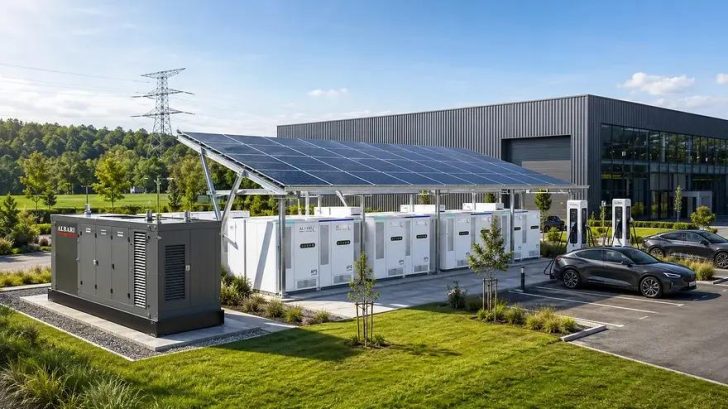
For example, a hotel may use solar during daylight hours, batteries to support selected loads during short interruptions and grid electricity when available. A gas generator may be retained for extended outages or periods of high demand.
A manufacturing business might use solar to reduce daytime grid consumption while retaining gas generation for production loads that require continuous power.
Hybrid systems can improve resilience and reduce reliance on a single source. But they are not automatically the cheapest option.
They require more careful engineering, electrical protection, control systems, equipment integration, maintenance planning and staff competence. A poorly designed hybrid system can be more complicated and expensive to operate than the individual systems it was intended to improve.
The key is to combine sources according to their roles, not simply accumulate technologies.
3. Compare the options against the costs that matter
A business should compare more than the purchase price of a generator or the installation cost of solar panels.
The real financial question is: how much will it cost to provide the required electricity, at the required level of reliability, over the useful life of the system?
| Decision factor | Solar | Natural gas | Grid | Hybrid |
|---|---|---|---|---|
| Reliability | Weather and storage dependent | Can be controllable with reliable fuel and equipment | Depends on actual local supply | Can improve resilience through redundancy |
| Fuel exposure | No purchased fuel for generation | Direct exposure to gas supply and prices | Tariff exposure | Depends on source mix |
| Initial capital | Often substantial, especially with batteries | Generator, connection and gas infrastructure can be substantial | Usually lower if connection exists | Often highest in complexity and combined equipment |
| Operating costs | Generally low routine generation costs | Fuel, servicing and repairs | Tariff and associated charges | Depends on dispatch and maintenance |
| Maintenance | Panels, inverters, batteries and protection systems | Engine, cooling, lubrication, fuel and exhaust systems | Internal installation and backup equipment | Multiple technologies and controls |
| Environmental impacts | Low operational emissions, but equipment has lifecycle impacts | Combustion emissions and possible methane leakage | Depends on generation mix | Depends on sources and dispatch |
| Space requirements | Roof or land | Generator space and potentially gas infrastructure | Existing connection | Space for several components |
| Operational flexibility | Limited without storage | Generally dispatchable | Subject to supply conditions | Potentially high with good controls |
This comparison is a starting point, not a final investment decision. Equipment specifications, local conditions, financing terms and the business’s load profile can materially change the outcome.
4. Calculate the total cost of ownership, not just the installation price
A solar vendor may offer a system for ₦80 million. A gas generator supplier may quote ₦65 million. A business owner could easily conclude that gas is cheaper.
But the purchase price is only one part of the investment.
A proper financial assessment should include:
Initial capital expenditure (CapEx)
- Equipment purchase.
- Engineering and system design.
- Installation and civil works.
- Electrical protection and integration.
- Gas connection or fuel infrastructure, where applicable.
- Battery storage and control systems.
- Testing, inspection and commissioning.
Operating expenditure (OpEx)
- Grid electricity bills.
- Gas purchases and delivery.
- Routine servicing.
- Replacement parts and consumables.
- Equipment monitoring.
- Insurance.
- Security and site maintenance.
- Technical personnel.
Replacement and lifecycle costs
- Battery replacement.
- Inverter replacement.
- Generator overhaul.
- Solar panel degradation.
- Control system upgrades.
- Disposal or recycling of equipment at the end of its useful life.
The cost of unreliable electricity
This is often missing from energy proposals.
A factory may lose production when power fails. A hotel may have to compensate guests. A supermarket may lose refrigerated products. A hospital may face serious service-delivery consequences. An office may experience reduced productivity and data loss.
These costs should be estimated where possible.
A business that spends less on electricity but loses several hours of production each month may not have achieved a genuine saving.
What does the Nigerian cost evidence tell us?
The International Finance Corporation’s 2025 Nigeria Country Private Sector Diagnostic provides a useful illustration of why the comparison should go beyond equipment prices.
It estimates commercial-scale grid-connected rooftop solar generation at around US$0.10/kWh in the context examined, compared with approximately US$0.127/kWh for Band A grid electricity. It also reports estimated costs of US$0.11–0.14/kWh for solar systems with battery storage, compared with US$0.30–0.60/kWh for diesel generation. IFC
These figures are useful reference points, not quotations for every Nigerian business. Actual costs vary with location, system size, financing, equipment, installation conditions, tariff category, utilisation and the cost of backup.
The important implication is that solar and storage can be commercially attractive alternatives to expensive diesel self-generation in suitable circumstances. But that does not mean every business should immediately replace its existing power system with solar.
The business must calculate its own cost per usable kWh, taking reliability and financing into account.
5. Understand the financing implications
A technology can be economically attractive over its lifetime and still be difficult for a business to afford.
Solar illustrates this particularly well. It can reduce future energy expenditure, but the initial investment may be substantial. A business with limited access to long-term financing may struggle to fund a system that would otherwise make financial sense.
There are several financing arrangements worth considering.
| Financing model | How it works | What to examine |
|---|---|---|
| Direct purchase | Business pays for and owns the system | Capital availability, payback and maintenance responsibility |
| Bank or asset finance | Business borrows to acquire the system | Interest rate, repayment period, collateral and currency exposure |
| Leasing | Business pays to use the equipment | Lease payments, ownership rights and maintenance obligations |
| Power purchase agreement (PPA) | A provider finances and operates the system, selling electricity to the business under agreed terms | Tariff escalation, minimum purchase obligations, contract duration and performance guarantees |
| Energy-as-a-service | Provider supplies an agreed energy service under a commercial arrangement | Service levels, uptime commitments, exclusions and exit conditions |
A PPA may reduce the need for upfront capital, but it does not mean the electricity is free or that the business has no financial obligations.
The contract should clarify who owns the equipment, who maintains it, what happens when the system underperforms, how tariffs change and what happens at the end of the agreement.
Financing should also be matched to the asset’s useful life and expected cash flows. A business should be cautious about funding long-life energy infrastructure with short-term, expensive borrowing.
6. Reliability should be measured against the cost of interruption
The word reliable is often used loosely in energy proposals.
A supplier may describe a system as reliable because it can generate electricity for several hours. But that does not answer whether it can support the business’s most important operations when required.
The business should identify its acceptable interruption levels.
For example:
- Can the organisation tolerate a 15-minute interruption?
- Can production be paused safely for an hour?
- Must refrigeration remain powered overnight?
- Are there critical systems that cannot be switched off?
- Can certain operations be moved to daylight hours?
- Is there a process for restarting equipment after an outage?
This leads to a useful distinction between essential and non-essential loads.
A hotel may not need its entire building to operate at full capacity during a grid interruption. It may need to prioritise lifts, emergency lighting, refrigeration, security, water pumps and selected air-conditioning systems.
A factory may separate production-critical machinery from administrative offices and non-essential lighting.
This load prioritisation can reduce the size and cost of the required backup system.
A business should also consider whether it needs:
- Automatic transfer between power sources.
- Battery storage for instant changeover.
- Uninterruptible power supplies (UPS) for sensitive equipment.
- Redundant generation capacity.
- Spare parts and maintenance contracts.
- Remote monitoring and fault alerts.
The goal is not necessarily to power everything at all times. It is to protect the activities whose interruption would create the greatest financial, safety or service-delivery consequences.
7. Examine fuel and tariff exposure
Each energy option exposes the business to a different form of price risk.
Solar: The business avoids purchasing fuel for solar generation, but remains exposed to equipment costs, financing costs, battery replacement and possible grid or backup expenses.
Gas: The business depends on the price and availability of natural gas, delivery infrastructure and the terms of its supply agreement.
Grid: The business is exposed to applicable electricity tariffs, billing arrangements and changes in its supply conditions.
Hybrid: Exposure depends on how much electricity is obtained from each source and how the system is controlled.
For Nigerian businesses, fuel supply deserves particular attention.
NERC’s 2025 annual report describes continuing gas supply constraints affecting thermal generation in the national electricity market. That is a reminder that a business considering gas-powered self-generation should investigate its own fuel supply arrangements rather than assume that natural gas will always be available when needed. PublicNow
The questions for a gas project should include:
- Is a pipeline connection available at the site?
- Is the gas supply firm or interruptible?
- What pressure and volume can be guaranteed?
- Who bears the cost of connection infrastructure?
- How are prices determined and adjusted?
- What happens when supply is curtailed?
- Is an alternative fuel or backup source available?
For grid power, the business should examine its actual service band, tariff and supply history. It should not base an investment decision on a tariff category alone.
For solar, the business should model seasonal generation, battery autonomy and the cost of any supplementary source.
A credible energy proposal should show what happens when assumptions change. What if gas prices rise? What if the grid tariff changes? What if battery replacement costs more than expected? What if the business expands?
This is where sensitivity analysis becomes important.
8. Do not overlook maintenance and technical capacity
An energy system is not a one-time purchase. It is an operating asset.
Solar installations require periodic inspection, cleaning where necessary, inverter monitoring, electrical checks and battery management. Gas generators require servicing, lubrication, cooling-system maintenance, engine checks and fuel-system management. Grid-connected systems need properly maintained internal wiring, protection devices, transformers and switchgear.
Hybrid installations require all of these functions to work together.
The organisation should establish:
- Who will operate the system.
- Who will carry out routine maintenance.
- Whether trained personnel are available.
- Whether spare parts can be obtained locally.
- Whether the supplier offers a credible warranty and service arrangement.
- How faults will be detected and reported.
- How quickly critical components can be replaced.
- What happens if the original installer is no longer available.
In Nigeria, technical competence and electrical safety should be treated as investment requirements, not optional extras.
The Nigerian Electricity Management Services Agency (NEMSA) states that electrical installations are subject to technical inspection, testing and certification, and provides certification arrangements for renewable-energy installation contractors. Nigerian Electricity Management Services Agency+2
Businesses should verify contractor competence, installation standards, protective systems and the applicable inspection and certification requirements before commissioning a system.
9. Consider the environmental impact of the entire system
Businesses increasingly need to consider energy decisions in relation to emissions, environmental performance and sustainability reporting.
But environmental comparisons should be based on evidence, not labels.
Solar photovoltaic systems have no combustion emissions during electricity generation. However, their production, transportation, installation, battery materials and eventual disposal have environmental impacts.
Natural gas generally produces less carbon dioxide per unit of electricity than many conventional liquid-fuel generators, but it is still a fossil fuel. Methane leakage during production and transportation is also relevant to its overall climate impact.
Grid electricity has an environmental footprint determined by the generation sources supplying the system and the wider electricity mix.
Hybrid systems can reduce emissions if they displace more carbon-intensive generation, but the outcome depends on which sources are used, how often and at what efficiency.
The organisation should assess:
- Greenhouse gas emissions.
- Local air pollution.
- Noise.
- Water requirements.
- Land and rooftop use.
- Battery chemistry and end-of-life management.
- Fuel transportation and storage risks.
- Waste disposal and recycling arrangements.
A business should also avoid assuming that installing solar automatically makes its entire electricity consumption renewable. If the system supplies only part of its demand and the rest comes from the grid or gas generation, the organisation must account for the actual energy mix.
10. Check the regulatory and site requirements before committing
Energy investments can involve approvals, technical standards, environmental considerations and electricity-market rules. The applicable requirements depend on the size, configuration and purpose of the installation.
For example, a business installing a relatively small rooftop solar system has a different regulatory profile from an organisation developing a large captive generation plant or supplying electricity to other customers.
NERC provides licensing and authorisation guidance for generation, captive power and other electricity-market activities. Its captive power permit requirements include technical documentation and other supporting information. Businesses should establish which requirements apply to their proposed capacity and operating arrangement rather than assume every installation follows the same process. NERC+2
The project team should also assess:
- Site ownership or permission to use the installation area.
- Structural suitability of rooftops.
- Electrical connection and protection requirements.
- Fire safety and battery installation arrangements.
- Gas pipeline access and safety requirements, where applicable.
- Environmental approvals or assessments where required.
- Insurance conditions.
- Applicable inspection, testing and certification.
These requirements should be established before the company signs a purchase agreement or makes a major capital commitment.
11. There is no universal best option: consider the business’s operating model
The most suitable energy arrangement depends on what the organisation does, when it operates, how much electricity it consumes and what happens when power fails.
Consider four illustrative situations.
A. A hotel with substantial daytime and evening demand
The hotel needs electricity for refrigeration, water pumps, security, lighting, lifts, kitchens and air-conditioning.
A solar-and-battery system could reduce daytime grid consumption and support selected loads during interruptions. Grid electricity could supplement supply when available, while an existing generator remains available for extended interruptions or unusually high demand.
The important design question is how much battery storage is economically justified. Attempting to power the entire hotel from batteries may cost considerably more than prioritising essential loads.
B. A manufacturing company with continuous production
The factory operates machinery throughout the day and night. Interruptions can damage materials, disrupt production schedules and affect customer deliveries.
Solar may reduce daytime energy expenditure, but the factory may still require dependable grid or gas generation for continuous production.
A hybrid system could be appropriate if the gas supply is dependable, the solar installation is technically feasible and the economics justify the additional investment.
The factory must also consider motor-starting loads, power quality, redundancy and the consequences of losing supply during production.
C. A supermarket or cold-storage business
The organisation’s most important requirement may be protecting refrigerated products rather than maintaining every electrical circuit.
Solar can support daytime consumption, while batteries or a dependable backup source can protect refrigeration and other critical loads.
The business should calculate the financial exposure associated with spoiled products, not merely the cost of generating electricity.
D. A professional services office
An office with substantial daytime activity may be able to use solar to meet a meaningful portion of its daily demand.
Grid electricity can supplement supply, while UPS systems or batteries protect computers, communications equipment, security systems and other essential loads.
A large gas generator may be unnecessary if the business’s critical loads can be protected more economically through a smaller, properly designed arrangement.
These examples are not recommendations for every hotel, factory, supermarket or office. They demonstrate why technology selection must begin with operational requirements.
12. Use a structured decision framework before approving the investment
A business should not move from an initial conversation with an energy vendor straight to procurement.
It should follow a sequence that connects technical evidence, financial analysis and management approval.
- Conduct an energy auditObtain electricity bills, generator records, fuel consumption, equipment inventory and load profiles. Establish daily and seasonal demand.
- Identify critical loadsDetermine which operations must remain powered, which can be interrupted and which can be rescheduled.
- Assess site and infrastructureExamine grid connection, roof or land availability, gas access, electrical infrastructure, safety and installation constraints.
- Develop more than one technical optionRequest proposals for relevant alternatives, such as grid plus backup, solar plus grid, solar plus battery, gas generation or a hybrid arrangement.
- Compare lifecycle costsInclude capital costs, financing, fuel, tariffs, maintenance, replacements, operating efficiency and the cost of outages.
- Test different scenariosModel changes in electricity tariffs, fuel prices, business growth, equipment performance and financing costs.
- Assess technical and environmental risksVerify system design, contractor competence, safety, emissions, warranties and regulatory requirements.
- Present a business case to managementShow the recommended configuration, alternatives considered, investment required, expected savings, reliability improvements, risks and implementation plan.
13. What should management demand from an energy proposal?
A proposal that says “installing solar will reduce electricity costs” is not yet an investment case.
Management needs to understand how much electricity the system will provide, what it will cost, how it will affect operations and whether the expected savings justify the investment.
A useful proposal should contain:
| Management requirement | Evidence expected |
|---|---|
| Current energy baseline | Grid consumption, generator output, fuel expenditure and outage records |
| Proposed configuration | System capacity, technology mix and technical design |
| Energy contribution | Expected kWh from each source and operating assumptions |
| Reliability improvement | Critical loads protected and expected backup capability |
| Capital investment | Equipment, installation, engineering and commissioning costs |
| Operating costs | Fuel, tariffs, servicing, insurance and monitoring |
| Financial assessment | Cash flow, payback, net present value and internal rate of return where appropriate |
| Risk assessment | Fuel, tariff, equipment, supplier, safety and operational risks |
| Environmental assessment | Expected emissions and other relevant impacts |
| Implementation plan | Procurement, approvals, installation, testing and commissioning |
| Performance measurement | Energy generated, grid consumption displaced, outages and cost per usable kWh |
The proposal should also disclose its assumptions.
For example, projected savings should not be based on the assumption that a solar system will operate at full capacity every day. Nor should a gas proposal assume uninterrupted fuel supply without a credible supply arrangement.
Management should be able to challenge the numbers and understand how the project performs if conditions are less favourable than expected.
14. The questions to ask vendors before signing a contract
Energy vendors naturally want to demonstrate the strengths of the technology they supply. That is not a problem. The problem arises when the business accepts a sales proposal without independently examining its assumptions.
Before signing, ask:
- What load profile was used to size the system?
- What percentage of the business’s electricity demand will it actually meet?
- How was peak demand calculated?
- What happens during cloudy periods, grid failures or fuel interruptions?
- What battery autonomy is guaranteed, and under what load conditions?
- What are the expected annual maintenance costs?
- Which components will require replacement, and when?
- What efficiency assumptions were used?
- Are savings calculated against actual electricity costs or an unrealistic baseline?
- Who is responsible for system monitoring and repairs?
- What performance guarantees are included?
- What happens if the system does not deliver the contracted performance?
- Are installation, inspection and commissioning requirements included?
- What happens at the end of the contract?
For financed systems and PPAs, businesses should pay particular attention to payment obligations, tariff adjustments, minimum purchase commitments, equipment ownership, default provisions and termination clauses.
A low initial quotation can become an expensive arrangement if the contract transfers too many risks to the business.
THE LION TAKE
Energy selection is a business decision, not a technology contest.
Solar is not automatically the answer because it is renewable. Gas is not automatically the answer because it can generate electricity at night. Grid power is not automatically the cheapest option because the business already has a connection. And hybrid systems are not automatically superior because they combine several technologies.
A business needs to know what electricity costs it today, what interruptions cost it, what its operations genuinely require and what it can afford to maintain over time.
Sometimes the answer will be solar and grid. Sometimes gas and grid. Sometimes a properly designed hybrid system. And sometimes the most sensible investment is to improve energy efficiency before buying additional generation capacity.
The objective is not to own the most impressive power system. It is to secure the right amount of reliable electricity at a sustainable cost, without exposing the business to unnecessary financial, operational or environmental risks.
That is the difference between buying power equipment and making an energy investment.