







To protect global orchard yields and reduce reliance on costly chemical sprays, agricultural biotechnology pioneer Okanagan Specialty Fruits (OSF) has created the world’s first gene-edited apple tree tolerant to fire blight.
Developed through OSF’s proprietary GenShield platform at its advanced plant genomics lab in Saskatoon, the innovation targets a devastating bacterial disease that causes an estimated US$3.2 billion to US$5.6 billion in global damages annually and can slash orchard yields by up to 40%.
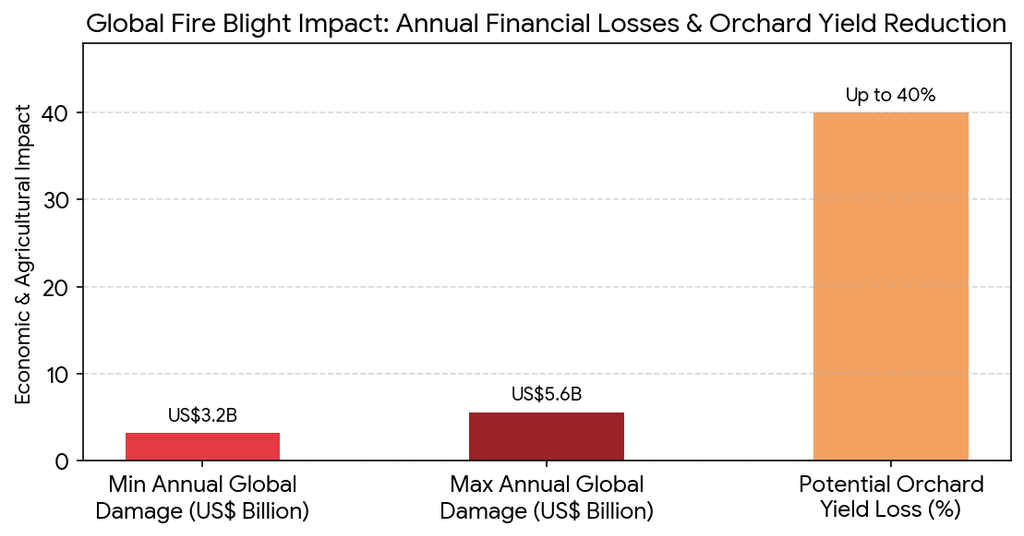
The impact chart above illustrates the massive economic and agricultural toll of fire blight, highlighting the commercial urgency behind OSF’s genetic resistance breakthrough.
Boardroom Breakdown: OSF GenShield Platform & Commercialization Matrix
As the first company in North America to apply a gene-editing approach to engineer disease tolerance in apples, OSF has structured its technology for broad industry licensing rather than closed exclusivity:
| Strategic & Technical Pillar | Core Metrics & Capabilities | Scientific & Operational Mechanism | Commercial & Market Impact |
|---|---|---|---|
| Fire Blight Disease Burden | US$3.2B – US$5.6B in annual global losses; up to 40% yield drop | Bacterial infection with no known cure; conventional control relies on costly pruning and chemical programmes. | Creates urgent grower demand for durable, built-in genetic protection. |
| GenShield Platform | Developed at OSF’s advanced plant genomics lab in Saskatoon | Disables susceptibility genes so bacteria cannot persist beyond a small initial entry lesion. | Applicable across apples, pears, and other fruit plants; drastically cuts chemical inputs. |
| Commercial Licensing Model | Open partnership and licensing rollout | Preparing to license its first disease-tolerant apple variety to North American growers while inviting global variety owners. | Built on widespread adoption to achieve the commercial scale needed for sustained R&D investment. |
| Market & Regulatory Hurdles | Multi-region yield stability & international export acceptance | Requires proven agronomic consistency across diverse climates and regulatory clearance in key export markets. | Determines global supply chain adoption and cross-border trade viability. |
How the GenShield Genetic Mechanism Works
Fire blight currently has no known cure, forcing commercial orchards to rely on intensive pruning and expensive chemical programmes that remain only partially effective. Using the GenShield genetics-based plant protection system, OSF scientists in Saskatoon knocked out the specific genes that make apples and pears vulnerable to the bacteria.
When exposed to the pathogen, the bacteria still enter the plant and cause a small lesion at the exact point of infection. However, the disease cannot spread or destroy the tree because the underlying genes required for the bacteria to persist after initial infection have been disabled.
Executive and Industry Science Perspectives
Highlighting the practical relief the breakthrough offers commercial orchard operators, OSF CEO and co-founder Neal Carter emphasized that built-in genetics eliminate ongoing chemical dependency.
“As apple growers, we know first-hand the difficulty and expense of trying to prevent and control fire blight through pruning and chemical programs,” Carter said. “GenShield solves that problem because the fire blight tolerance is built directly into the tree itself.”
Reinforcing the broader sustainability benefits for global produce supply chains, Max Teplitski, Chief Science Officer for the International Fresh Produce Association, noted that gene editing gives breeders an essential tool to help crops withstand pests and diseases so more planted produce reaches consumers with fewer agricultural inputs.
“We need innovation to grow fruits and vegetables more sustainably and keep them within reach for more families,” Teplitski said.
Commercialization Outlook: Scaling Through Global Licensing
By actively seeking partnerships with variety owners worldwide and preparing to license its first disease-tolerant apple variety to growers in North America, OSF is pursuing a collaborative commercialization strategy. While the sector’s ultimate commercial test will depend on multi-regional yield stability and regulatory acceptance across key international export markets, OSF’s open licensing model provides a clear pathway to scale durable disease resistance across the global fruit industry.