






To eliminate heavy fuel oil dependency and establish Africa’s first carbon-neutral brewery of its scale, Heineken Ethiopia is set to formally inaugurate a 4 billion birr (US$24.5 million) green energy project at its Kilinto Brewery in Addis Ababa in the second half of October.
Completed over approximately one and a half years, the specialized infrastructure is already powering the entire brewery with green electricity, according to Heineken Ethiopia Managing Director Bart De Keninck. The milestone directly advances the brewer’s 2024 sustainability pledge, building upon a 21% reduction in carbon emissions achieved over the preceding five years.
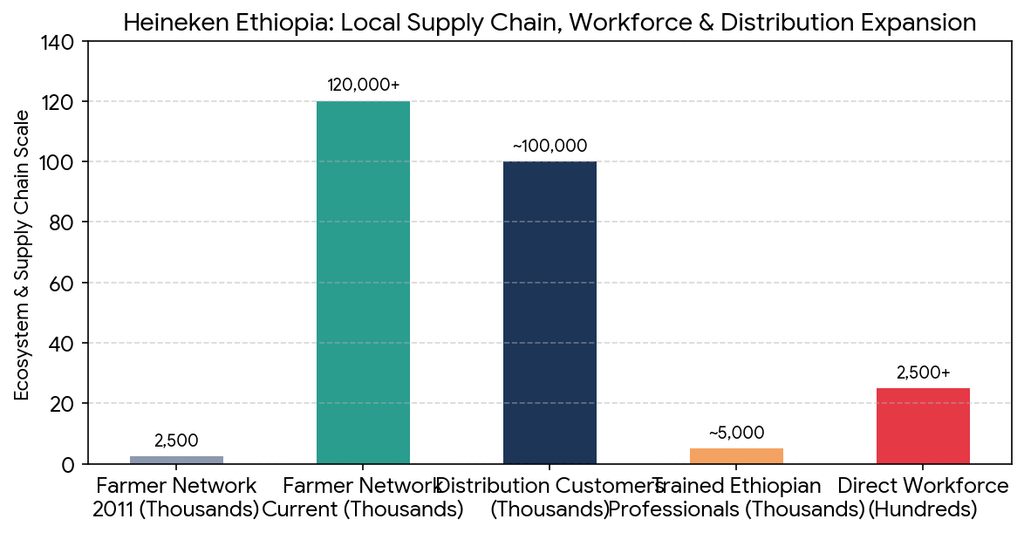
The operational metrics chart above highlights Heineken Ethiopia’s massive agricultural localization, scaling its farmer network 48-fold since 2011, alongside its nationwide employment and distribution reach.
Boardroom Breakdown: Heineken Ethiopia Sustainability & Operations Matrix
Having entered Ethiopia in 2011 via the acquisition of the Harar and Bedele breweries before inaugurating Kilinto Brewery in 2015 as part of a €310 million investment, Heineken has built an integrated national footprint:
| Strategic & Operational Pillar | Financial & Capacity Metrics | Execution Timeline & Assets | Economic & Environmental Impact |
|---|---|---|---|
| Kilinto Green Energy Project | 4 billion birr (US$24.5M) investment | Completed in ~1.5 years; formal inauguration in second half of October | Powers Kilinto entirely with green electricity, eliminating imported heavy fuel oil. |
| National Brewing Footprint | 3 breweries (Kilinto, Harar, Bedele); Kilinto designed for 1.5 million hectolitres annually | Portfolio includes Heineken, Walia, Bedele, Harar, plus Desperados (added in April via ~500M birr equipment investment) | Powered largely by local talent and expertise across 2,500+ direct employees. |
| 100% Local Barley Sourcing | Scaled from 2,500 farmers (2011) to 120,000+ Ethiopian farmers | Achieved 100% local barley sourcing in 2023 | Replaced more than US$1.4 billion in agricultural imports with Ethiopian-grown barley. |
| Supply Chain & Community ESG | ~400 local suppliers annually; ~100,000 distribution customers | ~100 million birr invested in 215 G+1 community houses; ~5,000 professionals trained | Directly benefits communities of about 4,000 people while expanding national technical skills. |
Executive Vision: Eliminating Heavy Fuel Oil Through Clean Technology
Highlighting the engineering shift required to decarbonize industrial heat generation in brewing, Heineken Ethiopia Managing Director Bart De Keninck noted that replacing fossil fuels demands substantial upfront capital commitment.
“Normally, to run a brewery, you need heavy oil to heat up the plant,” De Keninck said. “There has been new technology to use green electricity instead of oil, even though it requires huge investment.”
The transition positions Kilinto Brewery as a continental benchmark for industrial decarbonization, directly reducing foreign currency exposure tied to imported heavy fuel oil while advancing Heineken’s 2024 carbon-neutrality roadmap.
Deep Local Integration: Import Substitution and Portfolio Growth
Beyond clean energy infrastructure, Heineken Ethiopia’s operational model demonstrates extensive backward integration into the domestic economy:
- Import Substitution Milestone: By expanding its agricultural outreach from 2,500 farmers in 2011 to over 120,000 Ethiopian farmers, the company achieved 100% local barley sourcing in 2023, successfully replacing more than US$1.4 billion in imports.
- Portfolio Expansion: Alongside flagship brands Heineken, Walia, Bedele, and Harar, the brewer expanded into flavored beer in April by introducing Desperados following an investment of nearly 500 million birr in local production equipment.
- Social & Workforce Investment: Employing more than 2,500 people, collaborating with roughly 400 local suppliers, and serving approximately 100,000 customers, Heineken has also trained around 5,000 Ethiopian professionals and invested about 100 million birr to construct 215 G+1 houses benefiting roughly 4,000 community members.