









Your 30s can be an exciting stage of professional life. You may be earning more than you did in your 20s, taking on greater responsibilities, getting married, raising children, buying property or beginning to think seriously about long-term financial security.
But this is also a decade when financial decisions can become considerably more expensive.
A salary increase can create the impression that you are becoming wealthier, even when your expenses are rising just as quickly. A promotion can bring more income but also more lifestyle commitments. And the pressure to appear successful can lead professionals into financial decisions that look impressive today but become burdensome tomorrow.
The problem is not necessarily that professionals in their 30s earn too little. Sometimes, it is that they make important financial decisions without a clear understanding of the long-term consequences.
To examine this properly, we need to distinguish between ordinary financial challenges and avoidable mistakes, and ground the discussion in research on household finances, debt, savings, investment behaviour and financial wellbeing.
1. Confusing a higher salary with increased wealth
One of the most common financial traps is allowing expenditure to grow every time income increases.
A professional receives a promotion, moves into a better apartment, changes their car, upgrades their wardrobe, begins eating at more expensive restaurants and takes on additional financial commitments.
None of these decisions is automatically wrong. The problem arises when the increase in income produces an equally large increase in expenditure, leaving little or nothing to build wealth.
This is often described as lifestyle inflation.
Consider two professionals earning ₦500,000 and ₦1 million monthly respectively.
The first spends ₦470,000 every month. The second spends ₦950,000.
The second professional earns twice as much but may be no better prepared for an unexpected expense.
The important question is not simply how much you earn. It is how much of your income you retain, protect and put to productive use.
A salary increase should ideally create an opportunity to strengthen savings, reduce expensive debt and invest towards future goals before additional lifestyle commitments absorb the difference.
2. Having no emergency fund
An emergency fund is not money set aside for a holiday, a new phone or an attractive investment opportunity. It is money reserved for unexpected financial disruption.
Job loss, delayed salaries, medical emergencies, urgent family responsibilities, vehicle repairs and sudden household expenses can destabilise a professional who has no financial buffer.
Research from PiggyVest’s 2024 Savings Report, based on a survey of more than 10,000 Nigerians, found that 64% of respondents did not have emergency funds. Its 2025 report also highlighted declining saving behaviour: only 40% of respondents reported saving monthly, compared with 64% in 2023.
These are survey findings, not a census of all Nigerian professionals. Nevertheless, they illustrate a serious household financial resilience challenge.
EFInA’s Access to Financial Services in Nigeria 2026 findings offer another perspective: 62% of adults surveyed would find it very difficult to raise emergency money, while only 36% had savings or assets capable of covering two or more months. A2F Insights
For a professional in their 30s, an emergency fund is particularly important because financial responsibilities may already extend beyond personal expenses.
A reasonable starting objective is to build liquid savings equivalent to three to six months of essential expenses, adjusting the target to reflect job security, dependants, income stability and other obligations.
The mistake is not failing to accumulate six months of expenses overnight. It is having no deliberate plan to build a financial safety net.
3. Postponing retirement planning because retirement seems far away
At 30, 35 or even 39, retirement can feel like a problem belonging to somebody else.
There are more immediate priorities: rent, school fees, professional development, family support, property acquisition and maintaining a reasonable standard of living.
Consequently, retirement contributions may be treated as something to think about later.
But time is one of the most valuable resources in long-term investing.
Consider an illustrative example:
Two professionals invest ₦50,000 monthly, assuming a hypothetical annual return of 10%, compounded monthly, with contributions made at the end of each month.
- Professional A starts at 30 and invests for 30 years.
- Professional B starts at 40 and invests for 20 years.
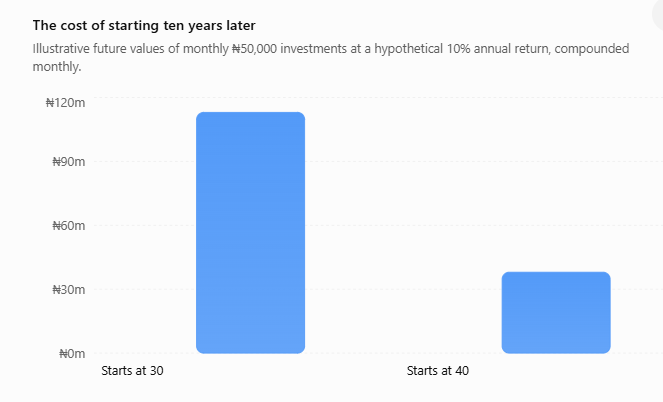
The difference is substantial, even though both contribute the same monthly amount and earn the same assumed return.
These are illustrations, not guaranteed investment outcomes. Actual returns, inflation, fees and taxes will affect the final value.
Nigeria’s pension data makes the retirement question particularly relevant. PenCom reported 10.58 million Retirement Savings Accounts at the end of 2024, while KPMG’s 2024 Nigeria Pension Industry Customer Experience Survey estimated that only about 15% of the working population was enrolled in the contributory pension system at that time.
For eligible employees, understanding pension remittances and checking that contributions reach their Retirement Savings Accounts are important. Self-employed professionals and eligible workers outside the mandatory scheme can also explore PenCom’s Personal Pension Plan. National Pension Commission
The mistake is assuming that retirement planning can always be postponed until income becomes more comfortable.
4. Borrowing to maintain an appearance of success
A professional’s financial decisions can sometimes be influenced by the desire to look successful.
The expensive car, designer accessories, elaborate wedding, premium apartment, luxury holiday or latest gadgets may communicate a particular lifestyle.
But when these purchases are funded through expensive borrowing, the appearance of financial success can conceal financial vulnerability.
Debt itself is not necessarily bad. A carefully structured loan can finance a productive business, an income-generating asset or an investment in education and professional development.
The danger lies in borrowing repeatedly to finance consumption that does not generate income or improve long-term financial capacity.
PiggyVest’s 2024 survey found that major expenses, including cars, rent, education and weddings, were among the reported reasons respondents entered debt. It also identified family and friends as a significant source of borrowing among respondents who were indebted. PiggyVest
For professionals in their 30s, this raises a practical question:
Are you using debt to acquire something that strengthens your financial position, or are you using tomorrow’s income to maintain today’s appearance?
The distinction matters.
5. Failing to protect income and assets
Many professionals think about making money but spend considerably less time considering what could happen if their ability to earn suddenly changes.
A salary is not guaranteed indefinitely. A business can experience losses. A health emergency can disrupt income. A family crisis can create substantial financial obligations.
Yet insurance is sometimes treated as an unnecessary expense rather than a financial protection mechanism.
Relevant forms of protection may include health insurance, life insurance where dependants rely on your income, appropriate disability or income protection where available, and insurance for valuable assets.
Nigeria’s EFInA 2026 findings indicate that insurance coverage remains limited, with only 5% of adults using insurance services. EFInA
This is a national financial inclusion finding, not a statistic specific to professionals in their 30s. But it highlights the wider protection gap.
A professional with savings and investments but inadequate protection may still be financially vulnerable.
The objective is not to purchase every insurance product available. It is to identify risks that could seriously damage your financial position and obtain appropriate, regulated cover.
6. Investing in opportunities you do not understand
The desire to build wealth can make professionals vulnerable to investment decisions driven by excitement, social pressure and fear of missing out.
Someone introduces a high-yield investment opportunity. A colleague claims to be earning impressive returns. A social media personality advertises a platform. A friend insists that an opportunity is only available for a limited period.
The professional invests without adequately understanding the business model, the underlying assets, the risks, the regulatory status or how returns are generated.
This is particularly dangerous when the promised returns appear unusually attractive.
The OECD’s 2023 International Survey of Adult Financial Literacy, involving 39 countries and economies, found an average financial literacy score of 60 out of 100. It also identified weaknesses in understanding interest, inflation and other basic financial concepts. The report found that adults meeting minimum financial literacy targets tended to have higher financial wellbeing and resilience.
The lesson is not that professionals should avoid investing because investments carry risk.
It is that investing requires knowledge, due diligence and an understanding of the relationship between risk and expected returns.
Before committing money, ask:
- What exactly am I investing in?
- How does this investment generate returns?
- Who regulates or supervises the provider?
- What are the fees and withdrawal conditions?
- What happens if the investment performs poorly?
- Can I afford to lose the money?
If the explanation depends entirely on promises of guaranteed high returns or pressure to recruit more investors, exercise particular caution.
7. Supporting everybody without planning for yourself
This is a particularly relevant financial challenge in Nigeria.
Professionals may be supporting parents, siblings, relatives, children, spouses and extended family members. They may also be contributing to medical bills, school fees, household expenses, rent and other responsibilities.
Family support can be meaningful and necessary. The mistake is not helping people.
The mistake is making financial commitments without understanding their cumulative effect on your own financial stability.
A professional may have a good salary but no savings because every unexpected family expense becomes an obligation. Another may repeatedly borrow to meet commitments because saying no feels unacceptable.
Over time, the person becomes a financial support system for others without building a financial support system for themselves.
A more sustainable approach is to establish a realistic family-support budget, distinguish recurring commitments from emergencies, and communicate financial limits.
Helping others should not require permanently placing your own financial future at risk.
8. Failing to understand inflation and purchasing power
A professional may save ₦2 million and feel financially secure because the account balance looks substantial.
But money is not valuable simply because its nominal amount increases.
Inflation reduces purchasing power. Money that can purchase a particular basket of goods today may purchase considerably less in the future.
This is why saving and investing should not be treated as interchangeable.
Savings provide liquidity and financial security. Investments seek to grow wealth over time, although they carry varying levels of risk and may lose value.
The OECD financial literacy research specifically identifies understanding inflation and interest as important financial competencies, yet finds that these remain weak areas among adults across participating countries.
For Nigerian professionals, the implication is important: keeping all long-term wealth in cash may expose it to declining purchasing power, while investing all available money in illiquid assets may leave insufficient funds for emergencies.
The objective is to balance liquidity, protection and long-term growth.
9. Depending on one source of income without preparing for disruption
A stable salary can create a false sense of financial security.
A professional may become accustomed to monthly income and build an entire lifestyle around it. Rent, school fees, loans, household expenses and family commitments may all depend on that single source.
Then a restructuring exercise, redundancy, business closure or career transition occurs.
The financial consequences can be severe.
This does not mean every employee must start a business or pursue multiple side hustles. Diversifying income is not automatically easy, and poorly planned side businesses can create additional losses and distractions.
However, professionals should consider how they would manage if their primary income stopped.
This may involve building emergency savings, maintaining marketable skills, developing a professional network, creating a viable secondary income stream or investing in assets that can provide future income.
The objective is resilience, not endless hustle.
10. Mistaking financial activity for financial progress
Some professionals are constantly moving money around.
They save in several apps, contribute to different cooperatives, buy shares occasionally, participate in investment groups, acquire property and make regular purchases of financial products.
But financial activity does not necessarily mean financial progress.
Someone may own land but have no liquid savings. Another may have substantial investments but carry expensive consumer debt. Someone else may earn a good salary but have no clear understanding of their net worth.
Financial progress requires a coherent picture of one’s financial position.
At a minimum, professionals should understand:
- Monthly income and expenditure.
- Total outstanding debt.
- Emergency savings.
- Pension and retirement contributions.
- Investment holdings and associated risks.
- Insurance and other financial protections.
- Assets, liabilities and estimated net worth.
A simple financial review conducted regularly can reveal problems that salary statements and bank balances alone may conceal.
What should professionals in their 30s be doing differently?
The objective is not to become wealthy overnight. It is to avoid allowing today’s decisions to create unnecessary financial pressure in the future.
A practical starting point is to:
- Know your numbers. Calculate your income, essential expenditure, debt and net worth.
- Build an emergency reserve. Start with an achievable amount and grow it consistently.
- Review your debt. Prioritise expensive borrowing and avoid taking on new debt for status-driven consumption.
- Start or strengthen retirement contributions. Understand your pension arrangements and consider additional long-term savings where affordable.
- Protect your financial position. Review relevant health, life and asset insurance.
- Invest deliberately. Understand the investment, its risks, fees, liquidity and regulatory status before committing money.
- Set boundaries around financial commitments. Plan for family support rather than allowing every request to become an unbudgeted obligation.
- Review your financial position regularly. A quarterly review can help you identify whether your income is translating into genuine progress.
THE LION TAKE
Your 30s are not a deadline for becoming wealthy. Neither should they be treated as a decade in which financial decisions can be postponed indefinitely.
It is a period when income, responsibilities, career opportunities and financial commitments may all be expanding simultaneously.
The danger is that professionals become so focused on earning more that they pay insufficient attention to retaining, protecting and growing what they earn.
A good salary is valuable. But a good salary without financial discipline can still produce financial insecurity.
The objective should not be to look wealthy by 35 or own every asset your peers appear to have acquired.
It should be to build a financial position that gives you choices: the ability to handle emergencies, make career decisions without desperation, support people responsibly, invest in opportunities and approach the future with greater confidence.
Because financial success is not simply about how much you earn. It is also about how much of your future your present decisions protect.