








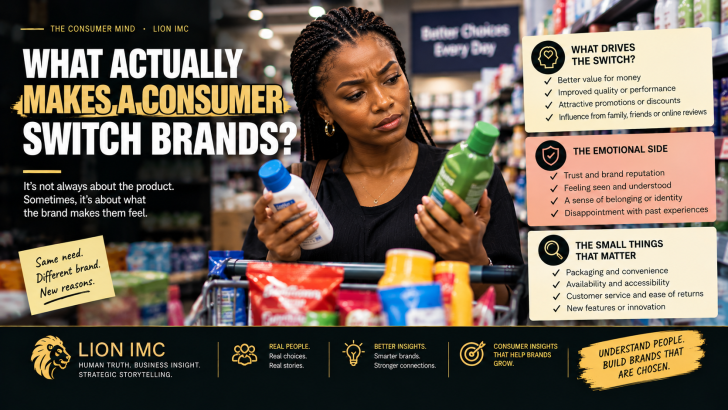
A woman walks into a supermarket to buy the detergent she has used for years. She knows the packaging, trusts the product and already knows how much it costs.
Then she notices another brand.
It is on promotion. The packaging promises better results. A friend recently recommended it. And, with prices rising, the possibility of saving a little money is difficult to ignore.
She picks it up, compares the two products and puts her usual brand back on the shelf.
Has the old brand lost her loyalty? Or has the competitor simply given her a reason to reconsider a decision she had stopped thinking about?
Now imagine the same thing happening in a bank, an insurance company, a telecommunications network or a business-to-business relationship.
The customer who seemed loyal yesterday is suddenly exploring alternatives. The brand that assumed it had secured the relationship is now competing for it again.
For marketers, this is a familiar and expensive problem. But the explanation is often too simplistic: the customer switched because the other brand was cheaper.
Price matters. Yet consumers do not always abandon brands over price, and a discount does not guarantee that they will stay.
Consumers switch when the reasons to leave become stronger than the reasons to stay—and the balance looks different for every customer.
1. Sometimes, the brand has made staying too expensive
Price is an obvious reason to reconsider a purchase, particularly when household budgets are under pressure.
A consumer may discover that a competitor offers a similar product for less. A business may find that another supplier can meet its requirements at a lower cost. A subscriber may decide that a service no longer justifies its monthly bill.
But consumers do not evaluate price in isolation. They evaluate what they receive in return.
A more expensive brand may retain its customers if it consistently delivers better quality, convenience or reliability. A cheaper competitor may struggle to attract them if switching introduces uncertainty or additional costs.
The question is not simply, “Which brand costs less?”
It is, “Which brand offers the best value for what I need?”
For Nigerian consumers, that calculation may include product quantity, durability, transport costs, availability, service reliability and the risk of wasting money on something that disappoints.
A lower shelf price is not necessarily a better deal if the product performs poorly or needs replacing sooner.
For marketers, this creates an important distinction: price sensitivity is not the same as price being the only thing a customer cares about.
A brand that competes exclusively through discounts may attract customers who are willing to leave just as quickly when another competitor offers a better deal.
2. A disappointing experience can break years of loyalty
A customer may tolerate one bad experience. The second creates doubt. The third may send them looking for alternatives.
A product fails when it matters. A bank makes resolving a simple problem unnecessarily difficult. A delivery arrives late without an explanation. A customer-service representative treats a loyal customer as if their business means nothing.
The damage is often bigger than the immediate inconvenience.
The customer begins to question whether the brand is dependable. And once that doubt appears, every subsequent experience is judged against it.
Research on Nigerian telecommunications offers a useful illustration. A study of 845 consumers in Lagos and Ibadan examined switching behaviour and found that the attractiveness of alternatives and advertising were strongly associated with switching, while service quality and customer loyalty were associated with lower attrition. Price also had a statistically significant but comparatively small effect in that study. Its urban, telecommunications-specific sample means the findings should not be generalised to every Nigerian consumer or product category.
The practical lesson is that customer retention cannot be reduced to price promotions.
If a brand repeatedly disappoints customers, a competitor does not have to be dramatically better. It may only need to be more dependable.
Sometimes, customers do not switch because they have fallen in love with another brand. They switch because they are tired of giving their current brand another chance.
3. A competitor makes the alternative feel more attractive
Customers rarely evaluate a brand in a vacuum.
They compare it with what else is available, what friends recommend, what they see advertised and what they believe they could gain by changing.
A competing brand may offer a better product, a more convenient service, a useful new feature or a clearer explanation of why it deserves the customer’s money.
Sometimes, the competitor’s advantage is real. Sometimes, it is simply more visible.
That distinction matters because customers make decisions using the information available to them not necessarily the full technical specifications marketers would like them to consider.
A 2014 meta-analysis published in the Journal of the Academy of Marketing Science synthesised findings from 170 independent samples across 152 manuscripts on switching costs and their antecedents. The researchers highlighted the role of market alternatives and competition in shaping consumers’ perceptions of the costs associated with switching.
In practical terms, the more compelling the alternatives appear, the easier it becomes for customers to question their existing choice.
This is why competitor monitoring should go beyond price lists.
Marketers should ask:
- What are competitors promising that we are not?
- Which customer frustrations are they addressing?
- Are they making the buying process easier?
- Are they offering benefits customers genuinely value?
- Have they changed what customers now consider normal?
A competitor may be taking market share not because it has a superior product in every respect, but because it has identified one important frustration that the incumbent has ignored.
4. Sometimes, the customer has simply outgrown the brand
Not every switch is a complaint.
A customer’s needs change. Their income changes. Their family grows. Their business expands. Their priorities shift.
The brand that suited a customer five years ago may no longer meet their needs today.
Someone who once prioritised the cheapest mobile plan may now need reliable connectivity for work. A small business may outgrow a supplier that cannot handle larger orders. A consumer may move from buying the smallest available pack to seeking better long-term value.
The brand may not have become worse. The customer has changed.
This is where brands can make a costly mistake: assuming that because a customer was satisfied before, the same offer will remain relevant indefinitely.
Retention requires ongoing understanding.
Are customers buying the same quantity? Are their expectations changing? Are they asking for benefits the brand does not currently provide? Are different customer segments developing different priorities?
The Nigerian telecommunications study published in the UNIZIK Journal of Marketing in 2024 reinforces the need to avoid simplistic explanations. It surveyed 382 tertiary-institution students in Adamawa State and found that value-added services significantly influenced switching behaviour in that sample, while price and service quality were not significant determinants in its analysis. That does not invalidate the other study’s findings; it illustrates that results can differ by sample, setting and the factors examined.
The implication for marketers is straightforward: do not assume that the factor driving one customer’s switch is the same factor driving everyone else’s.
5. The brand has stopped making the customer feel understood
There is a less obvious reason consumers leave: the relationship no longer feels relevant.
A customer may have bought a brand for years because it seemed to understand their needs, lifestyle, values or aspirations. Over time, the brand’s communication becomes repetitive, its offers feel generic, or its products no longer reflect the customer’s priorities.
The customer may struggle to explain exactly what has changed. They simply find themselves paying more attention to alternatives.
This is where emotional connection and practical value meet.
A brand does not need to become a customer’s best friend. It does need to keep demonstrating that it understands the problem the customer is trying to solve.
For one person, that may mean convenience. For another, reliability. For someone else, feeling confident that the company will stand behind its product when something goes wrong.
The mistake is to confuse familiarity with relevance.
A consumer can recognise your logo, remember your advertising and know your product very well—and still decide that another brand suits them better.
6. Switching is not always easy even when the customer wants to leave
Here is the other side of the story: dissatisfied customers do not always switch immediately.
They may stay because changing is expensive, time-consuming or inconvenient. They may have accumulated rewards, built routines around a product, linked other services to an account, or fear that the alternative will be worse.
A business customer may remain with a supplier because replacing it would require new contracts, staff training, technical integration or operational disruption.
These are switching costs, and they can delay a customer’s departure.
But there is a difference between a customer who stays because the brand continues to earn their preference and one who stays because leaving feels like too much trouble.
The first relationship may contain genuine loyalty. The second may be fragile beneath the surface.
A competitor that makes switching easier—or offers a convincing reason to endure the inconvenience—can expose that fragility.
For marketers, this means a low churn rate is not always proof of strong customer relationships. It may also reflect barriers to exit.
The more useful question is not simply, “How many customers stayed?”
It is, “Why did they stay, and would they choose us again if switching became easier?”
So, what actually triggers the switch?
Most switching decisions can be understood through three forces working together.
1. The push
What makes the customer want to leave?
Repeated disappointment, poor service, rising prices, inconvenience or declining relevance.
2. The pull
What makes the alternative attractive?
Better value, stronger performance, a useful new feature, a trusted recommendation or a more appealing experience.
3. The resistance
What makes the customer hesitate?
Switching costs, habit, uncertainty, existing benefits, inconvenience or fear of making the wrong choice.
This is a useful way to diagnose switching, not a formula that predicts every consumer decision. The relative importance of each force depends on the product, the customer and the market.
A dissatisfied customer with few attractive alternatives may stay. A reasonably satisfied customer who discovers a much better option may leave. And a customer who has wanted to leave for months may finally do so when the process becomes easy.
For a brand, the strategic task is to understand all three forces rather than reacting to the moment a customer disappears.
What should marketers do differently?
If you want to reduce switching, start with the reasons people consider leaving not with another campaign telling them why they should stay.
1. Investigate actual departures. Ask customers why they left, but do not rely only on a single exit survey. Look for patterns in complaints, repeat purchases, cancellations, returns and service interactions.
2. Study the alternatives customers choose. Identify what competing brands are doing differently and whether those differences genuinely matter to your audience.
3. Fix recurring frustrations before increasing advertising spend. Promotion can attract attention, but it cannot reliably compensate for a consistently disappointing experience.
4. Give customers a reason to remain. Improve reliability, convenience, service, product performance or other benefits customers actually value. Do not assume a loyalty programme will repair a broken customer relationship.
5. Segment your retention strategy. A price-sensitive customer may need a different solution from someone frustrated by poor service or someone whose needs have changed.
6. Measure the quality of retention. Track repeat purchase, churn, complaint resolution, customer feedback and reasons for staying. Distinguish customers who actively prefer your brand from those who remain mainly because switching is inconvenient.
And remember: not every departing customer can or should be won back. Sometimes the customer has changed, the brand is no longer a good fit, or the economics of retaining that customer do not make sense. The goal is to understand the decision and respond intelligently not to treat every departure as a marketing failure.
The Lion Take
Consumers rarely switch brands for just one reason. They switch when an alternative becomes more attractive, their current experience becomes less satisfactory, or the reasons they once had for staying no longer feel compelling.
Price may open the conversation. Poor service may accelerate it. A competitor may provide the final nudge. And habit may delay the decision until one more disappointment makes leaving feel worthwhile.
That is why customer loyalty cannot be secured by advertising alone.
The brands most likely to retain customers are those that keep earning their choice through relevant value, dependable experiences and a willingness to listen when expectations change.
Because the uncomfortable truth is this: your customer does not have to hate your brand to leave it. They only have to find a better reason to choose someone else.
The Lion Question: Think about the last brand you abandoned. Was it the price, a disappointing experience, a better competitor, or something you could not quite put into words? What would the old brand have needed to do to keep you?