






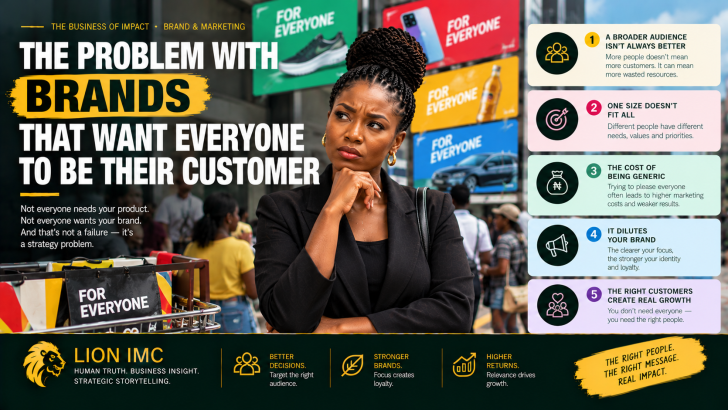
A brand says its product is for everyone. Young people, older people, wealthy customers, budget-conscious shoppers, businesses, individuals, the message is deliberately broad because management does not want to exclude a potential buyer.
It sounds commercially sensible. Why limit the market when more customers could mean more sales?
But there is a problem with that thinking: being available to everyone is not the same as being relevant to anyone.
A bank may offer products to almost every income group. A supermarket may sell to customers with different budgets. A telecommunications company may serve students, entrepreneurs, families and large organisations. None of these businesses needs to pretend that every customer has the same needs.
The real challenge is deciding which customers the brand is best positioned to serve, why those customers should choose it and how to communicate that value without becoming indistinguishable from competitors.
For Nigerian businesses operating in a market where customers weigh price, quality, convenience, trust and affordability, that distinction matters. A brand cannot assume that a large potential market automatically translates into effective demand.
The question is not whether a business can sell to different kinds of people. It is whether it understands which people it needs to win first — and what it must offer them to earn their preference.
When “Everybody” Becomes the Target
Consider a hypothetical fashion brand whose marketing team wants to appeal to students, young professionals, executives, parents and luxury shoppers.
To avoid alienating any group, its campaign says the clothes are stylish, affordable, premium, comfortable, exclusive and suitable for every occasion.
The message covers almost every desirable quality. Yet it gives a prospective customer very little reason to remember the brand.
A student looking for affordable everyday clothing may not know whether the brand is genuinely within budget. A senior executive seeking understated formal wear may not see the sophistication they want. A luxury shopper may interpret the emphasis on affordability as a signal that the product is not designed for them.
The brand has attempted to reassure everybody and ended up giving nobody a particularly compelling reason to buy.
This is the danger of confusing a broad market with a clear brand position.
A market can contain millions of potential customers without all of them being equally valuable, equally reachable or equally likely to buy.
The Difference Between a Large Market and the Right Market
A target market is not necessarily a small group. It can be a substantial population defined by shared needs, behaviours, circumstances or purchasing motivations.
The important thing is that the business has a reason for choosing that group.
A company selling affordable internet services might prioritise students, remote workers and small businesses that need dependable connectivity without premium pricing. Those customers are not identical, but the company can identify a meaningful need connecting them.
A premium skincare brand, on the other hand, may concentrate on consumers who value specialised formulations, expert guidance and a carefully designed experience. Its marketing may be less concerned with reaching the largest possible audience than with reaching people who recognise and will pay for its particular value.
Neither approach is automatically superior. The right choice depends on the product, competitive environment, available resources and business objectives.
The strategic mistake is refusing to make that choice.
Marketing theory has long distinguished segmentation, targeting and positioning as separate but connected decisions. A business first identifies meaningful differences in the market, then chooses the customer groups it can serve effectively, and finally establishes how it wants to be perceived relative to alternatives.
These decisions are not merely academic exercises. They influence product development, pricing, distribution, customer service and how marketing money is spent.
A brand that has not decided whom it is trying to win may struggle to make those decisions consistently.
The Nigerian market is not one uniform audience
There is another complication for brands operating in Nigeria: the market may be large, but customers do not all experience it in the same way.
Consider a consumer brand selling personal-care products. A customer in Lagos, a customer in a smaller town, a student managing a limited allowance and a parent buying for an entire household may evaluate the same product differently.
Price matters, but so can pack size, availability, familiarity, trust, perceived quality and the cost of switching from a product already in use.
McKinsey’s research on Nigeria’s retail economy identified several distinct apparel-shopping profiles, including low-price hunters, quality-conscious shoppers and aspirational brand buyers. The research illustrates why consumers in the same broad product category can have different motivations and shopping priorities.
This does not mean brands must create a separate product and campaign for every imaginable customer. It means they need to understand the differences that genuinely influence purchasing decisions.
A brand that assumes everybody wants the same thing risks making decisions based on management’s preferences rather than customers’ actual behaviour.
And in a diverse market, that assumption can be expensive.
The cost of trying to please everyone
When a brand refuses to define its priorities, the consequences can spread beyond advertising.
1. The message becomes generic
If a brand wants to appeal to every possible buyer, it may avoid saying anything distinctive enough to put off a particular group.
Its advertising becomes a collection of familiar promises: quality, affordability, innovation, trust, excellence and customer satisfaction.
Those qualities may all be desirable. But unless the brand gives customers a specific reason to believe it delivers them differently, the claims are easy for competitors to repeat.
The problem is not that the message is broad. It is that the message lacks a recognisable point of difference.
2. The marketing budget loses direction
A brand cannot assume that every audience deserves equal spending.
Some customers may be more likely to purchase, some may require more education before buying, and others may be difficult or costly to reach. Different groups may also respond to different channels, offers and messages.
Without clear priorities, a marketing team can spread its budget across numerous audiences and platforms without understanding which activities are contributing to its objectives.
The result is not automatically wasted spending. Broad campaigns can be effective. But the business needs a way to assess whether its reach is translating into awareness, consideration, trial, sales or another meaningful outcome.
3. The product begins to lose its purpose
Marketing is not the only function affected by an unclear target customer.
Product teams may struggle to decide which features deserve investment. Pricing teams may face competing demands for premium quality and the lowest possible price. Distribution teams may be pulled towards channels that serve different kinds of customers with different expectations.
A brand can expand its offering to meet these needs, but expansion requires deliberate choices about costs, capabilities and the value each product brings.
Otherwise, the company risks building an assortment of compromises rather than a coherent proposition.
4. Customers have less reason to remember it
Customers encounter competing products, promotions and promises. A brand needs to be recognisable and easy to recall when a relevant buying situation arises.
Clear positioning helps communicate what a brand offers and why it should be considered. Research on brand positioning identifies customer relevance and a meaningful point of difference as important elements in developing a compelling position.
A brand does not have to be unusual for the sake of being unusual. It does need to make it easier for people to understand what it stands for.
When its identity changes with every campaign or audience, that understanding becomes harder to establish.
But does a brand really have to choose?
Here is where the conversation requires some nuance.
A brand can serve a broad market without communicating as though every customer is identical.
Large consumer brands may need widespread distribution and broad awareness. A bank may serve individuals, small businesses and multinational corporations. A telecommunications operator may need to reach nearly every demographic to achieve its commercial objectives.
The answer is not necessarily to narrow the business until it serves a tiny niche.
The more useful distinction is between broad reach and unfocused strategy.
Broad reach means making a product available to a large audience and building awareness across that market. Unfocused strategy means failing to understand the different reasons people might buy, the value the business can offer them and the priorities that should guide its decisions.
A company can maintain one strong brand identity while adapting its messages, products, service experiences or offers to different customer groups.
For example, a bank might maintain a consistent promise of dependable financial services while communicating differently with a university student opening a first account, a business owner seeking working capital and a corporate finance director managing complex transactions.
The brand remains recognisable. The proposition becomes relevant to the situation.
There is also a useful counterpoint from research on brand competition. A 2024 article examining market-based assets argues that the traditional segmentation-targeting-positioning model does not, by itself, fully explain why brands grow or decline. That is a reminder not to treat targeting as a universal formula or assume that a narrowly defined audience guarantees success.
Brands still need distribution, product availability, competitive value and consistent execution. Knowing whom to serve is important, but it cannot compensate for a product people cannot find, afford or trust.
The real question is not “Who is our customer?”
It is a set of more demanding questions.
Who has the need our product is best equipped to meet?
Which customers can we serve profitably and consistently?
What problem are they trying to solve, and what alternatives are they considering?
Why would they choose us rather than a competitor?
Where can we reach them, and what would persuade them to act?
And perhaps the question management teams should ask more often: Which customers are we currently pursuing because the evidence supports the opportunity, and which ones are we pursuing simply because we are afraid to leave anyone out?
That final question can expose a difficult business reality. Sometimes a brand’s desire to appeal to everyone comes from genuine ambition. Sometimes it comes from fear: fear of losing potential sales, fear of making a difficult decision or fear that a clear position might exclude a profitable opportunity.
But refusing to prioritise is also a decision. It simply leaves the consequences to the market.
Five questions brands should answer before their next campaign
Before approving another advertising campaign, a marketing team should be able to answer five questions.
1. Who are we trying to influence?
Describe the audience in terms of meaningful needs, behaviours, circumstances or purchasing motivations — not just age, gender or income.
2. What do these customers need from us?
Identify the problem they want solved, the benefits they value and the obstacles that could prevent a purchase.
3. Why should they choose our brand?
State the difference in concrete terms. If the same promise could be made by every competitor, the positioning needs more work.
4. What evidence supports our assumptions?
Use customer interviews, sales records, market research, distribution data, campaign performance and feedback from frontline employees. Do not mistake the management team’s opinion for a complete picture of the market.
5. How will we know whether the strategy is working?
Choose measures linked to the business objective. Depending on the campaign, these might include qualified enquiries, trial, conversion, repeat purchases, customer retention, distribution growth or contribution to sales.
These questions do not require every business to commission an expensive research project before taking action. Even modest, structured customer research can reveal whether a brand’s assumptions match the buying behaviour it is trying to influence.
The important thing is to replace vague ambition with testable decisions.
The Lion Take
The ambition to win more customers is understandable. No business wants to surrender a profitable opportunity unnecessarily.
But the desire to reach everyone can become a distraction when it prevents a company from understanding why anyone should choose it.
The strongest strategy is not always the one that reaches the most people. It is the one that connects the right value with the right customer, through an offer the business can deliver and a message the customer can recognise.
A brand does not need to reject everyone outside its primary audience. It needs to know whom it is prioritising, why that choice makes commercial sense and how the strategy can evolve when evidence changes.
Because being for everyone may sound welcoming.
In the marketplace, however, a brand that stands for nothing distinctive can become very easy to overlook.
The Lion Question
If your brand’s next campaign had to focus on one clearly defined customer group, would your team know whom to choose and could it explain, with evidence, why that group matters most?