






Demonstrating powerful operational leverage and structural optimization across its upstream portfolio, indigenous energy leader Oando Plc has announced a 22 per cent reduction in production operating costs to $15.39 per barrel of oil equivalent (boe) for the nine months ended September 2026.
The significant cost contraction from $19.67 per boe in the prior-year period was achieved alongside a 14 per cent expansion in average daily production to 42,985 barrels of oil equivalent per day (boepd).
To visualize Oando Plc’s 9-month financial performance and operational turnaround, follow this structured <layout> block containing the Chart.js configuration data.
This grouped bar chart uses dual Y-axes to accurately accommodate and compare drastically different data scalescombining dollar per barrel values, daily barrel volume numbers (boepd), and multi-billion Naira financial indicators side-by-side.
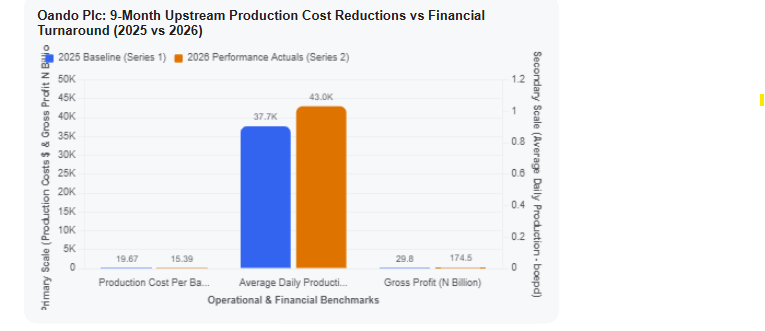
Boardroom Breakdown: 9-Month Upstream Operational & Asset Performance Matrix
Unveiled in Oando Plc’s unaudited financial results, the group’s cost reduction stems from systemic asset optimization across transportation, logistics, engineering services, and information and communications technology (ICT) spread across a largely fixed field cost base:
| Operational Performance Metric | 9-Month Target/Actual Baseline | Year-on-Year Growth Vector | Core Upstream Asset/Infrastructure Impact |
|---|---|---|---|
| Production Cost Per Barrel | $15.39 per boe | 22% Cost Reduction | Achieved by maximizing throughput across fixed-cost well structures. |
| Average Daily Production | 42,985 boepd | 14% Volume Increase | Comprises 12,193 bpd crude oil (+12%), 28,689 boepd gas (+13%), and 2,103 bpd NGLs (+53%). |
| Facility Uptime Reliability | 96.1 per cent uptime | Increased from 85.0% in 2025 | Significantly strengthens the structural safety of production and evacuation infrastructure. |
| Gross Profit Execution | N174.5 billion | 483% Growth Spike | Explodes from N29.8bn in H1 2025, driving top-line corporate revenue up 9% to N2.78tn. |
| Operating Profit/Loss | N159.7 billion profit | Reverses Legacy Loss | Completely reverses the steep operating loss of N109.7bn reported in the corresponding period of 2025. |
| Capital Expenditure (CapEx) | N110.7 billion deployed | Focused Upstream Injection | Capital directed entirely toward drilling activities across the core OMLs 60–63 assets. |
| Corporate Debt Leverage | Total Borrowings: N2.16tn | 22% Debt Reduction | De-leveraged significantly below the peak credit exposure recorded at the end of 2024. |
HSE Security Metric: These operational breakthroughs were safely achieved with zero fatalities and zero lost-time injuries (LTI) across approximately 14.9 million hours worked.
Upstream Drilling Campaign Tracker: Targeted Expansion via OMLs 60-63
Oando’s comprehensive seven-well drilling programme for 2026 has progressed rapidly across its operated infrastructure to offset natural field decline and satisfy its medium-term growth strategy:
- Completed & On-Stream: Successful drilling completed at Idu 6ST and Idu 15, with both wells actively delivering volumes to evacuation pipelines.
- Workovers Completed: Maintenance engineering successfully executed at Samabri 4T and Samabri 7T.
- Active Drilling Onsite: Rigs are actively advancing footage at Idu T and Samabri A50.
- Upcoming Spud Timeline: The final well in the 2026 asset program, Ogbainbiri, is on track to officially spud in December 2026.
The full completion of this drilling campaign is projected to inject between 16,000 and 20,000 barrels of oil equivalent per day in gross production, positioning Oando to reach its long-term target of approximately 100,000 boepd within the next four to five years. Concurrently, the group narrowed its full-year production guidance to between 40,000 and 45,000 boepd with a full-year CapEx target of $90m to $100m.
Global Executive Vision: Sustainable Value Compounding
Commenting on the performance, the Group Chief Executive of Oando, Wale Tinubu, stated that the company’s investment drive and operational execution had improved efficiency, reliability and production across its upstream portfolio.
“Our performance in the first nine months of 2026 demonstrates how diligent execution under our operatorship, supported by our renewed investment drive, is delivering greater efficiency, improved reliability, lower unit costs and ultimately higher production across our expanded upstream portfolio. Production averaged 42,985 boepd, up 14 per cent year-on-year, while facility uptime improved to 96.1 per cent and production operating costs declined by 22 per cent to $15.39 per boe. These gains were achieved with zero fatalities and zero lost-time injuries across approximately 14.9 million hours worked,” Tinubu said.
Looking ahead to the group’s corporate stabilization phase, Tinubu added: “For the remainder of 2026, our priorities are to progress the seven-well development programme, sustain operational reliability and strengthen shareholders’ funds through our impending equity raise. These initiatives are intended to reduce leverage, enhance our capacity to fund growth and support future shareholder distributions. We have demonstrated what we can achieve across our strategic assets and are confident in the opportunities ahead. Our commitment remains to realise the full potential of our substantial resource base and deliver lasting value for our shareholders.”
Clean Energy Operations: Lagos Electric Mobility Footprint
Beyond its upstream extraction engine, Oando’s clean energy division continues to achieve major infrastructure milestones in urban transit. The group’s electric mobility partnership with the Lagos Metropolitan Area Transport Authority (LAMATA) recorded more than 212,000 passenger journeys in the first nine months of 2026, operating at a steady average capacity utilization of 73 per cent.
An additional 11 electric buses, representing the first batch of a planned 50-bus rollout arrived safely in Lagos during the period, successfully scaling the active green transit fleet to 13. This expanded vehicle footprint is slated to enter full service in the fourth quarter, with LAMATA operating the assets on behalf of the Lagos State Government.