









To combat rising online misconduct and instil responsible digital citizenship among young Nigerians, the Akin Fadeyi Foundation, in collaboration with the Oil Producers Trade Section (OPTS), has trained hundreds of secondary school students in Lagos on the dangers of cyberbullying, sextortion, and social vices.
Held on Thursday, the intensive sensitization programme educated students on the strict legal consequences of digital abuse, emphasizing that social media platforms do not shield users from statutory accountability across Nigeria’s growing digital ecosystem of approximately 159 million mobile device users.
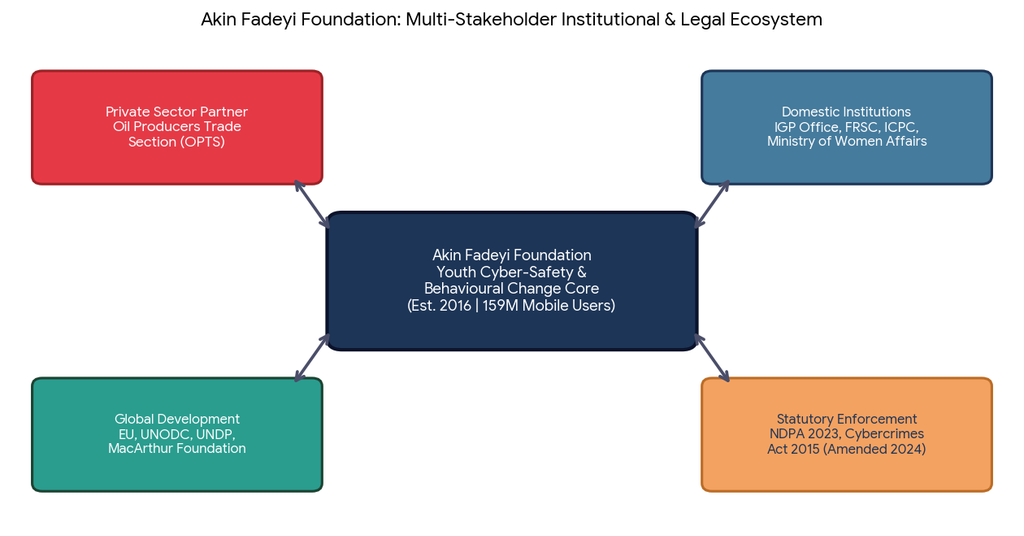
The ecosystem diagram above maps out the multi-agency partnerships and statutory frameworks supporting the foundation’s nationwide behavioural reorientation campaigns.
Boardroom Breakdown: Institutional Alliances & Legal Enforcement Matrix
Since 2016, the Akin Fadeyi Foundation has anchored its behavioural change campaigns on cross-sector institutional collaborations to reach wider demographics across Nigeria:
| Stakeholder Category | Partner Institutions & Frameworks | Operational Role & Strategic Focus |
|---|---|---|
| Corporate Sector Sponsor | Oil Producers Trade Section (OPTS) | Partnered directly with the foundation to fund and extend behavioural reorientation to young Nigerians in Lagos. |
| Domestic Law & Governance | Office of the Inspector-General of Police, Federal Road Safety Corps (FRSC), ICPC, and Ministry of Women Affairs | Institutional partners reinforcing civic accountability, anti-corruption, and youth protection standards. |
| International Development | European Union (EU), UNODC, UNDP, and MacArthur Foundation | Global development organizations supporting systemic behavioural change and social justice initiatives. |
| Statutory Legal Safeguards | Nigeria Data Protection Act 2023, Cybercrimes Prohibition, Prevention Act 2015 (as amended in 2024), and the Nigerian Constitution | Active legal frameworks enforced daily to prosecute online harassment, blackmail, and non-consensual image sharing. |
Parental Modeling and Leadership Accountability
Speaking at the event in Lagos on Thursday, the Founder and Executive Director of the foundation, Mr Akin Fadeyi, called on parents to complement their verbal instructions with exemplary conduct, noting that children are far more likely to emulate what they see their parents do than what they are told. Drawing from his childhood experiences, Fadeyi explained that lessons of hard work, diligence, and good relationships instilled by his parents shaped his character and professional development.
“My advice to parents is that what they say to their children is as important as what they do in their presence. When you give birth to children, the values you want them to imbibe should not end with what you tell them. You must practise those values,” Fadeyi said.
“I had my hardships while going to school. My mother was a teacher, but by the time I got to A-levels, I had already published a campus magazine. What galvanised my competence to achieve that was the quality of teaching I received from my parents, particularly their emphasis on hard work, diligence and friendship,” he added.
Fadeyi also urged public office holders to recognise the influence of their conduct on society, noting that leadership decisions and personal examples can either promote responsible behaviour or encourage wrongdoing.
“I am tired of advising the government, but they must understand that the people entrusted them with power. They should constitute themselves as a well-behaved institution because decisions they make with a stroke of the pen affect a critical mass of people. People are driven by the exemplary conduct of those who lead them, just as they can be influenced by the wrong conduct of those who mislead them,” Fadeyi said.
Bottom-Up Behavioural Change and Institutional Collaboration
Explaining the foundation’s operational strategy, Fadeyi stated that institutional collaboration and partnerships have remained central to its activities since 2016, particularly as rapid digital expansion across Nigeria’s 159 million mobile device users demands deliberate public education.
“At the core of the work we do in Nigeria are institutional collaborations and extensive partnerships. We realised that to take our behavioural change messages to a wider audience, we had to work with stakeholders. One cannot sit in the dark and keep winking,” he said.
Highlighting the specific collaboration that enabled the Lagos student outreach, Fadeyi added: “OPTS reached out to us to train these young Nigerians, and we were happy to do that because it aligns with the track record we have built in institutional collaborations. We have decided to drive behavioural change from the bottom up.”
Fadeyi maintained that Nigeria’s long-standing institutional challenges can only be resolved through individual responsibility and deliberate efforts to instil good values in younger generations. “The only way to change Nigeria is to start with ourselves. The problem we are dealing with is a dysfunctional system that has remained in place for decades. To change the nation, we must start with the man in the mirror,” he added.
Legal Consequences of Cyberbullying and Online Abuse
Speaking on the sidelines of the event, the lead speaker, Toyin Taiwo-Ojo, a child safety advocate, human rights activist, and legal practitioner—described cybercrime as an increasingly disturbing menace among the younger generation. She warned that circulating unverified information, bullying peers online, and sharing intimate images without consent for blackmail and harassment have made the digital space increasingly unsafe, even leading to loss of life among victims of sustained online abuse.
Taiwo-Ojo emphasized that internet users who exploit the perceived anonymity of social media face real prosecution under the Nigeria Data Protection Act 2023, the Cybercrimes Prohibition, Prevention Act 2015 (as amended in 2024), and relevant provisions of the Constitution.
“These laws have been put in place to protect people against cybercrime, and I can say to a very great extent that they are being applied every day and are beginning to produce the desired results,” she said.