







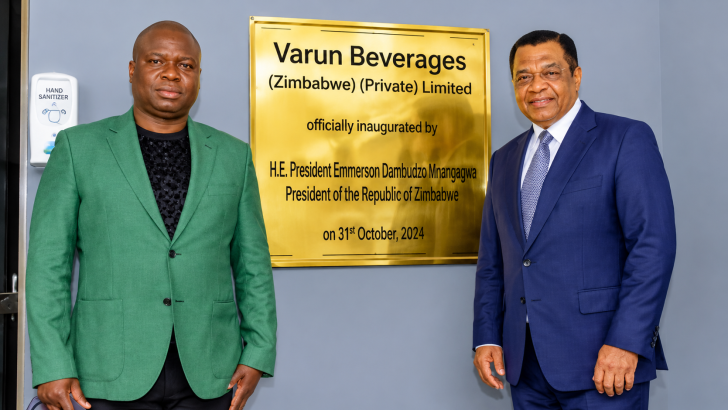
To drastically expand its manufacturing footprint and diversify into renewable energy and brewing, Varun Beverages Zimbabwe has announced plans for a US$350 million solar power project alongside a brand-new clear beer manufacturing plant.
The major capital commitments were unveiled during an official tour of the company’s beverage and snacks manufacturing facilities by Zimbabwe’s Minister of Local Government and Public Works, Daniel Garwe. Having entered Zimbabwe in 2018 through a greenfield bottling facility in Harare with more than US$100 million invested to date, the beverage giant is positioning itself for long-term industrial growth.
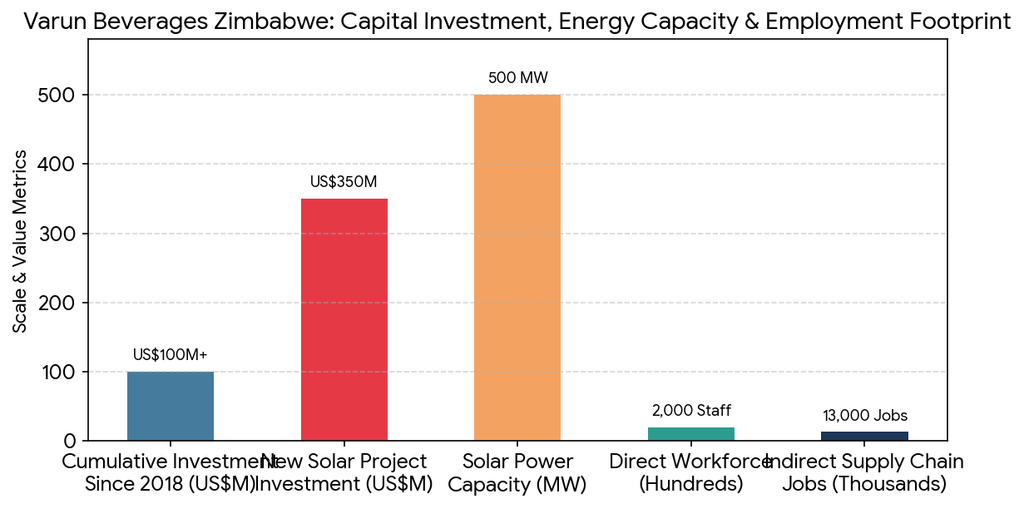
The metrics chart above highlights how the US$350M renewable energy deployment scales Varun Beverages Zimbabwe’s capital footprint alongside its substantial local job creation engine.
Boardroom Breakdown: Varun Beverages Zimbabwe Expansion & ESG Matrix
The newly announced investments blend heavy manufacturing expansion with green infrastructure and urban environmental management:
| Strategic Project / Asset | Financial & Capacity Metrics | Execution Partners & Stakeholders | Timeline & Operational Impact |
|---|---|---|---|
| Solar Power Project | US$350 million investment for 500 megawatts (MW) | Varun Beverages Zimbabwe, holding company RJ Corporation, INOX, and SkyPower | Strengthens industrial power security and accelerates clean energy generation in Zimbabwe. |
| Clear Beer Plant | Land officially allocated by the government | Varun Beverages Zimbabwe & Ministry of Local Government and Public Works | Groundbreaking expected end of November or December 2026; launch slated for late 2027 or early 2028. |
| Existing Production Lines | 11 active production lines | Core Harare manufacturing complex | Manufactures beverages, bottled water, snacks, and Mooju (a dairy-blend juice launched in September in 430ml and 1-litre packs). |
| Plastic Recycling Facility | Circular economy infrastructure | Joint collaboration with Geo Pomona | Supports waste recovery alongside an intensified corporate anti-littering campaign. |
| Employment Footprint | ~2,000 direct staff and 13,000 indirect jobs | Distributors, transporters, retailers, vendors, and service providers | Includes 350 young graduates initially recruited to build local technical capacity. |
Government Alignment with Zimbabwe’s Vision 2030
Speaking after inspecting the Harare manufacturing complex, Minister of Local Government and Public Works Daniel Garwe confirmed that the government had allocated land for the proposed beer manufacturing facility, with groundbreaking expected either at the end of November or in December 2026.
He noted that Varun Beverages currently operates 11 production lines manufacturing beverages, bottled water, and snacks, and is preparing to enter beer production. “To date, they have got 11 product lines, various products, from beverages, to water, to snacks, and many others,” Garwe said.
The minister emphasized that the investments aligned directly with Zimbabwe’s Vision 2030 development agenda, which seeks to attract international investors and support the country’s transition to an upper-middle-income economy. “This is what Vision 2030 speaks to. Invite global players to be part of the upper-middle-income journey. It’s not an event, it’s a journey,” he said.
Meanwhile, Garwe disclosed that Varun Beverages had agreed to withdraw its pushcarts from Harare’s Central Business District following concerns about urban congestion. Traders will instead operate in designated residential and industrial areas, complementing the company’s intensified anti-littering campaign.
Executive Vision: Confidence in Zimbabwe’s Business Environment
Varun Beverages Zimbabwe Chief Executive Officer Vijay Kumar Bahl detailed that the company, its holding company RJ Corporation, and partners INOX and SkyPower were investing US$350 million in the 500-megawatt solar power project. He confirmed that the clear beer manufacturing plant is expected to be launched by the end of 2027 or early 2028, alongside ongoing work with Geo Pomona on a plastic recycling facility.
Bahl stated that the investments demonstrated the company’s confidence in Zimbabwe’s business environment and its long-term commitment to the country. “When Zimbabwe declared that it is open for business, many listened. We acted. And today I can stand here and say, with confidence, that Varun Beverages is a classic case of an investor doing well in Zimbabwe,” he said.
Highlighting the human capital driving the conglomerate’s expansion across its 2,000 direct employees and 13,000 indirect supply chain roles, Bahl concluded: “Zimbabwe’s greatest asset is not under the ground. It is its people,” noting that the company initially recruited 350 young graduates to anchor its local operations.