






To simplify system design and eliminate hazardous chemical regeneration in industrial water treatment, DuPont has officially launched four new high-flow DuPont Electrodeionization (EDI) modules.
The expansion broadens DuPont Water Solutions’ portfolio for deionized (DI) water applications across heavy industrial markets and selected ultrapure water (UPW) applications within the microelectronics sector, covering nominal product-water flow rates from 2 to 8 m³/h when combined with its existing EDI-310 unit.
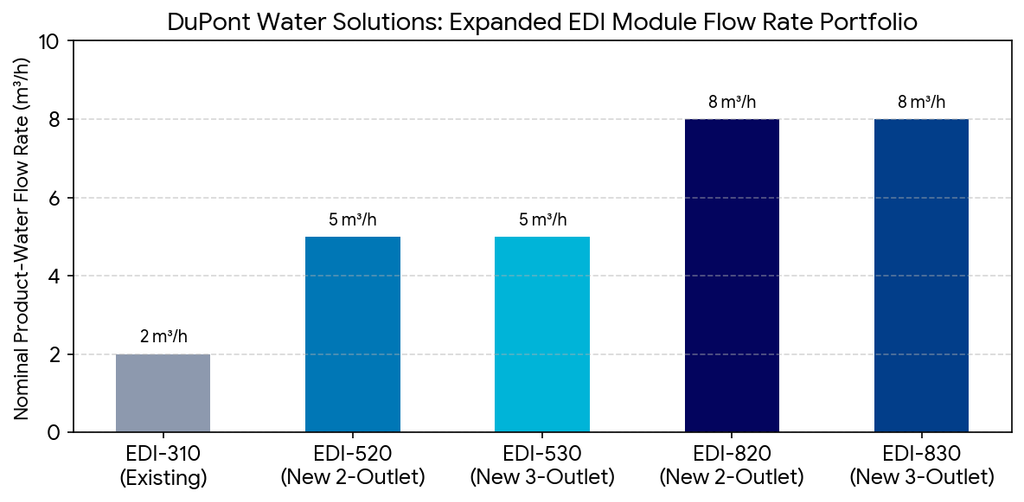
The portfolio capacity chart above illustrates how the four new high-flow plate-and-frame modules scale DuPont’s output capabilities from smaller installations up to heavy industrial projects.
Boardroom Breakdown: DuPont EDI Module Specifications & Architecture Matrix
Backed by more than two decades of EDI manufacturing experience, DuPont’s expanded portfolio integrates its existing spiral-wound technology with the new high-flow plate-and-frame modules:
| Module Series | Nominal Flow Rate | Outlet Configuration | Core Engineering & Performance Advantages |
|---|---|---|---|
| DuPont EDI-520 | 5 m³/h | Two-outlet configuration | Incorporates DuPont ion exchange resins, membranes, and electrodes to reduce dilute-chamber pressure drop. |
| DuPont EDI-530 | 5 m³/h | Three-outlet configuration | Designed for flexible OEM integration and end-user replacement projects while lowering electrical resistance. |
| DuPont EDI-820 | 8 m³/h | Two-outlet configuration | High-throughput plate-and-frame architecture tailored for large-scale industrial deionized water plants. |
| DuPont EDI-830 | 8 m³/h | Three-outlet configuration | Delivers continuous, chemical-free polishing for demanding microelectronics and UPW workflows. |
| DuPont EDI-310 (Existing) | 2 m³/h | Legacy spiral-wound baseline | Anchors the lower end of the 2–8 m³/h spectrum for smaller-scale water purification installations. |
Chemical-Free Purification Across High-Growth Industries
Electrodeionization combines electrodialysis and ion exchange resin technologies to continuously remove ionized and ionizable impurities from water using direct-current power. Typically deployed as a polishing step following reverse osmosis (RO), EDI provides a superior alternative to conventional mixed-bed ion exchange—delivering continuous, chemical-free operation that eliminates hazardous chemical regeneration and toxic chemical waste.
The new EDI range is engineered to meet higher-purity water requirements across critical global industries, including:
- Energy & Clean Tech: Power generation, green hydrogen production, and solar photovoltaic manufacturing
- Microelectronics: Semiconductor chip assembly and testing
- Heavy Process Industries: Chemical, coal-to-chemical, and petrochemical processing
- Industrial Manufacturing: Pulp and paper production alongside metallurgy operations
Executive Vision: Single-Supplier System Integration
Beyond EDI modules, DuPont supplies ultrafiltration (UF) and reverse osmosis (RO) membranes for DI water pretreatment, as well as polishing resins for UPW applications. This end-to-end portfolio enables OEMs and industrial end users to source complete water purification systems from a single partner.
“The expansion of our EDI portfolio gives our customers greater flexibility to address a broader range of higher-purity water requirements,” said Gary Gu, Global Technology Director, DuPont Water Solutions. “By combining high-flow EDI modules with our expertise across ion exchange, reverse osmosis and ultrafiltration, we can help customers simplify system design, operations and maintenance while supporting reliable, higher-quality water production.”