







The leadership team is excited. The designers have delivered. The marketing department is ready to unveil the new look. The presentation slides are beautiful, the launch campaign is approved, and everyone inside the company believes the brand is about to enter a new era.
Then the customers see it.
“Who approved this?”
“Why did they change it?”
“I preferred the old one.”
Within hours, the announcement that was supposed to generate excitement becomes an argument. The brand is trending, but not for the reasons its executives hoped.
This is the uncomfortable reality of rebranding: a company can be convinced it has improved its identity while its customers feel that something they valued has been taken away.
And it is not merely a hypothetical scenario. Some of the world’s best-known brands have learned this lesson the expensive way.
When a new look becomes a business problem
Consider Gap.
In October 2010, the fashion retailer replaced its familiar logo, a bold white word inside a navy-blue square with a new design featuring a simpler wordmark and a small blue square.
The change was intended to modernise the brand. But customers and design commentators reacted negatively, and criticism spread rapidly online.
Within about a week, Gap announced that it would restore its original logo. In its public statement, the company acknowledged that it had missed an opportunity to engage its online community before making the change.
Think about what that means. A major company had invested in a new identity, introduced it to the public, and then reversed course almost immediately.
The issue was not simply that people disliked a design. The episode exposed a gap between the company’s decision-making process and the emotional relationship customers had developed with its brand.
The old logo was not just a graphic. It was familiar, recognisable and associated with years of shopping experiences.
The company saw a logo that needed refreshing. Some customers saw a piece of the brand they already knew disappearing.
Tropicana: when customers could no longer recognise the product
The clothing retailer was not alone.
In 2009, Tropicana redesigned the packaging for its Pure Premium orange juice. The familiar orange pierced by a straw was replaced by a more minimalist image of a glass of juice. The company wanted a cleaner, more contemporary look.
But the redesign removed a visual cue that had helped shoppers identify the product quickly on crowded supermarket shelves.
A peer-reviewed study published in the Journal of Retailing and Consumer Services reported that sales of Tropicana Pure Premium fell by approximately 20% between late December 2008 and February 2009, compared with the corresponding period a year earlier. The researchers estimated the impact of the packaging redesign at about US$27 million. Tropicana subsequently restored its previous packaging.
This is an important distinction: the study estimated the financial effect of the packaging change; it does not mean every rebrand produces similar losses. Nor can all the movement in sales automatically be attributed to a single design decision without considering other market factors.
Nevertheless, the case demonstrates a fundamental marketing principle.
A design can look better in a boardroom presentation and perform worse in the real world.
A shopper does not necessarily examine a package as a designer would. The shopper wants to find the familiar product, understand what it offers and make a decision. If a redesign makes that harder, visual modernisation can become a commercial disadvantage.
The real problem: confusing brand identity with brand image
Every organisation has an identity it wants to project. It also has an image that exists in the minds of its audiences.
The two are related, but they are not the same.
- Brand identity: What the organisation deliberately communicates about itself—its values, personality, positioning, visual identity and promise.
- Brand image: How customers, employees, investors and other stakeholders actually perceive the organisation.
- Brand reputation: The broader judgement people develop over time based on what the organisation says, does and delivers.
A rebrand may change the identity overnight. The image and reputation will not necessarily change with it.
Imagine a Nigerian bank that has spent decades building a reputation for stability. It introduces a vibrant new identity to appeal to younger customers. The new colours are attractive, the campaign is energetic, and the digital adverts look impressive.
But what happens if customers still struggle with its mobile app, cannot resolve complaints quickly or experience long delays when trying to access their money?
The bank has changed how it looks without addressing the experience that shapes how it is perceived.
That is not a complete brand transformation. It is a new coat of paint on an unresolved business problem.
Five reasons a rebrand can go wrong
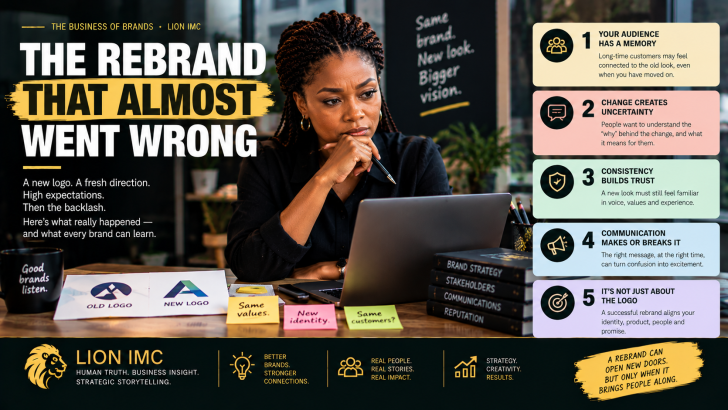
1. The company forgets that its audience has a memory
Customers do not encounter brands as blank slates. They accumulate experiences, habits, associations and expectations.
A familiar logo might remind someone of the first account they opened, the product their parents trusted or the business that served them reliably for years.
That emotional connection may not appear on a brand manager’s dashboard, but it can influence behaviour.
Research by Blazquez Cano and colleagues, published in 2019, examined rebranding and customer-based brand equity in the luxury fashion sector. The study highlighted the importance of maintaining a brand’s heritage and underlying DNA even when its image changes.
The lesson extends beyond luxury fashion: before discarding familiar brand assets, businesses should understand what those assets mean to the people who use them.
2. The organisation changes the appearance but cannot explain the reason
“It’s time for a fresh look” is not a business strategy.
A rebrand should answer a meaningful question. Has the organisation entered a new market? Has its offering changed? Has a merger brought different businesses together? Does the existing identity no longer reflect its purpose? Is the company addressing a serious credibility problem?
The reason matters because it determines what must change and what should remain.
If a company has expanded from a single product into a diversified business, a new identity might help customers understand that evolution. If nothing meaningful has changed beyond management’s preference for a different colour palette, the business case may be much weaker.
Employees and customers need to understand what the change means for them. Without that explanation, people are left to invent their own.
And when an organisation leaves a vacuum, speculation can fill it.
3. The company mistakes internal excitement for customer acceptance
A rebrand may have survived weeks of internal presentations, creative reviews and executive approvals before it reaches the public.
By launch day, the people involved may be deeply attached to the new identity. They have seen the thinking behind it. They understand the rationale. They know what the company hopes to communicate.
Customers have seen none of that.
They see the new logo on a billboard, a changed package on a shelf or a different name on an app. They may have no idea why the organisation made the change.
This is why internal approval is not a substitute for audience research.
Before launch, organisations should test whether customers can recognise the brand, understand the intended message and distinguish the new identity from competitors. They should also investigate whether the change creates unintended associations.
A beautiful presentation can tell a management team what it wants to hear. Research can reveal what the audience actually sees.
4. Communication begins at launch instead of before it
A rebrand is not simply a reveal. It is a transition.
Customers may need to know whether their favourite products are changing, whether a service remains the same, whether existing contracts are valid or whether the new name signals a change in ownership.
Employees need to know how to explain the transition. Sales teams need answers to customer questions. Customer-service representatives need consistent information. Business partners may need updated materials and instructions.
When all the organisation does is unveil a new identity, it leaves these audiences to work out the implications for themselves.
Gap’s 2010 reversal is instructive because the company itself acknowledged that it had missed an opportunity to engage its online community before making the change.
Communication does not guarantee universal approval. But it gives people a chance to understand the decision, ask questions and adjust.
5. The organisation thinks the logo is the whole brand
A logo is visible. Strategy is harder to photograph.
That is one reason rebranding projects can become disproportionately focused on colours, typography, signage, packaging and social-media templates.
Those elements matter. They create recognition and help a brand communicate consistently. But they cannot compensate for a poor product, an unreliable service, a confused market position or a broken customer promise.
If a business wants to be known for premium service, its service must feel premium. If it claims to be customer-first, its complaint-handling process must reflect that commitment. If it promises innovation, customers should experience meaningful improvements.
The visual identity should express the business reality—not disguise its absence.
What Nigerian businesses should consider before rebranding
For a Nigerian company, a rebrand can be especially consequential when customers rely heavily on familiarity, word of mouth, physical packaging, branch signage, dealer relationships or long-standing personal connections.
A manufacturer changing its packaging must consider whether distributors and retailers can identify the new product easily. A financial institution changing its name must help customers distinguish an identity update from a change in account details or service arrangements. A professional-services firm must ensure that clients understand what remains unchanged in its expertise, relationships and commitments.
The specific risks vary by industry, but the strategic questions remain consistent.
Start with the business problem
Define what the rebrand must achieve. Is the goal to attract a new audience, clarify a changed offering, repair perceptions, unify acquired businesses or support a new strategy?
Listen before you launch
Speak with customers, employees, distributors and other relevant stakeholders. Find out what they value, what confuses them and what they fear losing.
Test recognition and comprehension
Do not ask only whether people like the new design. Ask whether they recognise the brand, understand what has changed and can still find the product or service.
Prepare the people who deliver the brand
Equip employees, sales teams, customer-service staff and business partners with clear explanations, practical guidance and answers to likely questions.
Measure business outcomes, not applause
Track awareness, recognition, customer sentiment, enquiries, conversion, retention and sales where relevant. Establish a baseline before launch so the business can evaluate what actually changed.
When a rebrand is worth the risk
None of this means organisations should cling to old identities forever.
Brands can become outdated. Markets evolve. Businesses merge, expand or change direction. A company may need to move beyond perceptions that no longer reflect its capabilities. Sometimes, a radical identity change is precisely what the organisation needs.
The challenge is to distinguish between change that creates value and change that merely creates activity.
A well-planned rebrand preserves the useful parts of the brand’s existing equity while addressing what no longer works. It gives people a reason to believe in the new direction and a clear understanding of what it means.
The best rebrands do not necessarily preserve every familiar feature. They preserve the meaning that matters while making room for the future.
And that requires more than creative talent. It requires research, business strategy, stakeholder engagement, communication and disciplined measurement.
The Lion Take
A new logo can attract attention. A new identity can signal ambition. But neither guarantees that customers will come along.
Gap’s experience showed how quickly a seemingly simple design decision could become a public relations challenge. Tropicana’s packaging experience demonstrated that visual changes can also affect product recognition and commercial performance. Both cases remind businesses that the audience is not a passive recipient of brand decisions. It is part of the brand’s reality.
Before you change how the world sees your brand, understand what the world already sees in it.
Because a rebrand should not leave customers asking, “Who are you now?”
It should help them understand why the brand is changing and give them a reason to believe in what comes next.
The Big Question
If a company you have trusted for years suddenly changed its name, logo and identity, what would make you trust the new brand or decide to walk away?